

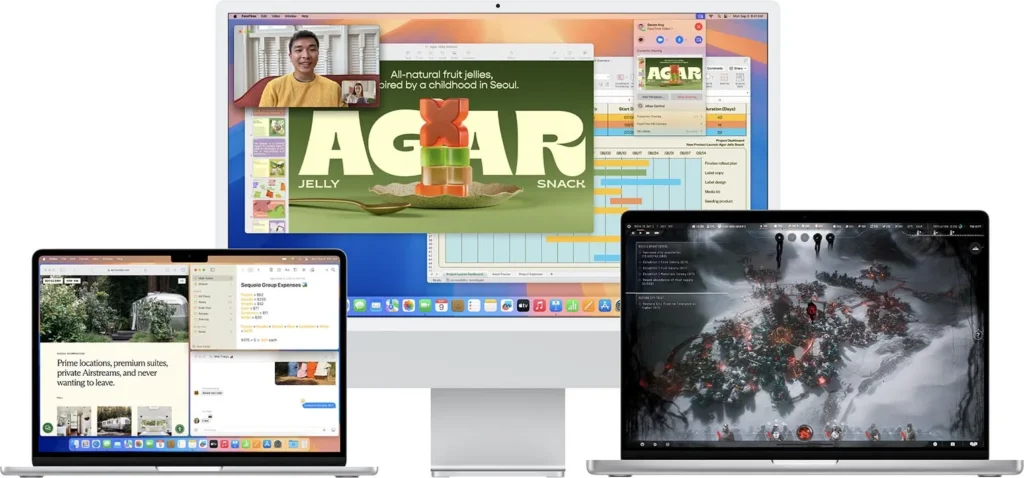
macOS 26.4 is now available: The Mac prepares to say goodbye to Intel
Apple has officially released macOS Tahoe 26.4, an update that aims for precision rather than dramatic changes. There are no groundbreaking visual upgrades or flashy demonstrations surrounding AI: this version features subtle improvements that reflect the current phase of the Mac platform.
macOS 26.4: A subtle update focused on daily efficiency
In its release notes, Apple presents macOS 26.4 as a collection of targeted enhancements. Safari has received a compact tab bar option, designed to free up more screen space and allow searching directly from the active tab. Meanwhile, Freeform has been upgraded with advanced image creation and editing tools, as well as a premium content library integrated into Apple Creator Studio. Overall, this update is geared more towards user comfort than functional disruption.
Apple also introduces 8 new emojis, including an orca and a distorted face, along with improvements to several utility functions. In Reminders, users can now mark a task as urgent via a keyboard shortcut and filter these items in smart lists. The family sharing feature is evolving as well: adults in a family sharing group can now pay using their own payment methods without relying on the organizer’s account.
Even subtitle and caption settings are becoming more accessible, with a real-time preview available directly from the dedicated icon.
A significant technical signal: Apple continues to prepare for a future without Intel
Beyond the small visible changes, macOS 26.4 confirms a more structural trajectory. Apple notes in its developer documentation that macOS 26 is the last version to support Intel-based Macs, and support for Rosetta for apps will end after macOS 27. This is no small detail: it indicates that the Mac ecosystem is entering a new phase of technological cleaning, where developers will need to accelerate the complete transition to Apple Silicon.
Some beta versions of macOS 26.4 also showed alerts related to apps dependent on Rosetta 2, indicating that Apple is gradually preparing users and developers for this transition. While this point is not prominently highlighted on the public-facing new features page, it fits into a clear strategy: simplify the Mac’s software stack to better support the next generation of performance and system functions.
The most notable absence is Siri
The major missing piece of macOS Tahoe 26.4 is undoubtedly Siri. While there were high expectations for a more contextual and personalized version of the assistant, this update does not include any significant breakthroughs in this area in Apple’s official notes. This absence aligns with several recent reports indicating that Cupertino’s AI roadmap remains under pressure, and that the most ambitious Siri features have slipped further down the timeline.
Apple had already acknowledged in 2025 that some improvements to Siri would take longer than expected and would arrive in 2026. However, at this stage, version 26.4 still does not manifest this promise on the Mac. This reinforces the notion of a company that prefers to hold back rather than deliver an unfinished experience, even if it gives the impression that its narrative around AI still lacks substance compared to the competition.
Apple opts for discipline over spectacle
macOS Tahoe 26.4 is not a groundbreaking update, but that doesn’t necessarily imply a weakness. Apple seems to be taking a more methodical approach: addressing pain points, enhancing its apps, preparing for the end of Intel, and stabilizing the platform before launching a more ambitious cycle involving Siri and Apple Intelligence.
In summary, macOS 26.4 appears to be a version of consolidation. It may not redefine the Mac, but it silently fine-tunes the machine. And sometimes, in the Apple universe, the most subtle updates are also those that prepare for the most profound changes.



