

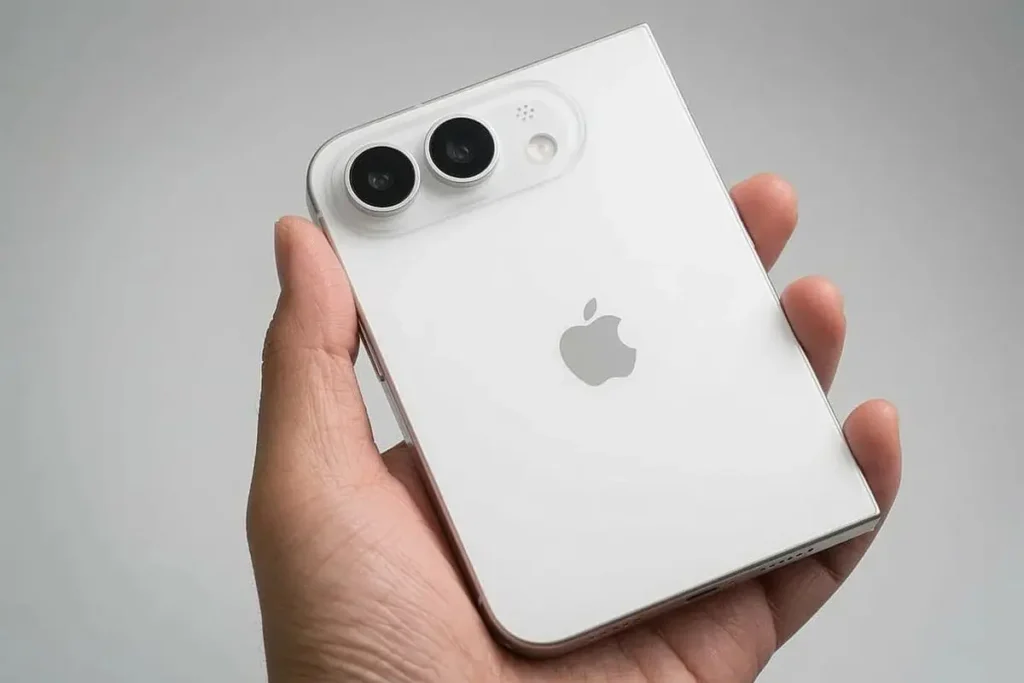
iPhone Ultra pliable : une nouvelle fuite refroidit les espoirs autour de sa batterie
The foldable iPhone Ultra may come equipped with a battery that is considerably smaller than anticipated. Previous rumors suggested capacities between 5,400 and 5,800 mAh, but new documents from an Apple supplier hint at a much less ambitious scenario.
If this leak is confirmed, Apple’s first foldable smartphone would launch with decent battery life, yet it wouldn’t push the boundaries of the segment.
Two Cells Detected, But Capacity Falls Short of Expectations
According to a recent report from a battery registration database in Asia, an Apple supplier has recently announced two new cells with the following capacities: 1,921 mAh and 2,962 mAh. Combined, they total 4,883 mAh.
This dual-cell configuration corresponds exactly to the type of architecture used by most current foldable smartphones to distribute the battery across the device’s two halves. There is no official confirmation that this pertains specifically to the iPhone Ultra, but the clues strongly suggest it.
If this capacity is confirmed, Apple could market the device as featuring a 5,000 mAh battery, a common practice of promoting a “typical” capacity rather than the nominal one.
Acceptable… But Not Very Impressive in 2026
A battery close to 4,900 mAh is still fairly good, especially for a foldable smartphone where internal space is particularly limited. The challenge lies elsewhere: the market has evolved significantly.
With carbon-silicon batteries, several Chinese manufacturers are now offering smartphones that surpass 7,000 mAh, with some exceeding the 10,000 mAh threshold. In this context, a foldable priced over $2,000 with a battery around 4,900 mAh may seem less ambitious than expected.
However, Apple might emphasize another argument: energy efficiency. With the upcoming A20 Pro chip manufactured using 2 nm technology, iOS optimizations, and aggressive power management, the company may offset a lower capacity with better real-world endurance.
Compared to Samsung and Google, the Gap Remains Limited
Even if this leak turns out to be true, the iPhone Ultra would not be significantly disadvantaged compared to other major foldables. For comparison, the Galaxy Z Fold 7 has a 4,400 mAh battery, while the Google Pixel 10 Pro Fold has a 5,015 mAh battery. Recent rumors indicate that Samsung is preparing to increase capacities this year.
The Galaxy Z Fold 8 Ultra is expected to have a 5,000 mAh battery, while the more compact and wider Galaxy Z Fold 8 is also likely to reach around 4,800 mAh.
If Apple ultimately adopts a battery closer to 4,900 mAh, the difference with its main competitors would remain relatively minimal.
The Real Challenge Will Be Battery Life, Not Spec Sheets
At this stage, there is no definitive evidence that these two cells are meant for the iPhone Ultra. As is often the case with supply chain information, it is prudent to remain cautious until an official announcement.
However, one thing appears certain: Apple is unlikely to try to win the milliampere-hour battle. Staying true to its strategy, the company might focus on balancing battery life, chassis thinness, and energy performance rather than simply chasing numbers.
The question remains whether this approach will be sufficient to convince consumers of a smartphone that could exceed $2,000. At this price point, users will expect much more than merely “acceptable” battery life.



