

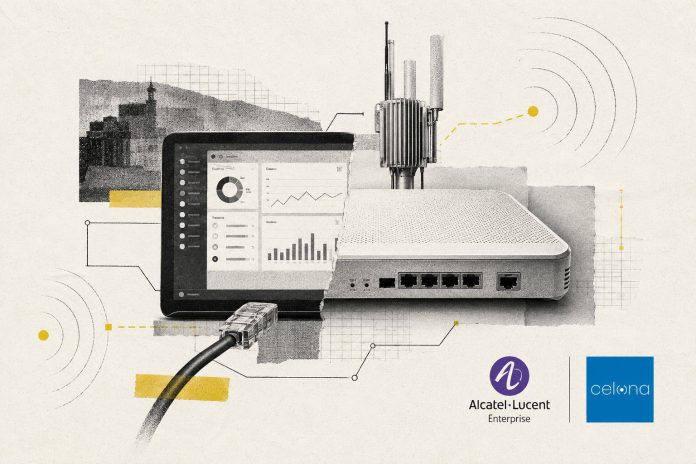
ALE has announced the launch of a new version of its ALE Private 5G offering, built on the AerFlex architecture developed by U.S. company Celona. This new iteration integrates authentication, network access control, firewall functions, and edge AI processing directly into the access points, which connect to existing local networks via a simple, powered Ethernet cable. The private cellular network can now be managed through OmniVista, the console that already oversees wired networks and Wi-Fi.
Previously, deploying private 5G required baseband units, a dedicated packet core, specific cabling, and on-site specialized engineers, resulting in lead times that could stretch to weeks or months. AerFlex eliminates three of these requirements. The access points connect to pre-existing switches via standard Power over Ethernet (PoE), and provisioning can be done from the cloud without needing a specialist at every facility. ALE rounds out its offering with new indoor and outdoor access points, an updated edge platform, and a portfolio of consulting, site study, and operational services.
The primary target market is industrial. Factories, warehouses, ports, and electrical substations heavily utilize robots, automated guided vehicles, programmable logic controllers, and connected sensors that need reliable connectivity with predictable latency—something that Wi-Fi alone cannot guarantee in metal-clad environments or expansive outdoor areas. “ALE Private 5G is designed to alleviate much of the traditional complexity associated with private cellular deployments, enabling companies to deploy and scale solutions much more easily, particularly in multi-site industrial environments,” said Christopher Maldonado, head of the Private 5G product line at Alcatel-Lucent.
Cellular Networking Now in the IT Console
The 5G access points are integrated within OmniVista and displayed alongside OmniSwitch switches and OmniAccess Stellar Wi-Fi access points in a unified inventory, complete with a common alarm console and a consolidated topological view. Automatic segmentation assigns each device to its respective VLAN, applying the appropriate quality of service policy for its application, while gateways connect legacy machines to the cellular network without needing replacement. Administrators no longer have to manage two separate tools but can operate everything from a single platform, simplifying network security policies across all three layers.
This convergence reshapes responsibility within industrial networks. Previously managed by telecommunications operators or automation specialists with their own tools and contracts, the private cellular network becomes the responsibility of the IT department when it joins the same console as the local network. This shift also aligns it with the NIS2 directive, which categorizes manufacturing, energy, transportation, and logistics as critical or important entities. The IT manager inheriting the production network also assumes accountability for incident reporting, mobile connectivity, and risk mapping.
The Spectrum Challenge Remains
While the AerFlex architecture simplifies installation, it does not address the access to frequencies. In France, companies looking to operate their own mobile networks must apply through the ARCEP regulatory framework for the 2.6 GHz TDD band, which ranges from 2,570 to 2,620 MHz. This band has been available since May 2019, with revised regulations expected in 2024, and requests must be submitted via the DALi portal. ALE’s statement merely advises clients to “check locally” for usage permissions, directing them to a page on Wi-Fi 6 GHz regulations which does not cover the subject. Therefore, project timelines remain contingent on the frequency application process, irrespective of any cabling simplifications.
The justification for private 5G lies where Wi-Fi struggles, namely in vast outdoor areas, metal-dense workshops, environments with significant electromagnetic interference, and for equipment requiring continuous connectivity while in motion. The spectrum is licensed exclusively to a single organization, ensuring that data remains on-site and performance becomes a contractual guarantee rather than a hopeful promise. This differentiated connectivity complements Wi-Fi within the same venues—it does not replace it.
The Implications of Server Elimination
By consolidating authentication, access control, address services, firewall capabilities, and AI processing into the access points, ALE has centralized sensitive functions within devices physically accessible in workshops, warehouses, or outdoor masts. The physical security of these access points thus becomes integral to the overall network security, a notable shift from past practices where packet cores were stored in locked enclosures. Moreover, remote provisioning implies reliance on a command plane hosted by the provider, raising questions about jurisdiction that need to be addressed before signing contracts, especially given Celona’s status as an American company subject to the Cloud Act.
Jurisdictional concerns also extend to the manufacturer. ALE International is a French company based in Colombes, with its workforce and research firmly rooted in France. Since 2014, 85% of its capital has been owned by the Chinese group China Huaxin, and the Alcatel-Lucent brand is licensed from Nokia. The announcement asserts that the company complies with “the strictest requirements regarding the protection of enterprise and personal data, whether concerning national sovereignty or international industry standards,” a claim that buyers of networks intended for facilities like refineries or ports will assess against their risk analyses.
For industrial IT leaders, the decision-making process centers around three verifiable criteria. Frequency availability dictates project timelines, the NIS2 responsibility framework activates once the production network falls under IT management, and the location of the command plane determines who may be compelled to deliver metadata for sensitive sites. However, the simplification of deployment is tangible, translating into weeks saved in implementation time.



