

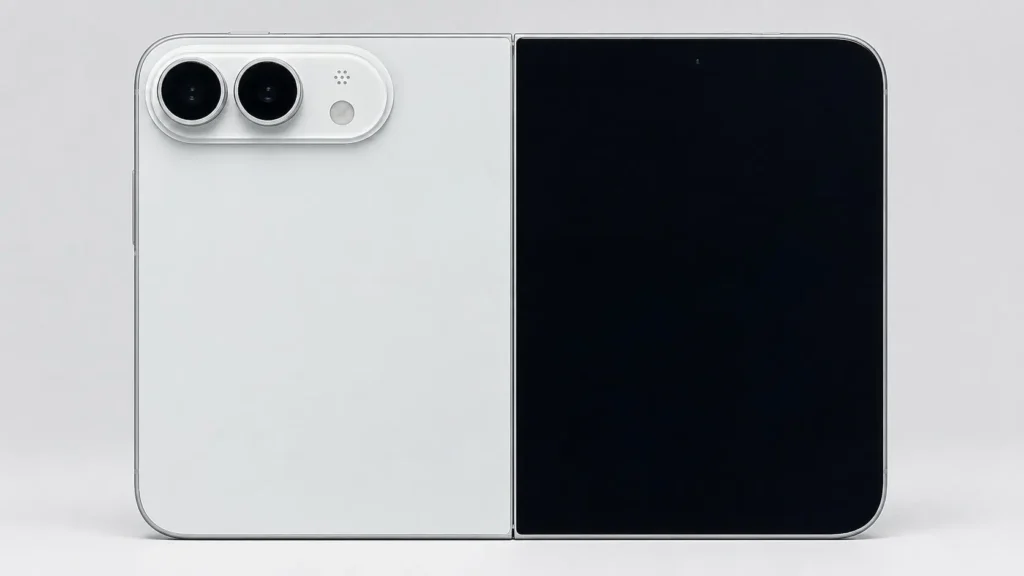
iPhone Ultra pliable : écran type iPad, charnière Liquidmetal et prix supérieur à 2 000 dollars
The first foldable iPhone from Apple is coming into focus as its anticipated presentation in September approaches. According to new information from Mark Gurman, the device is set to impress with its compactness, the quality of its hinge, and an interface similar to that of the iPad. However, several hardware compromises may lead to disappointment at a price exceeding $2,000.
A Foldable iPhone That Would Impress Once in Hand
Apple may be late to the foldable smartphone market, but this delay could allow it to offer a product that is already well-developed in several key aspects. In his latest Power On newsletter, Mark Gurman notes that users who have had the chance to handle the upcoming foldable iPhone particularly appreciate its compact form when closed, as well as the feel of its hinge mechanism.
The device is expected to adopt a book-like format, featuring an external display of approximately 5.5 inches and an internal screen close to 7.8 inches. When unfolded, it would therefore resemble more of a small iPad than just an enlarged iPhone.
An iPad-Inspired Interface to Utilize the Large Screen
The software is expected to play a central role. Apple is preparing an interface capable of displaying multiple applications side by side, with functionality akin to what is currently found on the iPad. This large screen could, therefore, become genuinely useful for multitasking, document viewing, or photography.
Gurman also describes the device as an excellent camera viewfinder, with the inner display naturally providing much more space for framing a shot.
Nonetheless, the foldable iPhone will remain based on iOS. It won’t offer all the multitasking capabilities of a true iPad, even though the interface will borrow some of its principles.
The Liquidmetal Hinge Could Be a Key Element
The folding mechanism might be one of the primary technological selling points of the product. Several sources have mentioned the utilization of an amorphous metal, often referred to as Liquidmetal, for certain components of the hinge. This type of alloy is distinguished by its high mechanical strength, elasticity, and ability to withstand certain stresses better than traditional crystalline metals.
For a smartphone that is intended to be open and closed hundreds of thousands of times, the advantages are clear.
Apple has been working with these types of materials for a long time and has held a licensing agreement for consumer electronics from Liquidmetal Technologies since 2010.
Apple Primarily Aims to Reduce the Fold Line
The hinge would not only serve to reinforce the device but also contribute to one of the project’s most crucial goals: making the central fold as discreet as possible. Recent rumors suggest a multilayer display paired with a new mechanical architecture designed to better distribute stress when the device is unfolded.
Apple is unlikely to completely eliminate the physical crease in the center of the screen.
However, the company aims to render it much less visible and less noticeable to the touch compared to the first generations of foldable smartphones. This is a field where Samsung, Honor, OPPO, and Vivo have also made significant strides.
Over $2,000, But No Telephoto Lens
The price could generate considerable expectations. Mark Gurman estimates that the device should exceed $2,000 in the United States, making it by far the most expensive iPhone ever marketed. Despite this price tag, the camera system is expected to be limited to two rear cameras, with the telephoto lens anticipated in Pro models being absent.
Thus, Apple could sell its most expensive smartphone with a less versatile camera system than that of the iPhone 18 Pro Max. This is one of the most difficult compromises to overlook.
Touch ID Instead of Face ID
Face ID is also expected to be removed. Rumors suggest the adoption of a Touch ID sensor integrated into the side button, a solution previously employed on some iPads. The primary reason is physical, as Apple’s quest for extreme slimness would leave too little room to properly integrate all the TrueDepth components necessary for Face ID, and Touch ID allows for space-saving while maintaining reliable biometric authentication.
Functionally, the solution remains perfectly viable. However, on a device priced over $2,000, the absence of Face ID is likely to be perceived as a step backward by some users.
The Compromises Stem Directly from the Foldable Format
These concessions are not necessarily due to a desire to cut costs. Foldable smartphones impose extremely stringent constraints on internal space. Indeed, two very thin sections must house the battery, electronic boards, cameras, speakers, and hinge.
Every millimeter gained becomes critical. Adding a periscopic telephoto lens or a complete TrueDepth system would force Apple to either thicken the device or reduce the space allocated for other components.
The first foldable iPhone seems designed around one priority: the form factor, even at the expense of certain features of traditional Pro iPhones.
“Ultra” Remains an Uncertain Name
The final name of the product is also a topic of debate. Mark Gurman claims that the device is commonly referred to internally at Apple as the iPhone Ultra. However, this does not guarantee that this name will be used during its commercial release. Other sources suggest that Apple may reserve “Ultra” for a future, even more ambitious iPhone and choose a name like iPhone Fold for the foldable model.
The discussion is particularly interesting given that the product may not necessarily be “Ultra” in terms of its technical specifications. Its price and screen technology will be extreme, but its camera could remain inferior to that of the Pro Max.
Apple Could Still Disrupt the Market
Even with these compromises, Apple’s entry could significantly impact the foldable smartphone market. Samsung and Chinese manufacturers have been developing this category for several years; however, it still remains quite minor compared to traditional smartphones.
A foldable iPhone would immediately enhance its visibility.
Millions of iOS users who have never seriously considered a Galaxy Z Fold might start to take an interest in the format simply because it now exists within the Apple ecosystem. The effect could also indirectly benefit competitors by normalizing this category further.
Success Will Not Only Depend on Technical Specifications
This is likely where the future foldable iPhone will differ from other premium models. An buyer won’t necessarily choose this device because it boasts the best zoom or the best value for money. They will choose it because it folds. The value of the product will rely on the transition between a compact smartphone and a screen close to that of a mini iPad.
If Apple successfully executes this transition with an excellent hinge, a very discreet crease, and an interface that is perfectly adapted, the absence of a telephoto lens might become secondary for some users.
Conversely, if the software experience does not genuinely justify the large screen, the compromises will become much more challenging to accept.
An Imperfect Product, Yet Potentially Very Significant
The first foldable iPhone from Apple appears not to desire to check all the boxes. It may be more expensive than the iPhone Pro Max, lacking a telephoto lens, abandoning Face ID, and remaining less versatile than an iPad for certain tasks. However, it would also introduce the largest format change in the recent history of the iPhone.
This is what makes this launch so significant.
Apple is not necessarily seeking to create the best iPhone according to traditional criteria. It aims to establish a new usage compelling enough that users will accept, at least for the first generation, some unexpected trade-offs on a device priced over $2,000.



