

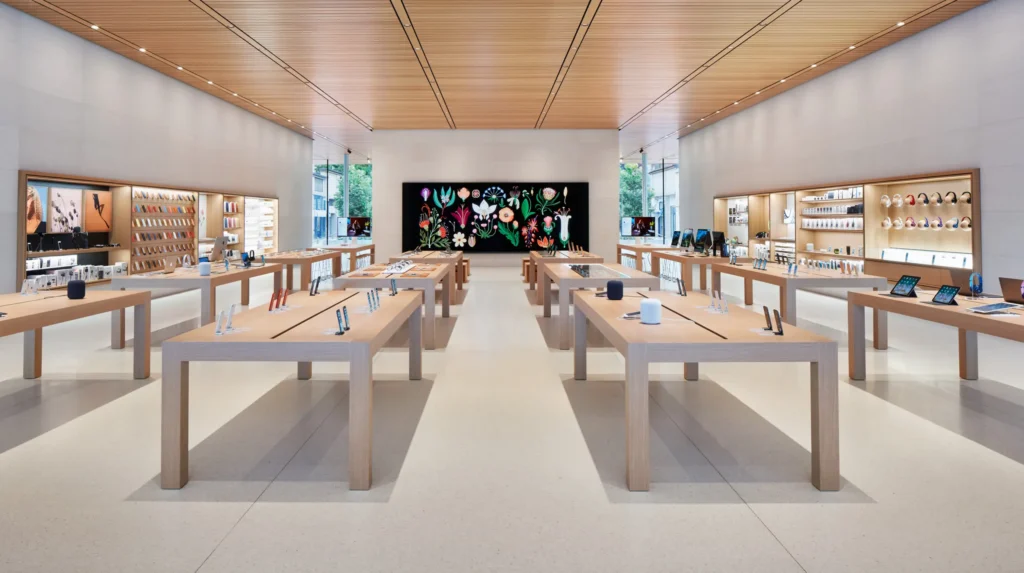
Apple prepares its Apple Stores for a new offensive in smart home technology
Apple is making unusual changes to the layout of its stores for autumn 2026. According to Mark Gurman, the “Avenue” spaces will be reorganized to accommodate a new wave of smart home products, including an updated HomePod mini and Apple TV, but primarily a mysterious Home Hub that may finally be ready for launch.
Apple reorganizes its store layouts
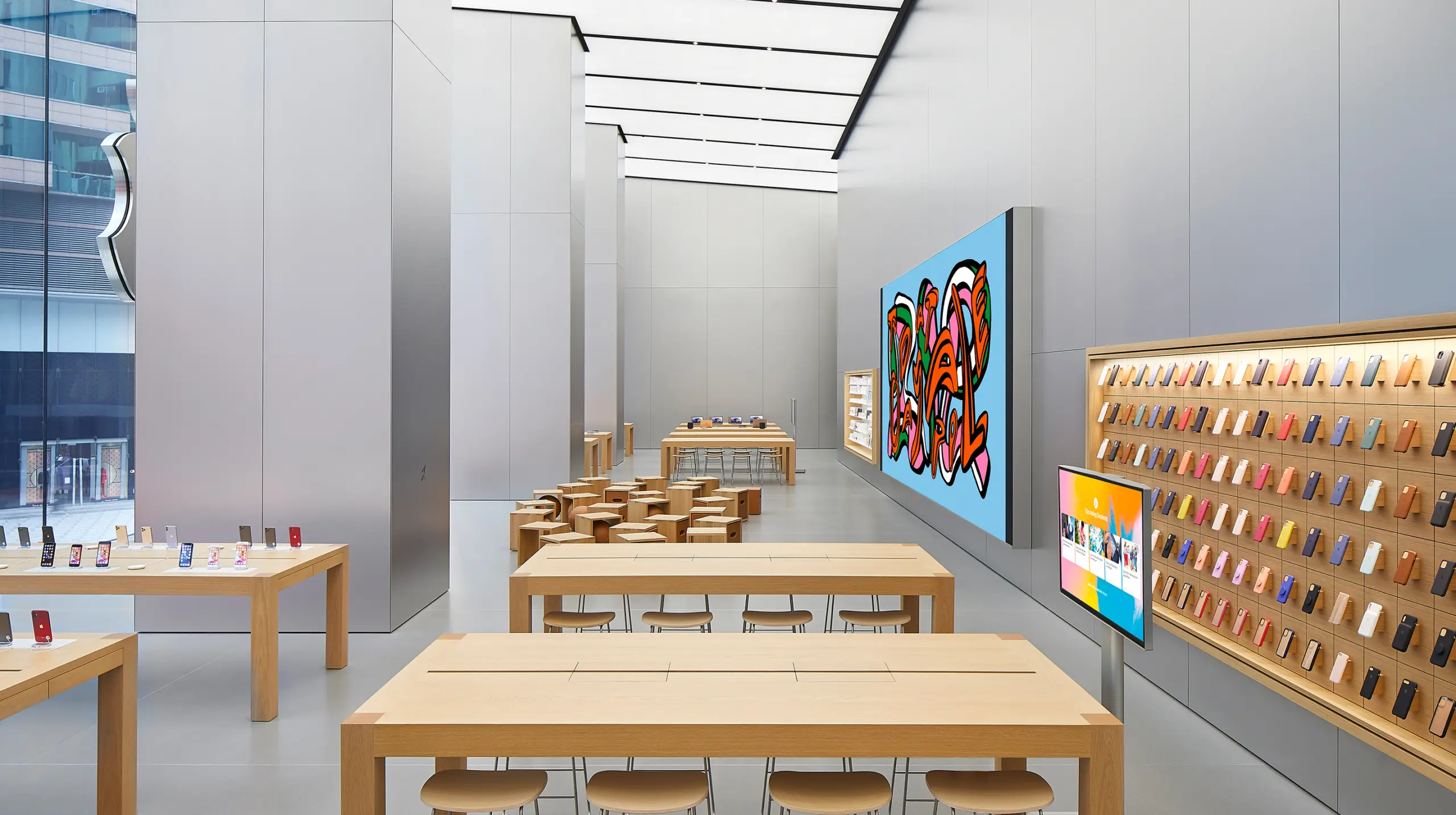
In the newest Apple Stores, accessories and certain products like AirPods, HomePod, Apple TV, or Beats are showcased along the walls in areas called Avenues. Apple plans to modify some of these spaces this autumn.
According to Mark Gurman, the teams responsible for store layouts are reconfiguring the Avenues and adding new locations for several unreleased products. On its own, a change in furniture may not seem particularly interesting.
However, for Apple, the scale of this project serves as a hint about what could be on the horizon in the coming months.
HomePod mini and Apple TV alone wouldn’t justify these changes
Two novelties are already highly anticipated. Apple is reportedly preparing a new generation of HomePod mini and a new Apple TV 4K with updated internal components. These devices could benefit from more powerful chips to better utilize the new Siri AI and the upcoming smart home functions.
Yet, neither a HomePod mini nor an Apple TV box truly requires the creation of new demonstration areas. They can easily replace the current models.
This is exactly what leads Gurman to believe that Apple is planning something more significant.
The Home Hub emerges as the obvious candidate
The main hypothesis pertains to the much-discussed Apple Home Hub, sometimes referred to as HomePad. This device aims to introduce a new category to the Apple ecosystem: a connected screen that serves as a control center for the home. Rumors suggest a square screen about 7 inches in size, capable of displaying widgets, calendars, reminders, photos, HomeKit controls, and feeds from security cameras.
A front-facing camera would also enable FaceTime calls and some user recognition functionalities.
Apple is said to be developing two variants: one for placement on a table or furniture, and another that can be mounted on the wall using a magnetic system.
Such a product needs to be showcased, not just placed on a shelf
This is where the retail strategy becomes crucial. A new HomePod mini is easily understandable. A Home Hub is much less so. Apple will need to demonstrate how the screen interacts with lights, locks, cameras, calendars, and Siri.
A demonstration area therefore becomes significantly more important. In a store, Apple can show how the product integrates with a smart home rather than merely displaying it next to a USB-C cable.
For a new category, the in-store experience can become a vital part of the product launch itself.
Apple has reportedly delayed its connected screen several times
The Home Hub is not a new rumor. Apple has been working on this type of device for several years, but its schedule has allegedly faced several postponements. The delays have been attributed to the development of the new generation of Siri. A connected screen whose interface relies heavily on voice interactions becomes much less appealing if the assistant that operates it is not sufficiently reliable.
The arrival of Siri AI in 2026 changes the context significantly.
Apple now possesses a much more suitable engine for a product that must remain constantly accessible in a room.
Siri will likely be the true test
The hardware is probably not the most challenging part. Apple knows how to produce an excellent screen, a decent camera, and a compact audio system. The real challenge will be to make the whole setup genuinely useful.
A Home Hub must understand natural requests, control accessories, display relevant information instantly, and differentiate between various household members. It will also need to act quickly without requiring the user to reach for their iPhone. If Siri fails too often or constantly asks for rephrasing, the product will lose much of its appeal.
A new version of the HomePod mini is also anticipated
The HomePod mini 2 remains an essential part of this initiative. The current model dates back to 2020, a notably long lifespan for an Apple product. The new generation is expected to evolve internally, with a newer processor enhancing Siri, Apple Intelligence functions, and interactions with the broader ecosystem. Connectivity upgrades are also rumored.
The HomePod mini could then function as an audio and smart home satellite around the Home Hub, rather than simply existing as an independent smart speaker.
The same strategy applies to the new Apple TV
The Apple TV 4K is also set for an update. This upgrade would primarily be internal, featuring a newer chip providing increased power and new functions related to Siri AI. Apple TV already serves as a HomeKit hub in many homes. Apple may strengthen this function and closely connect it to the upcoming Home Hub.
Together, these could form a genuine home architecture: the Home Hub for the visual interface, the HomePod for audio and voice commands, and the Apple TV for entertainment and HomeKit infrastructure.
Apple also has financial reasons to accelerate home technology adoption
The economic context provides another perspective. In its third fiscal quarter of 2026, Apple reported total revenue of $109.4 billion, a 16% year-over-year increase.
The iPhone and Mac experienced particularly strong growth. However, the Wearables, Home, and Accessories segment, which includes Apple Watch, AirPods, HomePod, and Apple TV, is progressing significantly slower. A new home product could thus drive growth in a category that has become more mature. Apple does not need the Home Hub to reach iPhone-like volumes immediately; it merely needs to create a new purchase opportunity for households already equipped with multiple Apple products.
The competition presents an opening
The connected screen market is currently in a peculiar phase. Google has not updated its Nest Hub for several years, and its main connected screens are currently unavailable on the US Google Store. Even the Pixel Tablet, which could double as a home screen when docked, is difficult to find directly through Google.
Amazon remains significantly more active with its Echo Show range.
However, this situation still leaves an opening for Apple. The market exists, while Google seems much less aggressive than it was during the era when Alexa and Google Assistant were in a constant battle for dominance in the living room.
Apple Stores could become the best place to persuade customers
This precisely explains the importance of the store rearrangement. At $100, a connected screen can be bought almost impulsively. At $300 or $350, consumers want to understand what they gain. Apple can then demonstrate the product connected to a camera, a lock, lights, and a HomePod.
A salesperson can explain the difference between the wall-mounted version and the one designed for tabletop use. Moreover, consumers can see how Siri interacts with the interface. For a category that remains somewhat abstract, this demonstration is likely more valuable than a technical specification sheet.
The autumn could mark the real start of a new home range
The timeline remains uncertain. The new HomePod mini and Apple TV seem well-positioned for an autumn release. The Home Hub might be unveiled in September, with availability later, potentially between October 2026 and early 2027. This delay would allow Apple to begin preparing its stores even before the product hits the shelves.
Consequently, the reorganization of the Avenues serves less as proof of an immediate launch and more as a strong signal of the direction being taken.
The most intriguing signal does not come from benchmarks or supply chains but rather from the walls of Apple Stores: Apple seems finally prepared to create the necessary space to make smart home technology a genuine product line.



