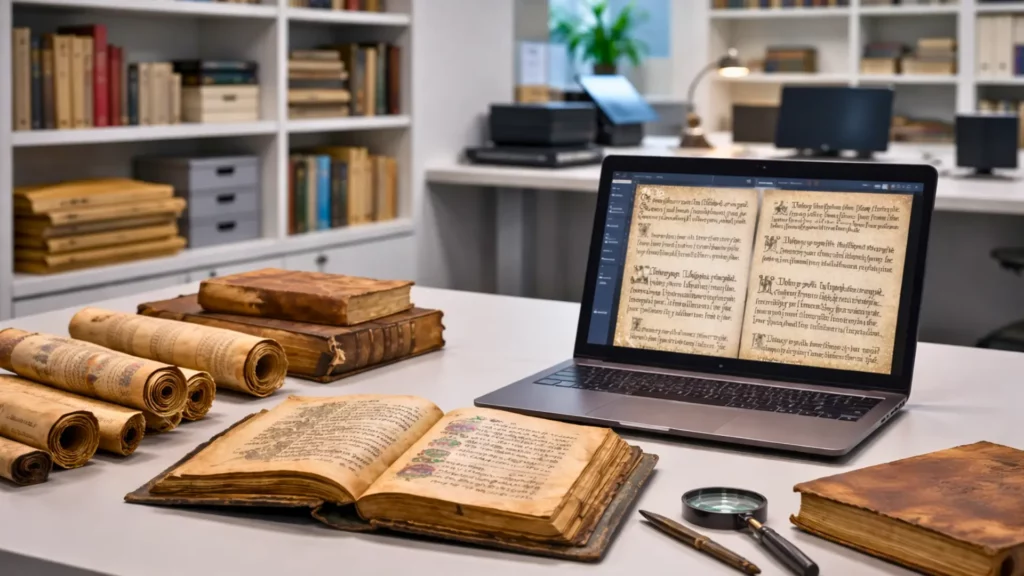
In just four months, an artificial intelligence has transcribed over 32,000 medieval manuscripts. A remarkable technological advancement or a daunting challenge for researchers? I delved into this extraordinary project led by Inria and came out fascinated… yet somewhat apprehensive.
An AI Fed by Years of Rigorous Human Work on Complex, Multilingual Manuscripts
The adventure begins far from servers and algorithms: it takes root in the painstaking work of a team of philologists and researchers. Over several years, they manually transcribed 200,000 lines of medieval texts from the 9th to the 16th century in no less than 11 different languages. Their goal? To provide an unmatched learning resource.
This linguistic and graphical diversity is not a luxury, but a necessity. Ancient handwritten script is fraught with challenges: abundant abbreviations, unstable spellings, and uncorrected scribe errors. It is impossible to train an AI seriously without exposing the algorithm to all this complexity. This heterogeneous corpus, true to the reality of manuscripts, enables the formation of a robust and adaptive system.
The team relied on two open-source software programs, Kraken and eScriptorium, which allow for the training of a visual transcription system without resorting to large language models. This strategy is paying off: the engine designed avoids haphazard interpretations. It does not seek to understand the text but to faithfully reproduce each graphic sign, like an ultra-precise digital copyist.
A Raw, Fast, and Reliable Graphic Recognition Without Linguistic Interpretation
What stands out is the speed: 32,763 manuscripts transcribed in just four months. Documents from Gallica, ARCA, E-Codices, Oxford, and Munich were processed en masse and made available on the CoMMA platform. For each text, the percentage of correctly recognized lines is indicated. Sometimes less than 50%, often over 90%. No rewriting, no correction: the raw transcription marks a methodological revolution.
But how does an AI distinguish between a “ri” and an “n,” or recognize a superscript number? The answer is that it does not understand; it interprets graphically. And this is the crux of the issue. These models do not “read” in a human sense; they identify shapes. It’s a logic of visual recognition, not semantic interpretation. It’s a bionic eye, not a hermeneutic intelligence.
Why AIs Like GPT or Mistral Are Ineffective Against Ancient Handwriting
It might be tempting to imagine ChatGPT or Mistral coming to the rescue, right? Wrong idea. These models are trained to produce text, not to interpret isolated graphic signs. And in the Middle Ages, there were no standardized spellings or rigid syntax. The graphic chaos of medieval manuscripts eludes linguistic models.
In fact, manuscript recognition is more akin to image analysis than linguistics. That’s why researchers have chosen a different path: to train the algorithm to see, not to understand. It’s counterintuitive but remarkably effective. This visual approach restores the materiality of ancient texts.
Mass Access to Texts but Overload for Historians: A New Scientific Challenge Ahead
With thousands of manuscripts now accessible on the CoMMA platform, historians have a treasure trove of documentary resources. However, this wealth raises a paradox: how to analyze so many texts with the care and rigor required for historical interpretation? Too much access can sometimes kill understanding. Documentary abundance becomes a methodological challenge.
In the face of this data avalanche, new tools will need to emerge: semantic exploration, intelligent visualization, prioritization of corpora. Because AI sets a frantic pace, far removed from the slow process of analysis. It’s no longer just about reading the texts but organizing them, relating them, and perhaps… reinventing them. The future of historical research might just be hybrid, blending human and machine.