

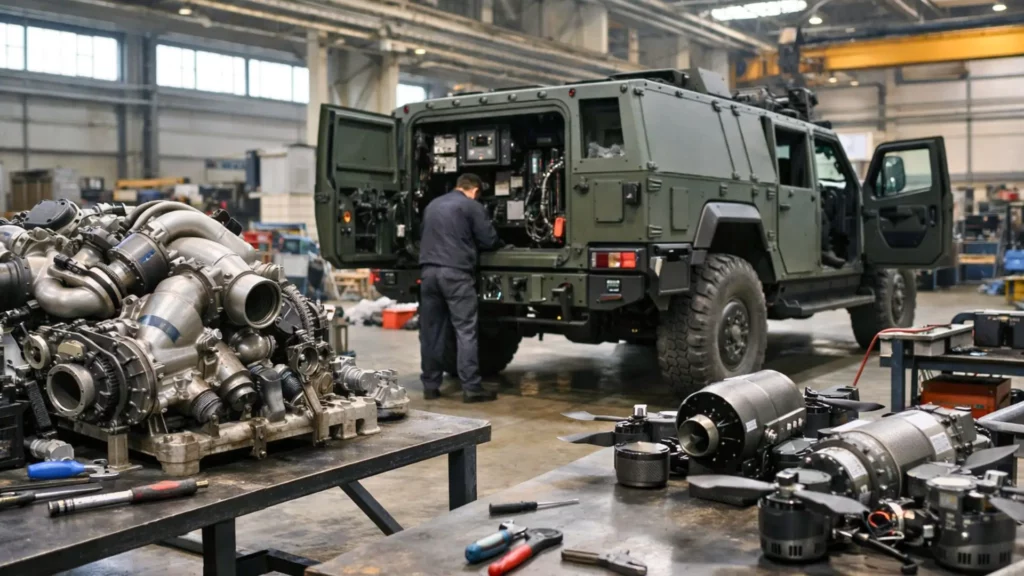
Since the Russian invasion of Ukraine, Berlin has been accelerating its rearmament efforts and creating new opportunities for its factories. In an economy weakened by high energy prices, Chinese competition, and the automotive crisis, defense is emerging as both an industrial leverage and a strategic choice.
In 2022, 100 billion euros changed the game and brought defense back to the center of a long-frozen debate in Germany
The shift comes from a clear geopolitical shock. In March 2022, Berlin launched a special fund of 100 billion euros to modernize the Bundeswehr. Two years later, Germany has also reached NATO’s goal of spending 2% of GDP on defense.
This decision marks a departure from a historical restraint. For a long time, defense remained a sensitive topic in Germany. However, the war in Ukraine has shifted the debate. Now, national security is woven into industrial calculations, moving beyond mere diplomatic rhetoric.
Weak demand, high energy costs, aggressive competition from China: the German industry sees defense as a quick solution
This pivot comes at a challenging time for traditional industries. In the automotive sector, orders are declining, investments are leaving the country, and layoffs are increasing. The automotive industry is struggling with Chinese competition, high costs, and the transition to electric vehicles.
At the same time, some factories are operating below capacity. Machines are idle, profit margins are shrinking, and visibility remains low. In this context, military public funding offers what many have been seeking: volumes, long-term contracts, and a market that is less cyclical.
For some subcontractors, the shift is no longer abstract; it’s about filling order books and preserving expertise. Thus, the defense pathway appears as a credible exit strategy, even though it cannot single-handedly replace the entire German export engine.
Deutz invests in drones, Volkswagen tests the waters: the reconversion is already taking shape
At Deutz, the transition is already evident. The Cologne-based engine manufacturer, founded in 1864, has strengthened its position in the drone sector. After acquiring Sobek in 2025, it also took a stake in Tytan. The industrial signal is clear.
Volkswagen is proceeding more cautiously, but movement is occurring. The company has showcased prototypes at a security exhibition to gauge the market. Following that, the Osnabrück plant, threatened with closure after 2027, could host military-related activities. The concrete reconversion is beginning.
Growth, jobs, innovation: defense can aid German industry, but the transition remains complex
On paper, the benefits extend beyond mere arms orders. Defense can support investment, preserve skilled jobs, and accelerate certain dual-use technologies. A growth effect is certainly possible, especially if production and research become more localized in Europe.
However, the equation remains tight. Military programs require time, reliable supply chains, and coordinated procurement. If Europe imports too much or makes decisions too slowly, the industrial rebound may be weaker than anticipated, and the employment impact will take longer to materialize.
Berlin is therefore betting on a dual approach: to enhance its protection and provide a renewed outlook for its factories. However, there is a major limitation. Not all companies will be able to follow this sensitive, costly, and regulated transition. The taboo is receding, but industrial selection has already started.



