

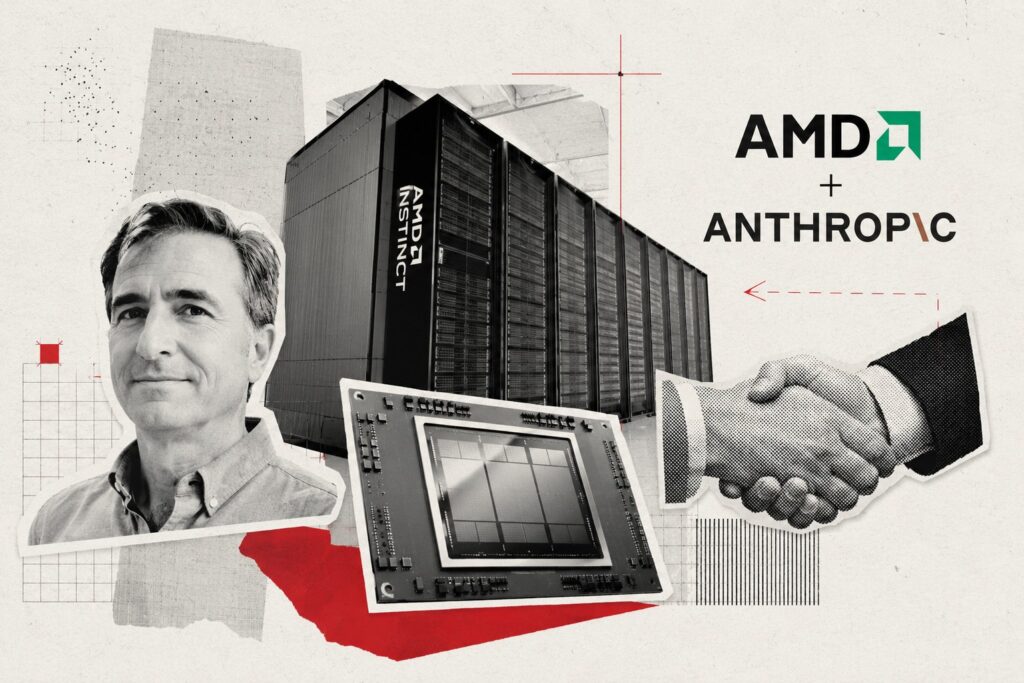
AMD and Anthropic Forge Strategic Partnership for AI Computing Power
AMD and Anthropic have unveiled a strategic partnership aimed at deploying up to 2 gigawatts of Instinct MI450 graphics processors within AMD’s Helios racks. The initial phase will see the activation of 1 gigawatt of capacity, projected to enter production in the first half of 2027. In addition, AMD has committed to investing up to $5 billion in Anthropic’s capital, alongside a multi-year technical collaboration to enhance its ROCm software suite utilizing the capabilities of Anthropic’s AI model, Claude.
The demand for computational resources to train and run AI models has outstripped the capacity that suppliers can deliver for several years. This imbalance is prompting labs to diversify their computing sources, while chipmakers are increasingly looking to provide direct funding to their clients instead of simply selling chips. Anthropic has already expanded its computing partnerships, incorporating AWS’s Trainium processors and Google’s TPU chips announced for late 2025. Current market leader Nvidia still dominates the sector.
This agreement follows closely behind AMD’s collaboration with OpenAI, which granted the latter an option to acquire around 10% of AMD in exchange for a multi-year deployment commitment. AMD estimates a staggering $2 trillion market opportunity for accelerators, processors, and data centers over the next four to five years, with $1.4 trillion focused solely on accelerators by 2030. The significance of this transaction underscores the competitive landscape within the semiconductor industry in the race for AI dominance. Following the announcement, AMD’s stock surged by approximately 10%.
### Chips, Capital, and Software in One Agreement
The deployment will leverage a combination of Instinct MI455X processors, EPYC “Venice” processors, Pensando networking solutions, and AMD’s ROCm software suite. This extends Anthropic’s existing use of the MI355X GPUs. “Access to computing resources is crucial for keeping Claude at the forefront and meeting our customers’ demands,” stated Tom Brown, co-founder and Chief Compute Officer of Anthropic.
The first gigawatt of capacity is slated to go live in early 2027, housed in AMD’s Helios racks, which the company touts as its most powerful AI platform at the rack level to date. However, AMD has not disclosed a timeline for subsequent gigawatts or a fixed amount for the investment, both of which may be realized in the future rather than being pre-committed.
The multi-year technical collaboration will see Claude available to AMD’s engineering teams to accelerate the development of ROCm, the software suite managing Instinct processors. “We are excited to deepen our partnership with Anthropic and deploy AMD Helios at a gigawatt scale,” remarked Lisa Su, AMD’s CEO.
### Closing the Software Gap with Nvidia
Aaron Rakers, an analyst at Wells Fargo, reaffirmed his price target of $615 following the announcement, expressing increased confidence in his $40.6 billion revenue estimate for AMD’s data center GPUs by 2027. He attributes this confidence in part to the software aspect of the partnership, as ROCm has historically lagged behind Nvidia’s CUDA ecosystem.
Utilizing Claude to expedite ROCm’s development is akin to treating this software gap as an engineering project supported by an AI model, rather than relying solely on internal teams. This approach reflects a broader industry shift toward a reversible relationship with proprietary computing, positioning Anthropic now as both a customer and potential shareholder rather than just a GPU user.
According to Tom Brown, an Anthropic engineer trained Claude on an Instinct MI355X rack over a weekend, resulting in a functional performance graph—a concrete example of AI-assisted development that may close the software gap more rapidly than anticipated, as analyzed by Moor Insights & Strategy. However, the firm cautions, “AMD’s open ecosystem strategy works at market share levels of 5-10%, but not at 40-50% without significant missteps from Nvidia, as Intel did with processors.”
### A Portfolio of Bets Rather Than an Isolated Deal
In the same month, AMD has also entered into similar agreements with OpenAI (with a Helios deployment planned for Q4 2026), Meta (for co-designing gigawatt-scale deployments), and Cerebras (for combined inference), as well as enterprise deployments with AT&T and Cisco. Consequently, Anthropic is now part of a series of anchor deals rather than being seen as an exception. “The next phase of AI will encompass frontier models, agents, and physical AI,” commented Lisa Su at the Advancing AI 2026 conference, where AMD announced its $2 trillion addressable market by 2030.
Anthropic relies on AMD for its production computing, including ROCm all the way down to the silicon level, while AMD is entrusting an increasing share of its engineering and product development teams to Claude. The capital investment of up to $5 billion further strengthens this interdependent operational relationship.
Anthropic confirmed in its statement that it will continue to use Nvidia GPUs in tandem with its AMD agreement, a clause that preserves its freedom of choice regarding computing suppliers, as AMD retains the option to sell to other model developers. Nevertheless, the reciprocity of the agreement fosters a mutual interest in its success, a factor procurement and security officials now consider when evaluating capital-supplier agreements in AI infrastructure.
### Venice and the Shift Toward Agentic AI
The new EPYC “Venice” processor integrated within the Helios racks designated for Anthropic offers up to 256 cores and is specifically designed for agentic workloads, where orchestrating software agents places more demands on the central processor than traditional model training. AMD claims—though independent verification is lacking—that its intelligent token routing can reduce AI costs by up to 90%.
Additionally, AMD is offering an air-cooled version of the MI350P, tailored for enterprises lacking the liquid cooling infrastructure of hyperscalers. For an IT department contemplating a switch to agentic inference, Venice shifts some of the workload to be absorbed by the central processor before involving graphic accelerators.
The timeline for the first gigawatt is set for the first half of 2027, providing a tangible measurement of execution, which should be differentiated from the conditional amounts announced this week. Diversification is primarily valued as a risk mitigation strategy against dependence on a single supplier, a criterion that infrastructure leaders are already considering for their cloud decisions. Meanwhile, further clarification about the reversibility clauses and the actual location of future capacity expansions is still needed from relevant cloud and hardware stakeholders.



