

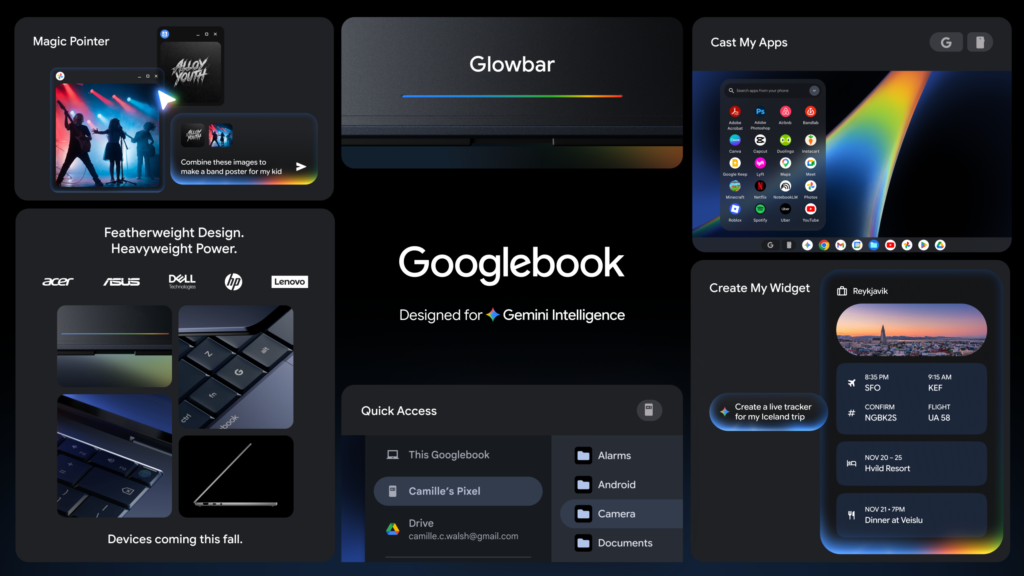
After fifteen years of Chromebooks, Google is preparing much more than just a simple successor. With Googlebook, announced at the Android Show 2026, the company is not only looking to launch a new line of laptops: it aims to redefine the very role of the laptop in the age of artificial intelligence.
The vocabulary used by Google is telling. The company is no longer really talking about OS — operating system — but rather an “Intelligence System”. This, while a mere marketing nuance, signifies a substantial shift in philosophy: the computer is now expected to anticipate the user’s intentions, rather than merely execute applications.
Android Finally Becomes the Basis for a Real Google Laptop
The Googlebook devices appear to rely on Aluminium OS, Google’s upcoming hybrid desktop platform based on Android. Visually, the interface remains similar to ChromeOS, but the architecture is profoundly different.
This time, Android applications would no longer be virtualized as on Chromebooks. Instead, they would run natively, providing a much smoother integration between smartphones, tablets, and computers.
Google promises direct access to phone applications from the laptop, immediate continuity between Android devices, simplified access to mobile files, and seamless workflows without manual transfers.
In other words, Google is finally attempting to create what many have been anticipating for years: a truly cohesive Android desktop ecosystem.
Magic Pointer: The Cursor Becomes an AI Interface
The most symbolic new feature is probably the “Magic Pointer.” Google believes the traditional cursor has hardly evolved in decades. With Gemini and the Google DeepMind teams, the pointer is now contextually driven by AI.
The concept resembles a permanent “Surround to Search” applied to the desktop:
- Hovering over a date might automatically suggest a calendar event
- Pointing at an image may trigger creative suggestions
- Selecting items could instantly initiate AI actions
The cursor stops being merely a selection tool. It becomes an intelligent interpretation layer for the screen. This is likely where Googlebook reveals its true ambition: to transform each computing interaction into an action assisted by Gemini.
AI-Generated Widgets to Replace Traditional Applications
Googlebook also introduces “Create Your Widget,” a feature that allows users to dynamically generate custom widgets through natural language prompts.
Gemini could aggregate Gmail, connect Google Calendar, manage bookings, build contextual dashboards, or display reminders and travel plans. The clear objective is to minimize the need to open separate applications.
Google appears to be shifting the computing experience towards a much more fluid and proactive model, where the interface continuously adapts to the user’s needs.
Google Finally Targets the Premium Segment
The most striking change may be the product positioning. Chromebooks have long been associated with education, budget constraints, and cloud simplicity.
Googlebook aims for something entirely different. The company is collaborating with Acer, ASUS, Dell Technologies, HP, and Lenovo. The brand explicitly mentions premium materials, high-end manufacturing, and a dedicated visual identity featuring a luminous “Glowbar” on the lid.

In other words: Google no longer wants to just compete with educational laptops. It is now directly targeting MacBook Airs, Copilot+ PCs, and future premium AI laptops.
The Personal Computer Enters the Gemini Era
The most fascinating aspect of Googlebook, in the end, is neither Android nor the design. It is the paradigm shift it reveals. For decades, computers have been designed around files, windows, applications, and manual multitasking.
Google seems poised to shift this logic towards a model centered on intention and constant assistance.
The laptop is becoming less of a traditional computing tool and more of a software agent capable of understanding context, anticipating needs, and reducing digital friction.
If Google succeeds, Googlebook could represent the most significant conceptual shift in laptops since the advent of the modern smartphone.
But, as always with Google, ambition alone is not enough. Success will depend entirely on one element: convincing developers and users that this new generation of Android PCs can genuinely replace Windows and macOS in everyday life.



