

Google Magic Pointer: The Mouse Cursor Becomes an AI Assistant with Gemini
For decades, the mouse cursor has remained virtually unchanged—merely an arrow designed for clicking, selecting, or dragging items on the screen. With Magic Pointer, Google aims to transform this mundane tool into a genuine AI interface.
Introduced as one of the flagship features of the upcoming “Googlebook” powered by Gemini, this technology could significantly alter how we interact with computers. At first glance, the idea seems almost absurd: giving contextual awareness to the pointer.
However, the more we observe daily laptop usage, the more this evolution appears sensible.
The Cursor Becomes a Language for Gemini
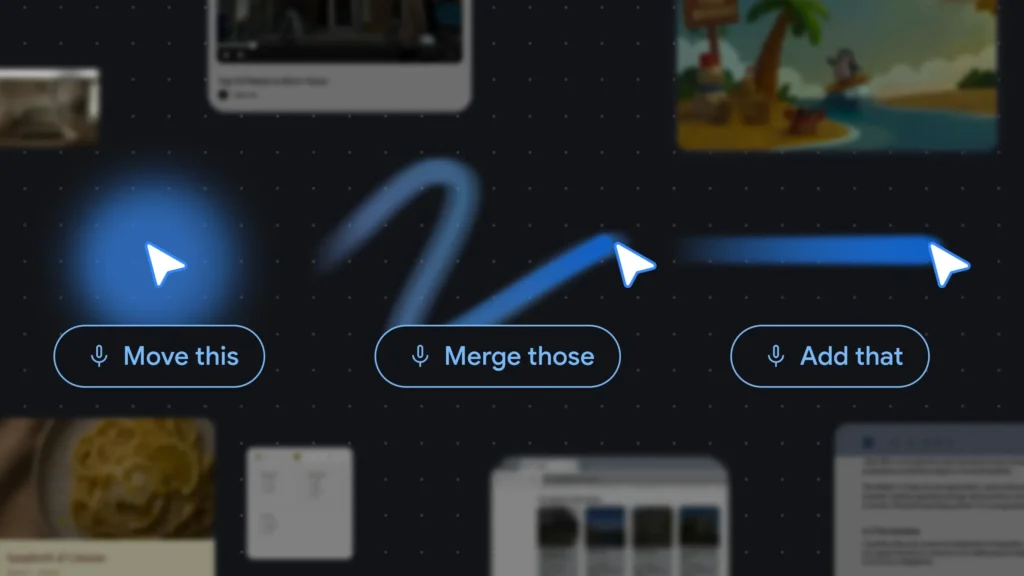
In a publication from Google DeepMind, the company explained its desire to rethink the computer interface for the era of generative AI. Instead of forcing users to open a chatbot window and write detailed prompts, Magic Pointer would allow them to simply point at an element on the screen and express a concise intention.
The system is based on a simple concept: the cursor provides the visual context, while the voice or text command indicates the desired action.
In practical terms, Gemini could precisely understand what the user is pointing to on a webpage, an image, an Excel spreadsheet, a PDF, or even a video. The pointer thus becomes a sort of intelligent remote control for everything displayed on the screen.
Google has already envisioned several scenarios:
- automatically transforming a table into a graph;
- comparing selected products on a shopping page;
- summarizing a PDF document into key points;
- identifying a building in an image;
- instantly converting currencies displayed on a product sheet.
In other words, the cursor would serve not just for navigation but also as a means to convey contextual intention to the AI.

An Interface That Mimics Human Interactions
Google’s approach is particularly intriguing because it directly draws from human behavior outside the screen. In real life, no one describes an object in detail before requesting an action. We simply point at something and say, “move that” or “look at this.” Magic Pointer seeks to replicate this natural mechanism within a computing environment.
This philosophy represents a significant shift in the design of AI interfaces. Until now, conversational assistants primarily relied on language; Google is now attempting to merge visual comprehension, spatial context, and brief commands.
The stakes are high. As AI becomes more pervasive, companies are looking to minimize friction between users and generative models. Text prompts could gradually give way to much more implicit interactions.
The cursor thus serves as an ideal entry point: it is already at the heart of nearly all actions on a computer.
Googlebook: A New Hardware Showcase for Gemini

Magic Pointer also reflects a broader ambition for future “Googlebooks”, this new category of laptops centered around Gemini. While Google remains somewhat reticent about the hardware itself, its logic closely resembles Apple’s strategy with Apple Intelligence: integrating AI directly into the system experience rather than through isolated applications.
On Googlebook, Magic Pointer is expected to operate across the entire operating system. However, for users outside this ecosystem, the feature will initially be limited to Gemini within Google Chrome.
This distinction clearly illustrates Google’s objective: to make hardware a premium showcase for its most advanced AI capabilities.
The Future of Interfaces Could Become Invisible
What makes Magic Pointer fascinating is not just the technology behind the cursor, but what it reveals about the evolution of personal computing.
Since the advent of generative chatbots, the industry has proliferated conversation windows and floating assistants. However, this approach sometimes adds an extra layer between the user and their actual work.
Google now seems to be exploring another direction: making AI almost invisible, directly integrated into existing gestures.
If Magic Pointer works as promised, it could transform a decades-old interface into a new epicenter of AI-assisted computing. This evolution may seem strange today, but it could soon become as natural as right-clicking or copy-pasting.



