

Google Maps limits reviews and photos for offline users: ongoing test or new strategy?
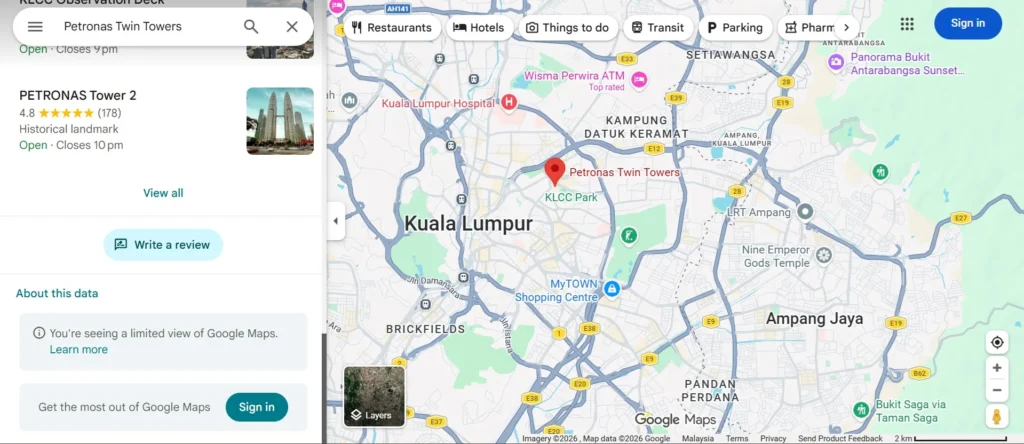
Google Maps is quietly testing a significant change for users who navigate without an account. In recent days, several users have reported that when offline, Google Maps does display routes, but conceals much of what makes it valuable on a daily basis: photos, reviews, menus, hours, coordinates, “popular times,” etc.
Instead, a message warns: “Limited display on Google Maps” and suggests that “logging in” could prevent encountering this restricted experience.
Currently, Google has not officially announced a permanent change. However, the widespread nature of the alerts on platforms like Reddit indicates a large-scale test, or at the very least, a more aggressive protective mechanism.
What’s changing: A “lite” version of Google Maps for offline users
User feedback has been remarkably consistent: when clicking on a location (restaurant, museum, store), the interface reduces to basic tabs (“Overview,” “About”), with a significant loss of community and practical elements.
Several articles highlight the impact: without an account, users miss out on everything that helps them decide where to go—not just how to get there.
The pop-up also lists potential causes: “Google Maps issues,” “unusual traffic” on the network, or browser extensions that could interfere—then gently nudges users toward the solution: logging in.
Two plausible (and not mutually exclusive) hypotheses
1) An “anti-scraping” mode that casts a wide net
The phrase “unusual traffic” immediately suggests a battle against bots, scraping, and certain automations. The issue is that testimonials include perfectly ordinary use cases. This therefore resembles a more sensitive security filter that sometimes triggers incorrectly.
2) An incentive for identification (and data collection)
The other interpretation is more strategic: Google Maps has become a product where user-generated content (reviews, photos, menus) is a gold mine… but also a resource that is costly to protect and monetize. Restricting the “full version” to logged-in users ties usage to an account (and thus to a profile), mitigates certain abuses, and could potentially enhance ad measurement/attribution.
Google hasn’t stated this explicitly, but the user interface prompt “Log in for an optimal experience” seems more like a behavioral lever than a mere error message.
Why it’s sensitive: Maps is about decision-making, not just navigation
In 2026, Google Maps serves as much for choosing as it does for navigation. Cutting access to reviews and photos when offline, even temporarily, effectively removes what has transformed Google Maps into a universal reflex: social proof and visual evidence.
This also marks a cultural shift: many users have become accustomed to browsing locations in private windows, secondary browsers, or “pro” environments without a Google session. These users may find themselves facing a stripped-down Maps—and, consequently, feel compelled to log in.
If Google confirms this behavior (or if it expands), we could see a clearer delineation: useful Google Maps without an account, complete Google Maps with an account. This is a small UX shift, but it sends a significant signal: Google may be starting to treat anonymity as a “degraded mode” rather than a neutral option.



