

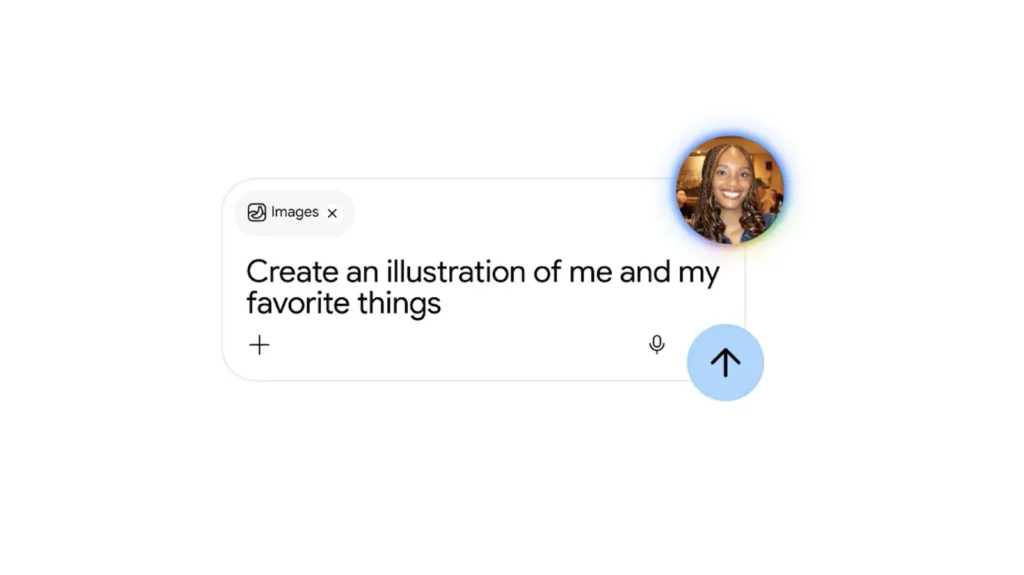
Google democratizes the creation of personalized images in Gemini through Google Photos
Google takes a significant step in its strategy surrounding generative artificial intelligence. Eligible users in the United States can now create personalized images in Gemini for free, a feature that was previously exclusive to paid subscribers.
This expansion reflects an approach that leverages both the power of AI and the wealth of personal data already available within Google’s ecosystem.
Personalized image creation goes free
Google has announced that the feature for creating personalized images in Gemini is now accessible without a subscription for eligible users in the U.S.
Previously, this capability was limited to the benefits reserved for Google AI Plus, Pro, and Ultra plans. It is now offered for free through Personal Intelligence technology, utilizing Google Photos and the Nano Banana model to generate visuals tailored to each user’s profile.
The goal is straightforward: to enable Gemini to produce images that reflect your tastes, environment, or even your appearance, without the need for consistently providing new photos.
An AI that relies on the entire Google ecosystem
With user consent, Gemini can utilize multiple Google services to enrich its creations: Google Photos, Gmail, YouTube, and Google Search. This strategy allows the assistant to better understand individual preferences.
A simple request like “Imagine my ideal home” can leverage elements already present in your history or photo library to produce a more coherent and personalized result.
Another notable new feature is that Gemini can now directly use existing user photos without the need for manual uploads during each creation.
An advantage that ChatGPT and DALL·E do not have
From a technological standpoint, competing models like ChatGPT or DALL·E are capable of generating quality images. The key difference lies elsewhere. Google has a unique advantage: its vast ecosystem of services that billions of people use daily.
While other generators typically require precise context or reference images, Gemini can already have, with user consent, a deep understanding of their interests, photos, or search history.
This integration significantly reduces the steps necessary to achieve a genuinely personalized output.
A free version with some limitations
However, this development does not imply unlimited access. To enjoy this free feature, several conditions must be met:
- You must have a personal Google account.
- You must be at least 18 years old.
- You must use Gemini in a compatible country and language.
- You must be logged into your Google account.
Google also specifies that the free version is based on Nano Banana 2, featuring certain usage and resolution limitations. Versions offering higher definition downloads and Nano Banana Pro remain exclusive to subscribers of paid Google AI offerings.
Personalization comes at the cost of data
This shift perfectly illustrates Google’s current strategy. Rather than simply delivering a high-performing AI model, the company seeks to leverage the richness of its ecosystem to offer an experience that is difficult for competitors to replicate.
However, this personalization has a clear trade-off: it requires access to personal data such as photos, emails, or search history.
Google emphasizes that this feature is entirely optional and can be disabled at any time from Gemini’s settings.
A new battle over personal AI
Beyond image generation, this announcement reflects a broader trend in the industry. After emphasizing the raw power of AI models for so long, tech giants are now aiming to create assistants that genuinely understand their users.
Apple is preparing a similar approach with Apple Intelligence, Microsoft is expanding personalized features in Copilot, while Google is doubling down on the deep integration between Gemini and its historical services.
The next major battle in AI may not only revolve around the quality of models but also on their ability to transform personal data into genuinely useful experiences… without crossing the line of privacy.



