

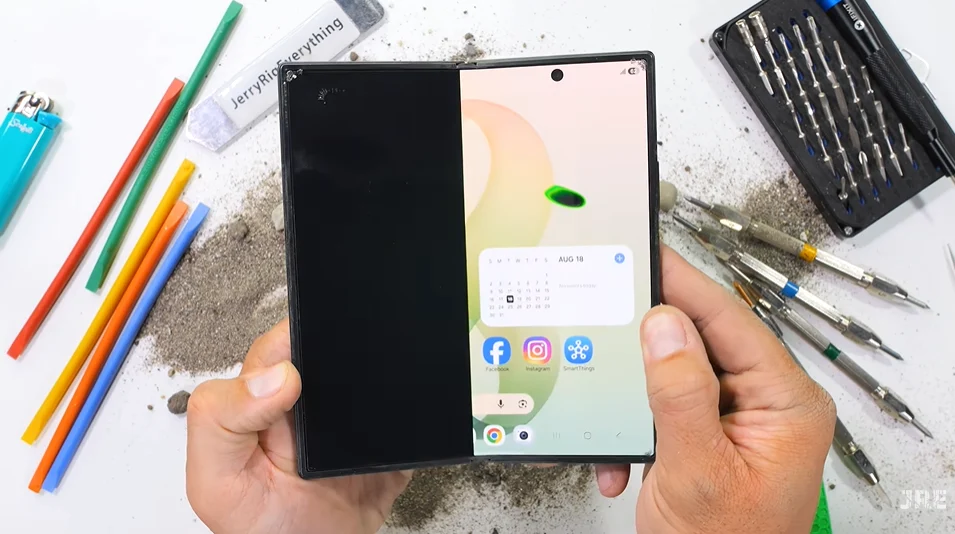
Galaxy Z Fold 8 Ultra: The foldable screen breaks during JerryRigEverything’s durability test
Samsung has emphasized the durability of its new Galaxy Z Fold 8 Ultra, but this ambitious model from its foldable range has revealed an unexpected weakness. During the traditional torture test by JerryRigEverything, the Galaxy Z Fold 8 Ultra endured a first reverse bend before its internal screen completely failed during a second more rigorous attempt.
The contrast is striking, especially since the standard Galaxy Z Fold 8 passed the same test without major damage. This difference brings up a fundamental question for ultra-thin foldables: how much can thickness be reduced without compromising structural safety?
The Galaxy Z Fold 8 Ultra Doesn’t Survive the Second Bend Test
Zack Nelson, the creator behind the JerryRigEverything channel, subjected the Galaxy Z Fold 8 Ultra to the same series of trials as previous Samsung foldable smartphones. Scratches, dust, pressure on the hinge, and especially the infamous bending test, where the device is forced in the opposite direction of its intended mechanism.
The first attempt, with the phone fully opened, caused no immediate damage. However, during the second, more aggressive test, the situation changed drastically.
Under pressure, the internal screen briefly flickers before turning completely black and failing to work. The smartphone also shows considerable flex in the chassis when forced backward.
While the phone is not literally broken in half, its most critical—and expensive—component becomes unusable.
Given that the device is priced at 2,200 euros, this outcome is far from flattering.
The Standard Fold 8 Had Survived
This comparison with the standard Galaxy Z Fold 8 makes the failure even more intriguing. Just a few weeks ago, this model underwent the same testing protocol and managed to endure reverse bends without major functionality loss. This robustness aligns with the generally positive history of Samsung’s larger foldables.
Even previous generations of Galaxy Fold typically survived JerryRigEverything’s tests despite their complex architecture. The Ultra model, therefore, stands out as a notable exception.
The Issue Doesn’t Necessarily Mean the Phone Is Fragile in Daily Use
However, it’s essential to put this result into context. JerryRigEverything’s bending test deliberately replicates extreme stress. A typical user isn’t expected to try bending their smartphone backward with two hands. Thus, this type of testing does not conclude that a Fold 8 Ultra will spontaneously break in a pocket.
The test’s significance lies elsewhere. It measures the structural resistance margin of the phone beyond its standard usage. And, it appears that the Ultra model has less reserve in this regard than the standard model.
Samsung Had Reinforced Almost All Structural Aspects
This outcome is all the more surprising given Samsung’s extensive communication regarding durability improvements. The Galaxy Z Fold 8 Ultra features an Armor Aluminum chassis, while the external screen includes Gorilla Glass Ceramic 3 protection. The Armor FlexHinge has been redesigned, and under the folding screen, Samsung uses two layers of titanium grouped under the term FlexTitanium.
On paper, the Ultra model thus appears particularly sophisticated. Samsung even refers to “lasting durability” in its marketing.
Thinness Could Be the Price to Pay
The problem may lie less with the materials used than with the phone’s overall geometry. When opened, the Galaxy Z Fold 8 Ultra measures only about 4.1 mm in thickness.
At this level, every fraction of a millimeter matters. It must accommodate the flexible screen, the protective layers, the electronic components, the battery, the cables, and the mechanical structure within an extremely compact volume. A thinner smartphone also has less material to absorb or redistribute unusual stress.
Therefore, the Galaxy Z Fold 8 Ultra may exemplify the physical limits of the ongoing race for thinness.
The Screen May Not Be the Culprit
The exact cause of the failure remains unknown. Several scenarios are possible. The flexible cable connecting the screen to other components could have been damaged. A sensor detecting the phone’s opening or closing may have failed. The hinge itself may have exerted unusual pressure on the screen. It’s also possible that one of the internal layers experienced sufficient stress to disrupt screen operation.
Without complete disassembly, it’s impossible to determine exactly which component failed.
FlexTitanium Can’t Eliminate All Stressors
Samsung uses titanium beneath the screen to enhance rigidity and reduce deformation around the fold. While this solution likely improves resistance during normal use, it does not transform the flexible screen into a rigid structure. A foldable must remain capable of bending tens of thousands of times. Therefore, there is inevitably a compromise between flexibility and mechanical resistance. The thinner the phone becomes, the more difficult this balance becomes.
In a traditional smartphone, the structure can be relatively homogeneous. In a foldable, the hinge introduces a mechanical break in the center of the chassis. This must absorb the forces when the device is opened, closed, or subjected to torsion. Samsung has made tremendous progress in this area since the first Galaxy Fold. However, no system can entirely eliminate stress when the phone is bent in the wrong direction.
The Ultra model simply seems to reach its limit more quickly.
Foldables Are Always More Complex Than Standard Smartphones
This is one of the most critical takeaways from this experience. A Galaxy Z Fold combines two screens, several batteries or cells, an extremely precise hinge system, and many flexible cables. Each part must continue to function while accommodating the repeated movements of the chassis. This complexity inherently increases the number of potential failure points. It also explains why repairing a foldable remains significantly more expensive.
In the U.S., Samsung charges approximately $639 to replace the internal screen module of the Galaxy Z Fold 8 Ultra outside of specific coverage. The cost for replacing the external screen is much more reasonable, at around $149. This price difference perfectly illustrates the economic challenge of large foldables. The internal screen is not merely an OLED panel; it integrates several specific layers, the flexible mechanism, and a significant part of the product’s structure.
Thus, even a minor serious damage can become particularly costly.
Samsung At Least Offers One Replacement for the Screen Protector
Nevertheless, Samsung includes one free replacement for the internal protective film during the first twelve months. After this period, the operation costs around $19. This is useful for cosmetic issues or superficial peelings of the protector.
However, this does not cover a complete failure like the one observed in JerryRigEverything’s test. A black screen after structural deformation necessitates a much more significant replacement.
The Price Immediately Alters Perception of Risk
At 2,200 euros, expectations change. Such an expensive phone must be treated as a premium product. However, it must also inspire enough confidence to be used normally without its owner continuously worrying about repair costs. This remains a persistent issue in the foldable market. Manufacturers offer increasingly thinner, sleeker, and more sophisticated devices, but the perception of fragility is challenging to eliminate.
A single extreme test video can quickly reignite the debate.
Thinness Has Become the New Battleground for Foldables
For several years, manufacturers mainly focused on eliminating the gap between the two halves of the phone when closed. They then reduced the visibility of the crease. Today, competition largely centers on thickness and weight. Honor, OPPO, Huawei, Samsung, and several Chinese manufacturers are all striving to produce foldable devices that resemble less and less two stacked smartphones.
This is a logical evolution.
However, the Galaxy Z Fold 8 Ultra demonstrates that this pursuit has its limits. A 4.1 mm thick smartphone, when opened, looks impressive on a technical sheet. In hand, this thinness can also make the device much more pleasant to use. However, if every millimeter removed decreases rigidity or safety margin, the situation becomes more complex.
The best foldable is not necessarily the thinnest; it’s the one that finds the best balance between ergonomics, weight, battery life, and durability. The Galaxy Z Fold 8 Ultra seems to have pushed one of these parameters particularly far.
It would be excessive, however, to present this result as evidence of a total failure. The Galaxy Z Fold 8 Ultra could very well withstand several years of normal usage conditions. Dust protection, hinge improvements, and titanium layers remain relevant. The test simply indicates that its structure has a lower breaking threshold than the standard Fold 8 under a specific situation.
This is precisely the type of information that a torture test is designed to reveal.



