

Galaxy S27 Pro and S27 Ultra: A New Horizontal Camera Block Appears in Leaks
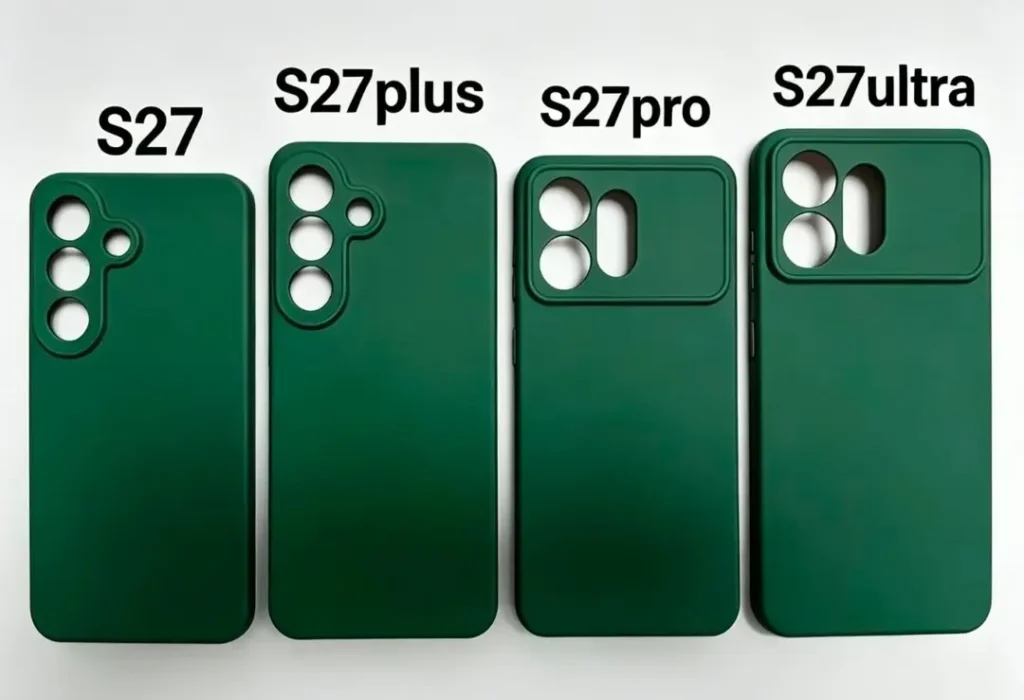
Recent leaks regarding the cases for the upcoming Galaxy S27 series provide a cohesive first look at the design Samsung might adopt in 2027. The Galaxy S27 and S27+ are expected to maintain a relatively traditional layout with separate photo modules, while the Galaxy S27 Pro and S27 Ultra are set to take a different direction.
The two high-end models could feature a large horizontal camera block positioned at the top of the chassis. This choice would break away from several years of a sleek vertical design and may also allow Samsung greater flexibility in internal space organization.
A More Classic Design for the Galaxy S27 and S27+
The cases attributed to the Galaxy S27 and S27+ reveal an architecture that remains close to recent generations. Samsung is likely to keep separate openings for the various camera sensors, avoiding a large common island. This has become almost emblematic of the Galaxy S lineup, with lenses embedded directly in the back rather than enclosed in a massive module.
This choice enables Samsung to maintain a visual continuity across the standard models while reserving a stronger identity for the Pro and Ultra versions.
This strategy makes sense, as the Galaxy S27 and S27+ are the most mainstream models in the lineup, while Samsung appears eager to create more distinctive versions for the premium variants.
The Galaxy S27 Pro and S27 Ultra Could Feature a Large Horizontal Module
The changes become more apparent on the Galaxy S27 Pro and S27 Ultra. The new cases indicate a large horizontal camera array positioned towards the top of the phone. This layout matches several recent renders and is gaining credibility, though nothing is official yet.
Samsung seems set to abandon the vertical arrangement used in its high-end models for several generations.
A wider block could provide more freedom in arranging sensor layouts, stabilization systems, and thermal components. This does not necessarily mean that Samsung will immediately incorporate much larger sensors, but the architecture may facilitate their eventual integration.
So far, leaks suggest there won’t be a dramatic increase in overall sensor sizes.
The S27 Ultra’s 4x Telephoto Lens Could Bring Significant Photography Enhancements
The main technical upgrade mentioned recently concerns the telephoto lens of the Galaxy S27 Ultra. Samsung may replace the current 5x periscope zoom with a 4x telephoto lens equipped with a larger sensor. While on paper, slightly reducing the focal length may seem like a step back, a larger sensor could enhance image quality in a broader range of situations.
This approach could also help capture more light and improve performance in challenging conditions.
Additionally, it could provide a more versatile zoom range between the main sensor and telephoto lens, provided Samsung effectively manages digital cropping and software processing. Therefore, the number on the zoom doesn’t tell the entire story. A better-equipped 4x module could deliver more consistent results than a limited 5x.
The Galaxy S27 Pro Emerges as a ‘Mini Ultra’
A significant new addition to the lineup would be the Galaxy S27 Pro, which is expected to position itself between the standard Galaxy S27 and the Galaxy S27 Ultra. Rumors suggest an approximate screen size of 6.4 to 6.6 inches, with a philosophy similar to that of the Ultra but in a more compact format. The Galaxy S27 Pro could share its main sensor and ultra-wide lens with the Ultra model while forgoing certain specific features like the S Pen.
Samsung appears to be responding to a clear demand: offering a compact smartphone without sacrificing the most attractive photographic components of the lineup. Currently, choosing a smaller model often means settling for less ambitious photo capabilities. The S27 Pro could precisely bridge that gap.
Four Models Already Observed in GSMA Certifications
The complete lineup is expected to include four devices. The references SM-S952B, SM-S956B, SM-S957B, and SM-S958B have already been associated with the Galaxy S27, S27+, S27 Pro, and S27 Ultra, respectively, in GSMA certification listings. These appearances reinforce the idea of a lineup structured around four tiers rather than the traditional trio.
The launch is anticipated in the first quarter of 2027, likely between January and February if Samsung maintains its typical schedule. At this stage, the certifications mainly confirm the existence of multiple variants but do not yet validate all characteristics being circulated regarding screens, cameras, or batteries.
Exynos 2700 and Snapdragon 8 Elite Gen 6 Pro on the Horizon
The Galaxy S27 lineup is also expected to mark a widespread transition to 2nm chips. Depending on the regions, Samsung could utilize its own Exynos 2700 or Qualcomm’s upcoming Snapdragon 8 Elite Gen 6 Pro, manufactured by TSMC. This situation is particularly noteworthy for the Galaxy S27 Ultra, as Samsung might reintroduce its Exynos in a model where Qualcomm has long held a prominent place.
This return would be symbolically significant. The Ultra model is Samsung’s technological showcase, and reinstating a proprietary chip would indicate that the company feels it has made sufficient progress in performance and efficiency.
Until regional configurations are confirmed, however, it remains too early to determine how Samsung will distribute the two platforms.
BOE and Qi2 May Also Influence Hardware Approach
Additional rumors suggest more subtle yet potentially significant changes. Samsung may be considering sourcing some OLED panels for the Galaxy S series from BOE, marking a noteworthy evolution in its supply chain. This choice could help reduce costs or further diversify suppliers, though the specific models affected have not yet been clearly identified.
The Galaxy S27 lineup may also support magnetic Qi2 charging, bringing the Galaxy series closer to the already popular ecosystem of magnetic accessories found on other smartphones.
If Samsung integrates magnets directly into the chassis, the benefits would extend beyond charging; car mounts, external batteries, wallets, and other accessories could become much easier to use.
Samsung Appears to Aim for Clearer Differentiation in Its Lineup
These leaks suggest that Samsung seeks to make its Galaxy S family visually clearer. The Galaxy S27 and S27+ models would continue in a reassuring continuity, while the Galaxy S27 Pro and S27 Ultra would adopt a more pronounced identity through the new horizontal camera block.
This separation aligns with the introduction of the Pro model.
Samsung could thus create two families within the same lineup: classic devices aimed at the general public and premium models that focus more on photography, performance, and ambitious formats. This would also prevent the Galaxy S27 Pro from merely resembling a slightly enhanced Galaxy S27+.
The Galaxy S27 Pro Could Be the Most Interesting Model of the Generation
While the Galaxy S27 Ultra will likely remain Samsung’s most advanced phone, the new Galaxy S27 Pro could be the one that significantly alters the structure of the lineup. A more compact smartphone with photography features similar to the Ultra would address a relatively underserved space in the Android market.
The challenge will undoubtedly be the pricing.
If Samsung positions the S27 Pro too close to the Ultra, the model risks losing some of its appeal. On the other hand, a sufficiently middle-ground position could make it an attractive option for those seeking the best technologies without committing to a massive format.
Current circulating cases do not confirm this entire strategy, but they strengthen the notion that the Galaxy S27 will not simply be an invisible evolution.
After several years of consistent design, Samsung appears ready to more distinctly evolve the appearance of its premium models, with the new horizontal camera block likely becoming the most immediately recognizable feature.



