

Firefox Project Nova: Mozilla prepares for a major redesign with a visible anti-AI button
Mozilla aims to restore character to Firefox. With “Project Nova,” the browser is set to undergo its most significant visual transformation in years, incorporating a new graphic identity, extensive customization options, and simplified access to privacy settings—particularly those related to artificial intelligence.
Beyond mere aesthetic changes, this evolution signals a strategic intent: to differentiate Firefox in a Chromium-dominated market while emphasizing a user control and transparency narrative.
A more modern, rounded interface designed for customization
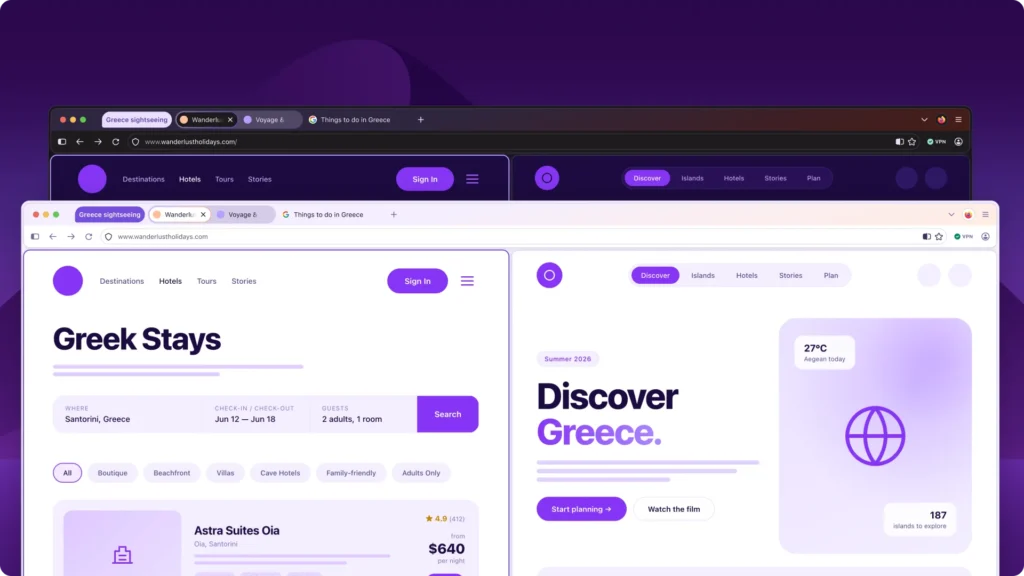
Mozilla describes Project Nova as a complete overhaul of the user experience. Initial screenshots reveal a much more organic interface, featuring “bubble” tabs, rounded buttons, and a color palette inspired by fire tones—a clear nod to Firefox’s historical identity.

The icons have also been redesigned to ensure visual consistency across both light and dark themes. Mozilla seems to be aligning with a broader market trend towards softer, less technical interfaces that emphasize visual comfort.
However, the most intriguing aspect may lie in the new customization options. Firefox will introduce new color themes applied throughout the browser window, akin to Chrome’s themes. The company is even exploring settings that allow modification of tab shapes and other interface elements.

This approach not only positions Firefox as a privacy-focused browser but also as a customizable and identity-driven product—an area where Arc Browser or Vivaldi have recently gained traction.

More accessible AI settings and a genuine transparency message
One of the most strategic changes concerns the artificial intelligence settings. Mozilla promises clearer and faster access to the button that disables all current and future AI features in the browser.
In a context where AI integrations often multiply without real granular control, Mozilla aims to differentiate itself from competitors like Google Chrome and Microsoft Edge. The message is straightforward: the user remains in control.

Mozilla also clarifies that AI models are only downloaded locally if the user explicitly chooses to use these functions. Moreover, if some components are installed, Firefox already displays more clearly which models occupy space on the device—a subtle jab at Chrome and its AI downloads that can exceed several gigabytes.
This strategy aligns with Mozilla’s historical position: advocating for a more transparent and less intrusive web while progressively incorporating AI usages that have become essential.
Firefox 151 already introduces the Web Serial API and new productivity features
Alongside the announcement of Project Nova, Mozilla also launched version 151 of Firefox this week. Among the most notable additions is support for the Web Serial API. This technology allows websites to communicate directly with certain hardware devices without requiring a native application. For instance, a site could update the firmware of a peripheral or control a connected device directly through the browser.
Mozilla continues to expand Firefox’s “platform” capabilities to compete with Chromium-based browsers, which have often been ahead in this type of modern web API.
Firefox 151 also brings a new homepage layout, new wallpapers, and the ability to merge multiple PDFs directly from the built-in PDF reader.
On the productivity front, Project Nova will also mark the return of the “compact mode,” highly valued by advanced users. This option reduces the space occupied by the browser’s controls to maximize the display area for web pages.
Mozilla also plans to improve access to tab groups, split view, and vertical tabs.
In short, Firefox is attempting to blend aesthetic modernization with advanced productivity tools—a combination that has become essential in the face of rising “power user” browsers.
A bid to reclaim a foothold in a locked market
Project Nova arrives at a challenging time for Mozilla. Firefox retains a loyal user base, but its market share continues to be pressured by Chrome, Edge, and Safari.
This redesign therefore does not merely aim to beautify the browser. It seeks to make Firefox visually appealing, more competitive with modern usages, and align with current expectations around customization and privacy.
Mozilla appears to have recognized that in 2026, a browser is no longer just a technical tool: it is also a workspace, a personal environment, and increasingly, a permanent AI interface.
With Project Nova, Firefox aims to redefine its role in this new generation of the web.



