


Firefox: Claude AI from Anthropic Discovers 22 Security Flaws in Two Weeks
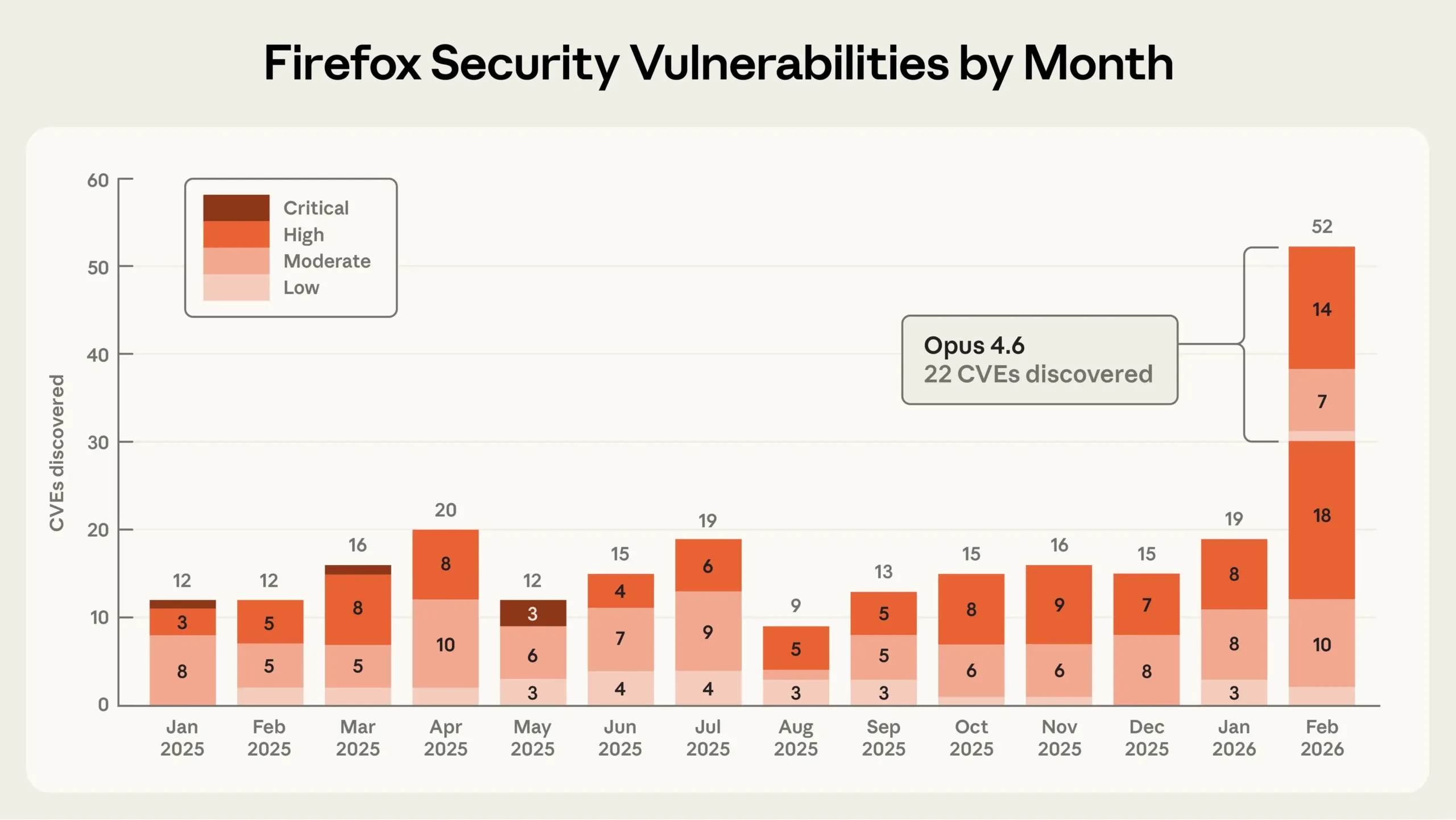
Firefox is among the most audited open-source projects globally, and this is why the experiment conducted by Anthropic with Mozilla is generating buzz. In just two weeks, the team identified 22 distinct vulnerabilities, 14 of which were categorized as “high severity”; most have already been addressed in Firefox 148.
A “Commando Operation” Over Two Weeks in a Reputedly Solid Codebase
According to Anthropic, they launched Claude Opus 4.6 on Firefox, initially targeting the JavaScript engine before expanding the analysis to other areas of the browser. This was done because Firefox is both complex and thoroughly tested, providing a good testing ground for evaluating what the AI can actually find.
The results are striking in volume: some of the vulnerabilities are already covered by Mozilla’s security bulletins for Firefox 148 (published at the end of February 2026), even though some fixes are still pending in future versions.
The Most Revealing Point: Claude Can Find Flaws… Better Than It Can Exploit Them
The crucial distinction here is that, based on accounts from the experiment, Claude Opus 4.6 was significantly better at detection than at writing exploits. The team reportedly spent around $4,000 in API credits to create proof of concepts, achieving only two successes—and even those did not demonstrate any “realistic” ways to bypass the browser’s defenses.
In simple terms: currently, AI appears to boost the capabilities of triage and auditing rather than (yet) enhancing operational attack skills—though that boundary could shift rapidly.
Why It Matters: Open Source Security Enters the “Signal Flood” Era
The benefits are clear: if AI can spot vulnerabilities in a hardened project like Firefox, it can help secure thousands of less-monitored libraries. However, the flip side is equally important: alongside useful reports, there may also be an avalanche of noisy tickets, false positives, and “polluting” contributions—a cost that only well-resourced teams can absorb.
In this specific case, Mozilla has the capacity to handle this. Many smaller project maintainers do not.
The Defensive Advantage… Will Depend on Organizational Speed
The Anthropic × Mozilla experience points toward a concrete future:
- The discovery of vulnerabilities becomes less rare (leading to more patches, faster).
- The bottleneck shifts: it’s no longer “finding,” but rather “verifying/prioritizing/patching/publishing properly”.
- Coordination (responsible disclosure, validation, triage tooling) becomes as strategically important as coding.
If open-source players equip this chain, AI can become a force multiplier for defense. Otherwise, it risks turning security into constant noise—or worse, providing an advantage to those who automate exploitation faster than the fixes.



