

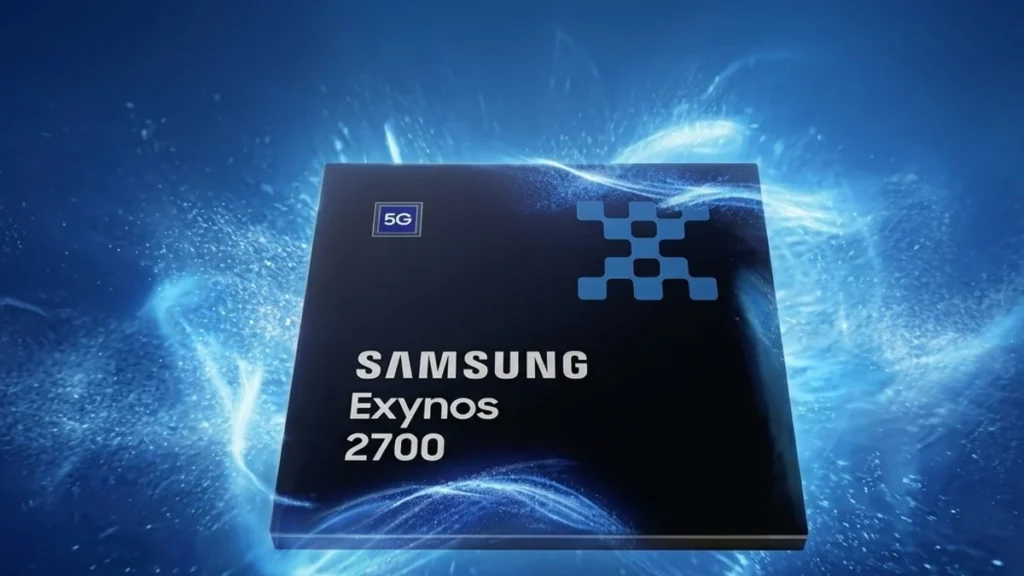
Exynos 2700: Samsung confirms its future 2nm chip for the Galaxy S27
After several years dominated by Qualcomm in the premium smartphone market, Samsung has sent a strong signal: the Exynos is not finished yet.
During a recent internal briefing, Samsung officially confirmed the development of the Exynos 2700, its upcoming high-end mobile platform. This announcement puts an end to speculations about a potential abandonment of the Exynos line and suggests a strong comeback in the upcoming Galaxy S27.
Samsung Revives Its Exynos Strategy
In recent years, the Exynos chips have faced significant challenges. Due to criticisms regarding the performance and energy efficiency of previous generations, Samsung even decided to launch the Galaxy S23 and Galaxy S25 series exclusively with Snapdragon processors.
This decision fueled rumors that the South Korean giant might gradually phase out its mobile division in favor of Qualcomm.
Such speculations now seem to be dismissed.
According to statements from Park Yong-In, president of Samsung System LSI, the Exynos 2700 is currently progressing without major issues and is intended for future premium smartphones. Unsurprisingly, the Galaxy S27 series is now the most likely candidate.
A New Generation Fabricated at 2 Nanometers
One of the key aspects of the Exynos 2700 is its manufacturing process. Based on various leaks over recent months, the chip is expected to utilize the SF2P process, the second generation of 2nm fabrication developed by Samsung Foundry. This evolution represents a significant strategic milestone for Samsung.
As the semiconductor market enters a new phase of competition over embedded artificial intelligence and energy efficiency, mastering the 2nm process has become a critical indicator of competitiveness against players like TSMC and Qualcomm.
Finely crafted processes generally offer better energy efficiency, reduced heat output, enhanced performance at equal power levels, and greater transistor density.
Samsung Prioritizes Battery Life Over Benchmarks
Early results from Geekbench earlier this year raised some eyebrows. The observed performance levels are reported to be relatively close to those of the Exynos 2600. At first glance, this might seem disappointing.
However, one detail completely changes the interpretation of the numbers: the tested sample operated at a frequency below 3 GHz. This information suggests that Samsung is no longer solely focused on winning the benchmark wars but aims to optimize the balance between power and consumption. According to several reports, the Exynos 2700 could achieve up to 12% additional performance, a 25% reduction in power consumption, and an 8% reduction in silicon area.
In a context where battery life is becoming as crucial as raw power, this approach could prove particularly relevant.
A New Thermal Architecture to Compete with Snapdragon
Another area of improvement relates to thermal management. Samsung is reportedly developing a technology called Heat Path Block (HPB), designed to enhance heat dissipation and maintain more stable performance over longer usage periods. This is precisely where Qualcomm has gained an advantage in recent years.
Snapdragon processors often provide excellent peak performance, but they also feature more mature thermal management that limits throttling during prolonged gaming sessions or heavy use.
Samsung appears to be addressing this historical weakness. Instead of trying to surpass the upcoming Snapdragon 8 Elite Gen 6 Pro in raw power, the company may focus on better stability and improved battery life.
A Strategic Challenge Beyond the Galaxy S27
The significance of the Exynos 2700 extends far beyond the mere launch of a new smartphone. Samsung is also aiming to demonstrate that its Foundry business can produce advanced chips that are competitive on a global scale.
This demonstration comes at a crucial time. Several tech giants, including AMD, Google, and Tesla, are currently viewed as potential future clients for Samsung’s production lines for their next generations of processors. A successful Exynos 2700 would thus serve as a technological showcase to attract more partners to the company’s factories.
The Return of Exynos Could Redefine the Galaxy S27
For users, the confirmation of the Exynos 2700 primarily indicates that Samsung seems ready to return to its traditional dual-platform strategy. Certain regions could receive Galaxy S27 models equipped with Exynos, while others will stick with Snapdragon versions.
The real question is no longer whether Exynos will make a comeback, but whether Samsung has finally managed to close the gap between its chips and Qualcomm’s.
After several years of reassessment, the Exynos 2700 could represent the resurgence generation. For Samsung, the stakes are high: proving that its future in semiconductors does not solely depend on the chips it manufactures for others but also on those it designs in-house.



