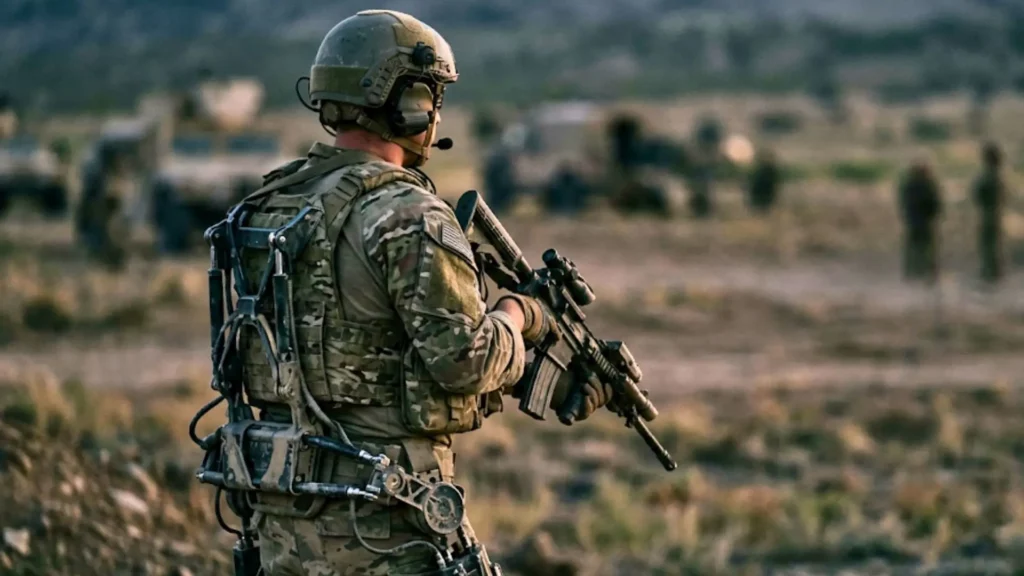
Armies around the world are transforming their soldiers using cutting-edge technologies. Exoskeletons, augmented reality, and brain stimulation are redefining the landscape of modern combat. Behind the promises of enhanced performance lie significant ethical and security issues.
The Military Exoskeleton Moves from the Lab to the Field: This Device Changes Soldiers’ Operational Lives
A soldier in the field carries up to 40 kg of equipment. The exoskeleton transfers this weight to the ground through an articulated system, resulting in reduced muscle fatigue and increased endurance. Three French regiments, including the 13th Alpine Chasseur Battalion, have already tested this passive device in the field.
In the United States, the HULC exoskeleton from Lockheed Martin allows the carrying of loads up to 91 kg. However, active versions remain limited by their weight and the reduced battery autonomy. The global market for these devices is estimated to reach 315 million dollars by 2029.
Augmented Reality Revolutionizes Military Training: Soldiers Prepared for Combat Without Leaving Their Base, at a Lower Cost
Specialized helmets enable soldiers to train in fully virtual combat environments. These simulations replicate terrain, weather conditions, and complex tactical scenarios. The U.S. Army will deploy its Synthetic Training Environment to several centers starting in 2026, beginning with Fort Johnson in Louisiana.
This system integrates virtual reality and augmented reality across multiple domains: land, air, sea, and cyber. Geographically dispersed units train together in a networked real-time environment. In 2024, Saab introduced an augmented reality-based simulator that improves learning retention by 35%.
This approach significantly reduces costs related to munitions, fuel, and logistics, while also eliminating hazards linked to live exercises. The global military simulation market was valued at nearly 18.5 billion dollars in 2025, and continues to grow regularly.
Stimulating Soldiers’ Brains to Decide Faster: tDCS Intrigues Armies, But Results Remain Mixed
Transcranial direct current stimulation (tDCS) delivers a mild electrical current through the scalp, targeting specific areas of the brain without any incision. Recent studies conducted on active military personnel show mixed results, with some real improvements and others being insignificant depending on the task.
A review published in 2025 in Frontiers in Human Neuroscience examined works conducted between 2019 and 2024. It noted significant improvements in sustained attention and execution speed. However, certain protocols can degrade working memory, indicating that the effects are difficult to control.
In December 2024, a conference held at the Val-de-Grâce School in Paris highlighted the ethical questions raised by these neurotechnologies. Mental autonomy of soldiers and unassessed long-term risks have prompted experts to call for strict legal regulations before any operational deployment.
Promising Technologies, but an Urgent Ethical Debate: Who Protects the Augmented Soldier from Technological Abuses?
The physical and cognitive enhancement of soldiers raises fundamental questions about their status. Connected neural devices could become targets for cyberattacks. A malicious actor capable of interfering with these systems would pose a direct threat to the safety of combatants and the outcome of operations.
Beyond cybersecurity, manipulating soldiers’ emotions or behaviors through invasive technologies contradicts the principles of humanitarian law. France has opted to limit enhancements to external devices, while other nations move forward without such safeguards, reigniting an international debate on the ethical boundaries to establish.