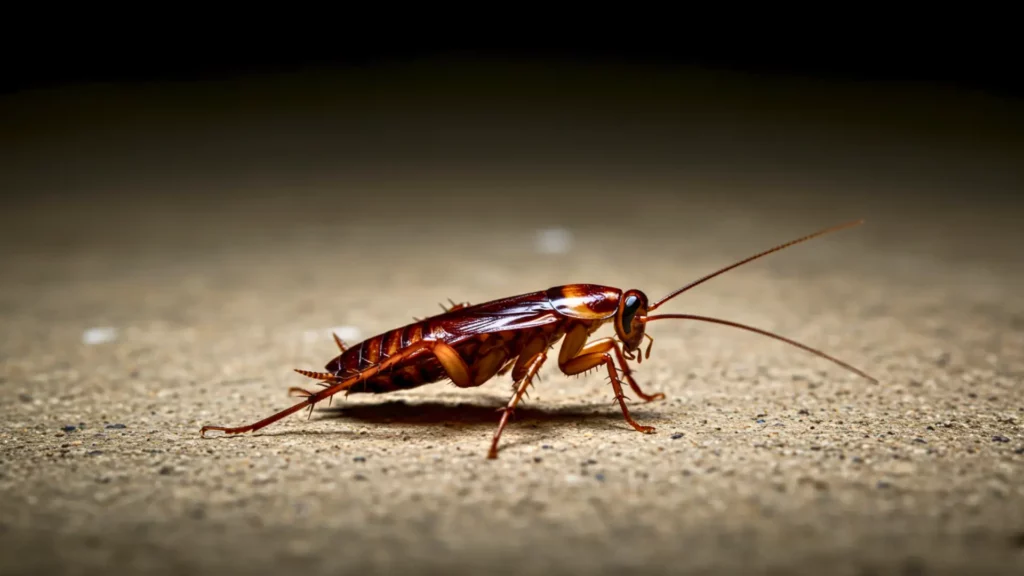
What if the true robots of the future are neither made of steel nor silicone, but are living beings? In a German laboratory, researchers are transforming ordinary cockroaches into intelligent scouts. This unsettling innovation lies at the intersection of biology, AI, and robotics, enabling exploration in areas where our machines still fall short.
Transforming an Ordinary Insect into a Technological Tool: How AI Builds on the Natural Abilities of the Cockroach
The concept may be surprising, but it is based on a simple logic: to harness the living rather than replicate it. For years, robotics has attempted to imitate nature using complex machines. Here, however, the approach is reversed, starting with an organism already optimized by evolution.
The cockroach proves to be an ideal candidate. Quick, discreet, and capable of surviving in extreme environments, it navigates easily through tight spaces. By attaching a micro-electronic module that combines sensors, communication, and embedded computing, the insect becomes a mobile technological tool.
In this setup, artificial intelligence does not take control of the living being but enhances it. Specifically, it interprets the collected data, optimizes trajectories, and coordinates swarm movements. The result is continuous, silent, and effective exploration without motors or detectable mechanical signatures.
Why These Enhanced Cockroaches Can Explore Areas Unreachable by Drones or Conventional Robots
Imagine a building collapsed after an earthquake. In this scenario, drones can’t access the site, wheeled robots get stuck, and humans face enormous risks. This is where these enhanced insects can excel. They crawl, climb, and slip between debris, transmitting valuable real-time data: temperature, gas levels, movement, and sounds.
Additionally, their ordinary appearance is a significant advantage. A cockroach in a basement typically attracts little attention. Silent, without light or alerts, this biological invisibility becomes a strategic asset in surveillance or reconnaissance contexts.
A New Form of Hybrid Robotics Where the Living Becomes a Support, Engine, and Sensor of the Machine
What stands out most is a paradigm shift. We are no longer discussing robots that mimic the living but rather living beings that become technological systems. In this framework, these cockroaches can be guided from a distance or act collectively using algorithms inspired by the behavior of social insects.
We thus enter a realm of robotics that is evolutionary, adaptive, and almost organic. Less rigid, and therefore less predictable, it raises important questions. To what extent can living beings become mere material support for technological ambitions?
Is This Technology a Necessary Marvel or the Start of a Worrying Instrumentalization of Life?
Yes, from a technological standpoint, it is brilliant. Moreover, real civil applications such as rescue, risk prevention, and scientific exploration exist. However, one question remains: have we genuinely contemplated the limits?
Transforming insects into tools raises ethical, political, and philosophical issues. This project is not just about cockroaches and AI; it fundamentally addresses our relationship with living beings. Ultimately, it forces us to envision a future where the boundary between nature and technology becomes blurred, requiring collective decision-making about how far we are willing to go.