


Cloudflare launches EmDash: Why Matt Mullenweg is angry?
Cloudflare is taking on a giant of the web. With EmDash, a new open-source system currently in early access, the company aims to address what it sees as the structural limitations of WordPress—this time placing AI at the core of content management.
An ambitious promise, but it is far from gaining unanimous support.
EmDash: A “spiritual successor” that fails to convince everyone
With EmDash, Cloudflare is clear about its ambitions: to offer a modern alternative to WordPress, reimagined for the era of language models. However, the reaction has been immediate.
Matt Mullenweg, the founder of WordPress, dismissed the idea of a “spiritual successor,” accusing it of being more about promoting Cloudflare’s services than about any genuine philosophical continuity.
This tension sets the stage: EmDash is not just a product; it’s a direct challenge to the WordPress ecosystem.
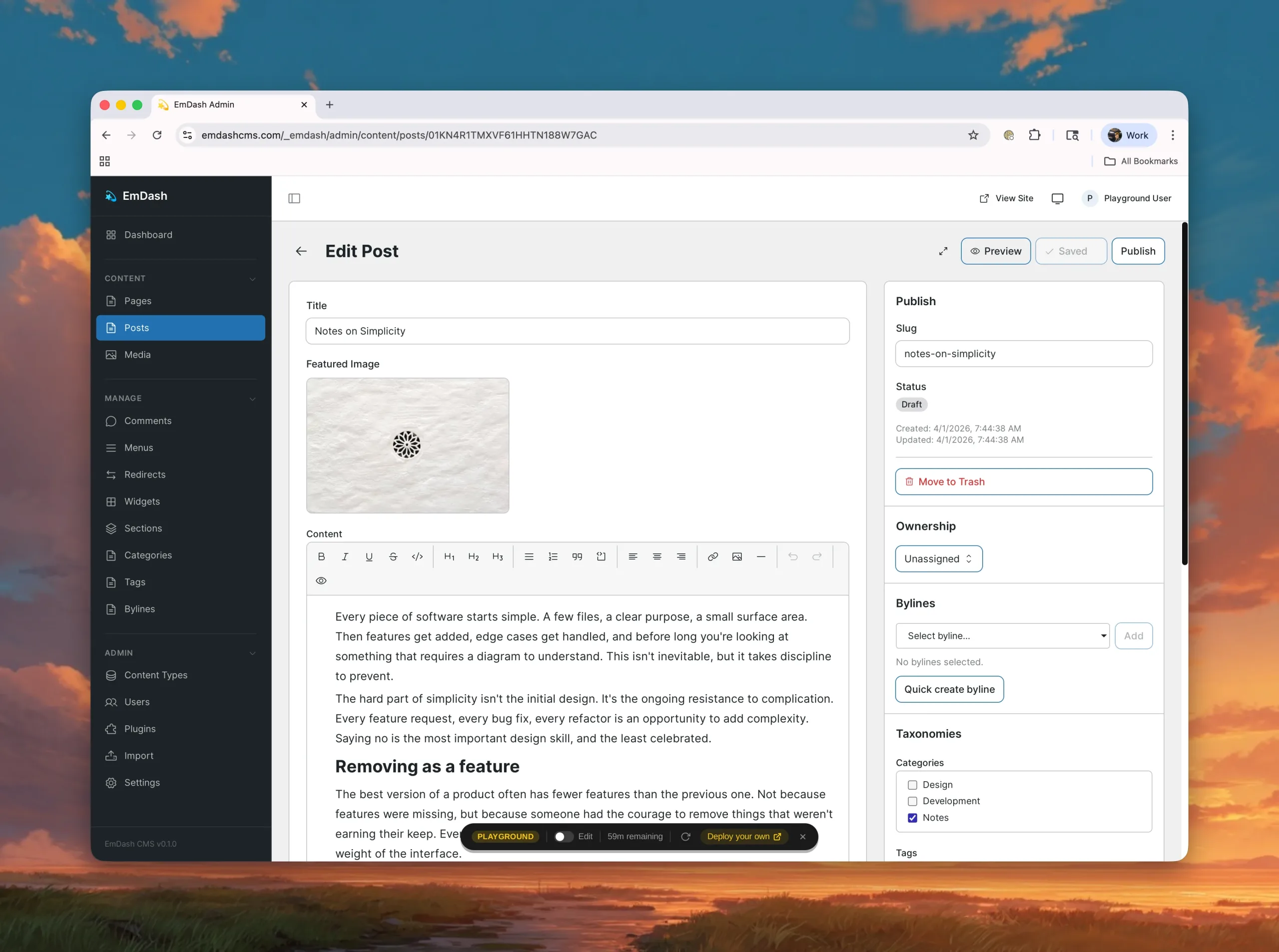
An architecture designed for AI agents
Where EmDash truly stands out is in its design. Cloudflare claims to have built a CMS “from scratch”, with several key technical choices:
- native integration of an MCP (Model Context Protocol) server
- direct compatibility with LLMs
- use of TypeScript to facilitate interaction with AI
- base constructed on Astro, a performance-driven and AI-oriented framework
The result: content is no longer just displayed; it becomes manipulable by intelligent agents.
The real issue: rethinking content for AI
Behind EmDash lies a deeper idea. Today, WordPress largely relies on a logic inherited from the classic web: content is stored in HTML, optimized for display but challenging to manipulate elsewhere.
Developers like Joost de Valk (Yoast) and Hendrik Luehrsen point out a structural limitation: modern content must be designed to flow between APIs, interfaces, AI, and multiple systems.
EmDash approaches the problem differently: structured content, machine-readable and usable by AI. This is an approach that aligns better with current usage (cross-platform, personalization, automation).
Security: a breakthrough or a marketing argument?
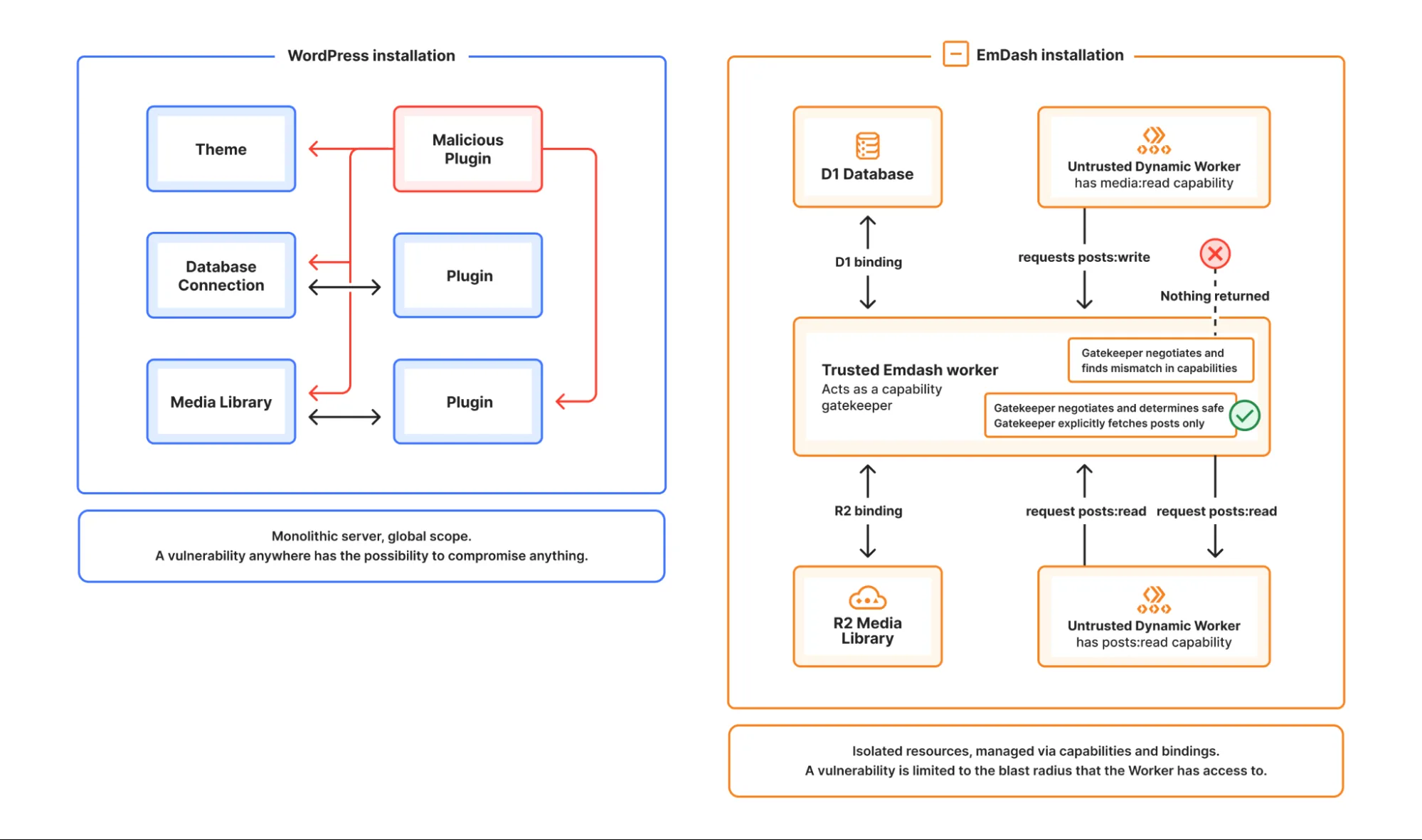
Cloudflare also emphasizes a sensitive point: security. According to the company, WordPress plugins—often written in PHP—have too broad access to the system. EmDash offers an alternative with Dynamic Workers, isolating code execution. The goal: prevent a plugin from compromising the entire site.
Some WordPress developers argue that vulnerabilities are often fixed quickly, that the risks are sometimes exaggerated, and that the “crisis” narrative is primarily used to position EmDash favorably.
The debate is revealing: security has become a competitive argument as much as a technical challenge.
A rapid adoption… but lingering doubts
On the ground, EmDash is already impressing with its speed. Brian Coords (Automattic) notes that one can go from zero to a functional site in record time. However, he also describes it as a “vibe-coded” product—appealing, but still immature in its depth.
Another critical point: the reliance on the Cloudflare ecosystem. Unlike WordPress, which benefits from a massive community, decades of documentation, and a universal ecosystem, EmDash could trap users within a more closed infrastructure, offering few guarantees of portability.
WordPress is already reacting
The impact of EmDash is immediate. Barely launched, the project is prompting Automattic to adjust its roadmap. The launch of WordPress 7.0 has been postponed to include an AI client, a dedicated API for models, and real-time collaborative work. In other words: WordPress isn’t denying the issue—it’s accelerating to address it.
Cloudflare won’t dethrone WordPress overnight. But that may not be the objective. EmDash serves more as a revelation of the limitations of historical architecture, the lag in AI integration, and the need to rethink content.
In this context, two scenarios emerge:
- either EmDash builds a new ecosystem
- or it forces WordPress to evolve faster
In both cases, the web benefits. What is at play here is broader than a duel between platforms. It is a transition from the editorial web to the programmable web, from static content to intelligent content, and from the user to the agent.
And in this transition, the CMS becomes an interface for AI, not just for humans.



