

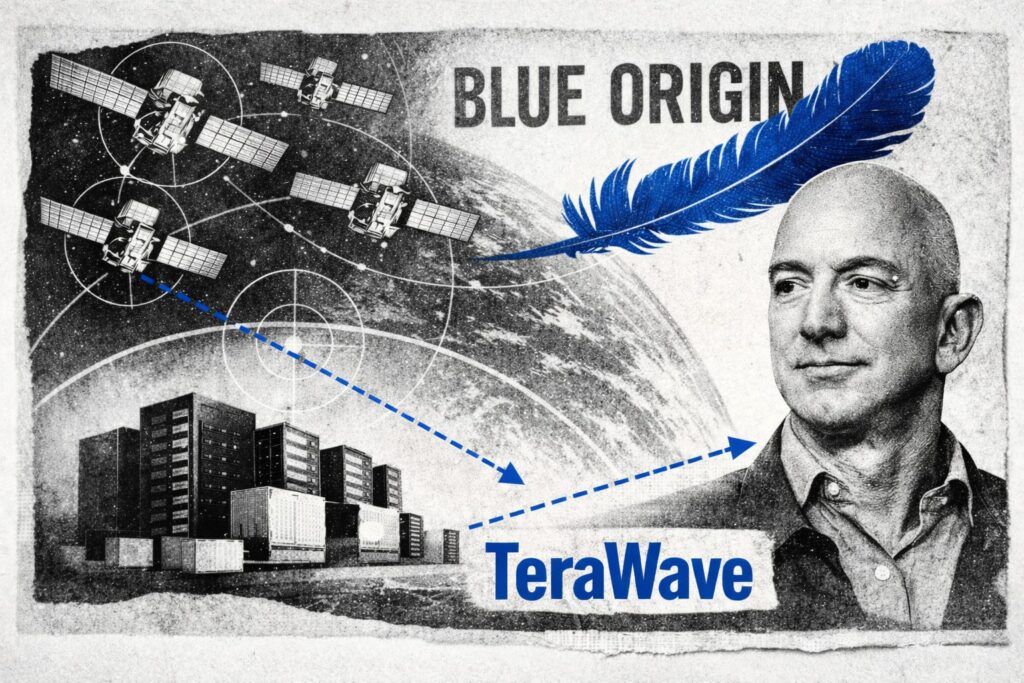
Blue Origin Unveils TeraWave: A Game-Changer in Global Satellite Connectivity
Blue Origin, Jeff Bezos’ space venture, has announced the launch of TeraWave, an ambitious satellite constellation designed to deliver ultra-high-speed global connectivity—boasting speeds of up to 6 terabits per second. Targeting organizations with critical infrastructure, large data center operators, and government institutions, TeraWave aims to reshape the satellite telecommunications market by addressing specific business needs, diverging from the mass-market approach favored by established industry players. The deployment is slated to commence in late 2027.
TeraWave emerges amidst a significant transformation in connectivity infrastructure. In recent years, the rise of low Earth orbit (LEO) satellite constellations has paved the way for universal connectivity, driven by operators like SpaceX (Starlink) and Amazon (Project Kuiper). Blue Origin is taking a different route, emphasizing technical excellence and market segmentation. The company plans to focus on tens of thousands of professional users worldwide, characterized by extreme demands for reliability, speed, and security—requirements that consumer-grade solutions often fail to meet.
The TeraWave architecture consists of a dual constellation that combines over 5,000 satellites in low Earth orbit and around 100 medium Earth orbit (MEO) relays. The MEO satellites will utilize inter-satellite optical links, ensuring service availability, redundancy, and continuity, even during major disruptions to terrestrial and submarine networks. This optical connectivity promises unprecedented aggregated throughput while reducing latency for international traffic, addressing critical issues related to sensitive data management, data center interconnectivity, global synchronization, and crucial relay services for international supply chains.
Orbital Hybridization, Optical Links, and User Segmentation
Blue Origin’s technical strategy focuses on orbital hybridization: LEO provides mass coverage for sparse or isolated regions, while MEO achieves record-breaking speeds and ensures the resilience of large infrastructure. The Q/V bands used in LEO can deliver up to 144 Gbps per beam, while MEO optical links can exceed terabit speeds. This strategy aims to complement existing fiber networks and terrestrial infrastructures, enhancing their reliability and offering continuity solutions during outages, disruptions, or exceptional overloads.
By limiting TeraWave access to institutional and industrial customers, Blue Origin also seeks to meet demands for customization, advanced integration, and regulatory compliance—criteria often overlooked by mass-market solutions. This strategic differentiation positions the operator in the niche of critical connectivity, where organizations prioritize performance predictability, secure data flows, and tailored service agreements. This segment, less vulnerable to price wars, is projected to capture a growing share of the satellite market’s value over the next five years, according to industry studies.
A New Geopolitical Landscape for Digital Infrastructure
The launch of TeraWave comes at a time of heightened tension in the geopolitics of communication networks. Recent attacks on submarine cables, the risks of breakage on certain continental backbones, and escalating hybrid threats are prompting both public and private entities to consider diversifying their interconnection methods. In this context, satellite networks present a strategic solution, reducing reliance on vulnerable choke points, enhancing the resilience of distributed architectures, and creating new avenues for digital autonomy.
Blue Origin’s approach aligns with the vertical integration trend in the market: the operator controls the entire supply chain, from satellite development to launch capabilities, terminal provision, and managed services. This industrial integration, bolstered by the capabilities of the New Glenn rocket, seeks to ensure the sovereignty of the solution while reassuring clients concerned with compliance, extraterritoriality, and supply chain security. The ecosystem philosophy is also evident in the announced openness to technology partners and integrators who can enrich the offering with customizable solutions for integration, monitoring, or encryption.
An Industrial Challenge Ahead
The successful rollout of TeraWave hinges on Blue Origin’s ability to scale its industrial capacities. The timeline forecasts the start of launches in late 2027, with a gradual activation across various orbits. Identified challenges include ensuring reliability of long-distance optical links, the industrialization of user terminals, and aligning technical standards with major operators and cloud service providers. The project’s success will also depend on Blue Origin’s capability to secure contracts with pilot clients in sectors such as energy, defense, finance, and critical infrastructure.
More broadly, TeraWave raises questions about the future of the satellite telecommunications market. The previously dominant model of universal connectivity is ceding ground to segmented and hybrid strategies. Value is shifting towards data-intensive business applications and continuity assurance. The intersections of AI, distributed computing, and orbital optical networks suggest the emergence of a new tier of digital infrastructure—one that is more resilient, agile, and potentially less susceptible to geopolitical bottlenecks.
A New Variable in Connectivity Strategies
The introduction of TeraWave offers companies a new lever to adjust their connectivity strategies. Anticipated benefits range from securing cross-border data flows to implementing business continuity plans that account for total terrestrial fiber outages, as well as developing distributed edge computing services in remote areas. For IT departments and security leaders, this evolution represents an additional tool to enhance availability, mitigate outage risks, and better manage interconnection costs amid exponentially growing bandwidth demands.
In the medium term, TeraWave’s success could spark a reconfiguration of industrial partnerships, with traditional operators seeking to integrate these satellite solutions into their portfolios, and user companies demanding better integration between satellite layers and cloud or edge platforms. This trend, already evident among some European and North American players, signals a paradigm shift: connectivity is no longer a mere access service but a strategic component of organizational information management and operational sovereignty.



