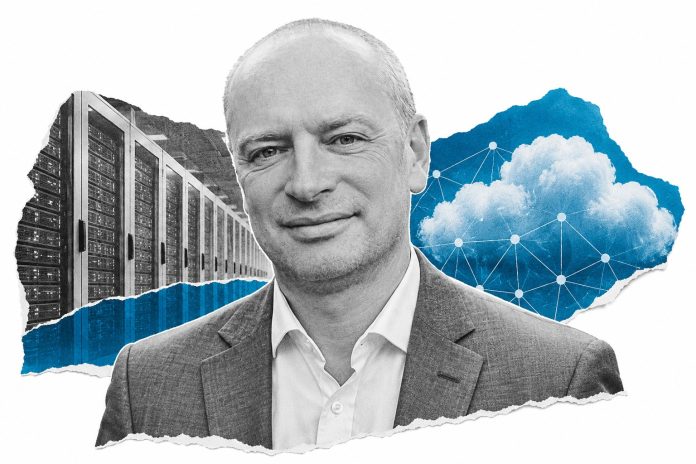
Arnaud Franquinet Takes the Helm at Gandi as Domain Registration Faces New Challenges
Since 2023, Arnaud Franquinet has been at the forefront of Gandi, a French domain registration company that operates under the European group Your.Online. In his analysis, Franquinet posits that artificial intelligence (AI) will transform domain names into invisible entities without rendering them obsolete. He anticipates that conversational assistants will replace traditional registrars as the face of domain transactions, while the brand domain (.brand) remains an overlooked asset for French companies.
Understanding Domain Registrars: Beyond Just Selling Names
Established 25 years ago, Gandi is one of the first French registrars accredited by ICANN, the organization responsible for coordinating domain names. A registrar acts like a notary, connecting users to domain registries and facilitating the annual lease of domain names. Behind each domain name lies a DNS—the Domain Name System—which Gandi enhances with its own Anycast DNS network, ranking it among the top 10 globally.
The Impact of AI and Automation on Domain Registration
Will AI and high-speed transaction automation affect the registrar business? Franquinet answers with a nuanced ‘yes and no.’ It’s not AI itself that disrupts the industry, but how it is utilized, especially with the advent of prompts. As we interact with the internet more conversationally, Franquinet believes that Google, as we knew it, will fade away within five to six years. The rising popularity of prompts is reshaping high-level internet activities. Companies selling web hosting and email services face potential disruption from AI; however, the fundamental infrastructure comprising DNS and domain names remains intact. Interestingly, while domains once grew at about 2% annually, projections for 2026 suggest that growth could spike to around 8% due to AI simplifying the website creation process for many users.
Do Domain Names Still Matter in an AI-Driven Future?
Domain names were designed for human interaction because they’re easier to remember than strings of numbers. If consumers begin relying on agents to make purchases—like buying from Nike—traditional domains like nike.com could become irrelevant. The agent would access the corresponding IP address instead, bypassing the domain entirely. Nonetheless, the underlying infrastructure reliant on domain names and DNS resolution will persist. While the visibility of domain names might diminish, their foundational role will endure.
The Prospects of a ‘Headless’ Internet
The future also envisions a so-called “headless” internet, where AI directly interacts with APIs or servers to obtain necessary information. What implications does this hold for registrars when language models take orders instead of clients? Franquinet states that the front end will operate externally and customer interactions may evolve into dialogues like “add a domain name” or “create a site.” Gandi plans to develop its own AI, leveraging their expertise to engage collaboratively with users’ conversational AIs. As LLMs (large language models) simplify access to numerous resources, a growing number of users will possess less technical know-how. It becomes crucial for Gandi to facilitate dialogues with an expert AI that can guide users in navigating basic inquiries.
Rethinking the Registrar’s Business Model
Will this shift toward external interfaces alter a registrar’s economic model? On a foundational level, Franquinet insists that nothing changes. However, it will highlight the true expertise of registrars, allowing for a clearer distinction between those who merely provide interfaces and those with deep industry knowledge. As the business model shifts from product sales to service-related subscriptions, customers might expect a higher level of service without needing to dissect individual products.
Data Sovereignty and Client Privacy
An emerging challenge is the sovereignty of user data. Gandi’s core principle is to ensure that data pertaining to domains, websites, and emails remains securely within their control. They emphasize that they do not monetize user data. The technical challenge lies in interacting with frameworks potentially prone to external data exploitation while maintaining robust data sovereignty. A key focus will be substantial investment in Gandi’s AI and computational capabilities to ensure a level of independence that retains their expertise without compromising user data.
Staying Relevant in a Changing Landscape
In light of potential changes, how can Gandi maintain its relevance to agents who are not obliged to utilize their services? Franquinet anticipates increased consolidation among registrars due to rising regulatory pressures, which make compliance tougher for smaller entities. LLMs will further accelerate this trend as capability in DNS resolution and infrastructure quality will outweigh marketing considerations. Gandi currently resolves approximately 2.5 million domain names with one of the lowest abuse rates globally, demonstrating its strong technological backbone.
Adapting to Generative AI SEO Strategies
Will businesses need to adjust their online presence amid the emerging landscape of generative AI SEO (GEO) that extends traditional SEO? According to Franquinet, AI lacks true intelligence; it operates purely as a probabilistic heuristic model reflective of its training data. As geopolitical forces inundate AI with biased information, similar tactics may emerge concerning brand identities. The key will be to establish an aggressive GEO strategy that breaks through into various LLMs, focusing less on artificial marketing and more on authentic representation. He notes France is lagging in this area, emphasizing that it’s not just a technical issue but a strategic reassessment of how to position brands in the evolving digital world.
Advice for CIOs and Data Security Officers
When addressing an audience of Chief Information Officers (CIOs), security officers, and data directors in France, Franquinet’s advice is straightforward: “You’ve missed the boat on .brand domains.” A .brand domain allows companies to own the extension itself, providing enhanced security as they own their namespace. For instance, rather than using nike.com, a company could establish a .nike domain—ensuring that no other entities can impersonate them. He highlights the accessibility of this investment, suggesting that for medium-sized enterprises, a €300,000 investment could yield significant returns in brand protection.
Understanding Investment Accessibility for Smaller Businesses
While the €300,000 cost of a .brand domain might seem out of reach for smaller businesses, Franquinet argues that this applies more to medium enterprises and above. He contends that the investment pales in comparison to the security and authenticity benefits it provides, allowing companies to lock down their brand and maintain exclusive use of their domain.