

Apple, Google and Xiaomi prepare for 50W Qi wireless charging
The next major evolution in wireless charging may come from a collaboration among key players in the industry. According to multiple reports from China, Apple, Google, Xiaomi, and other manufacturers recently participated in a meeting of the Wireless Power Consortium (WPC) focused on the future standard of 50W Qi charging.
The goal is to develop a new generation of wireless charging that is faster, more efficient, and compatible across different brands.
A strategic meeting on the future Qi standard
The gathering took place in Beijing during a Qi Off-cycle Meeting, a technical event organized by the Wireless Power Consortium separate from its usual schedule. This was the first such meeting held in the Chinese capital.
Over four days, the participants worked on various aspects of the upcoming standard, including the validation of technical specifications, initial prototype testing, and compatibility between devices from different manufacturers.
This marks a crucial phase in the development of the future Qi standard.
Major manufacturers were present
The Wireless Power Consortium is the body responsible for setting the Qi wireless charging standards utilized today by the majority of smartphones, earbuds, and compatible accessories.
The consortium comprises over 300 companies and oversees more than 13,000 Qi-certified products.
During this meeting, several big names in the industry were represented, including Apple, Google, Xiaomi, Huawei, Honor, OPPO, vivo, Anker, Philips, NXP, and Renesas. The simultaneous presence of these companies underscores the importance placed on the development of the upcoming standard.
Toward a universal 50W wireless charging standard
The future Qi 50W standard naturally aims to increase charging power. However, the primary goal remains to provide a universal solution that can work effectively with devices from different brands.
Currently, several manufacturers already offer wireless charging that exceeds 50W.
For instance:
- OnePlus markets its AirVOOC technology at 50W
- OPPO also offers AirVOOC charging at 50W
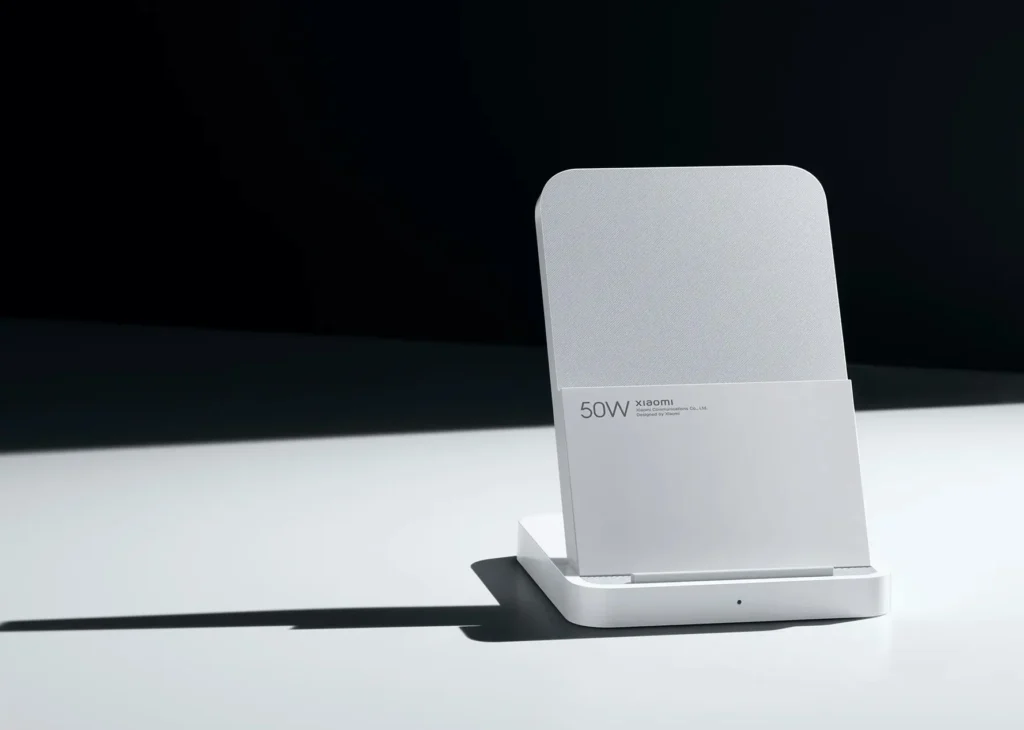
- Xiaomi already sells multiple smartphones compatible with 50W wireless charging and has even showcased prototypes exceeding 80W
The challenge is that these technologies remain proprietary. To achieve optimal performance, it’s typically necessary to use a charger and accessories from the same brand.
The future Qi 50W standard aims to eliminate this constraint.
Xiaomi seeks to influence the future norm
During this meeting, Xiaomi also presented its own charging architecture. The manufacturer advocates an approach based on low inductance and reduced voltage to boost energy efficiency.
According to Xiaomi, this technology would help minimize energy losses, lower heating during charging, enhance overall efficiency, and facilitate the design of thinner smartphones.
However, it remains to be seen whether this architecture will be adopted in the final version of the standard.
A standard that won’t arrive soon
The development of the Qi 50W standard is still in its early stages. According to available information, the final version of the standard is not expected to be completed until 2028. Meanwhile, manufacturers will continue testing to ensure a high level of safety, reliability, and compatibility among the many devices that will adopt this technology.
A development more significant than just power increase
While 50W wireless charging is already a reality for some manufacturers, the upcoming Qi standard could have a far more significant impact. The main benefit lies not just in increased power but in the ability to use a single charger with smartphones from different brands without sacrificing performance.
For users, this would represent a major advancement in terms of simplicity and interoperability while reducing reliance on proprietary accessories.
If Apple, Google, Xiaomi, and other members of the Wireless Power Consortium can agree on a common specification, wireless charging could finally achieve the same universality as wired charging via USB-C, while significantly increasing in speed.



