

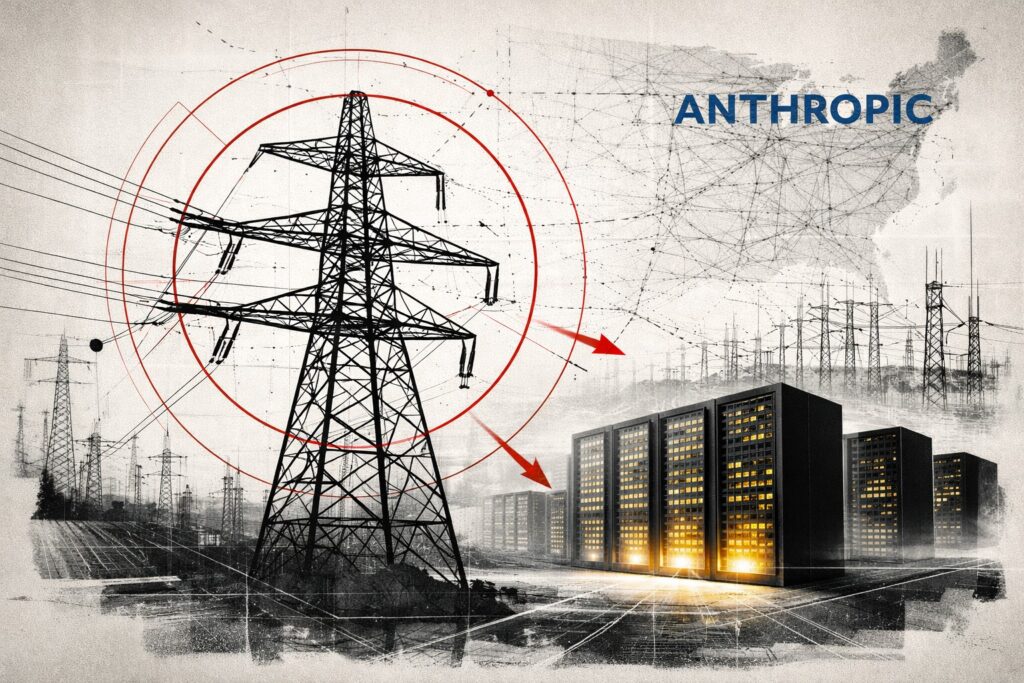
Anthropic Pledges to Absorb Electricity Price Hikes to Shield Consumers
In a significant move, Anthropic has announced that it will absorb the rising electricity costs linked to its data centers, thereby preventing any increased charges from impacting residential bills. The company stated that it will finance the necessary upgrades to local electricity networks required for its operations while also addressing the potential effects of its energy demand on residential rates. This comes amidst a growing demand for electricity in the U.S., driven by a surge in artificial intelligence usage, which now commands power levels in the tens of gigawatts across the country.
According to forecasts from the U.S. Energy Information Administration (EIA), electricity consumption in the United States is expected to reach record levels, surpassing 4.268 trillion kilowatt-hours (kWh) in 2026 and 4.372 trillion kWh in 2027. The increase is fueled by a rise in residential, commercial, and industrial electricity use, and particularly the rapid expansion of data centers dedicated to artificial intelligence.
In a blog post dated February 11, 2026, Anthropic acknowledged that the deployment of AI-focused data centers demands substantial quantities of electricity and that this expansion could place pressure on local networks as well as electricity prices. The company emphasized that the growth of AI infrastructure is occurring at a scale of “tens of gigawatts” in the North American market. For context, 10 gigawatts is equivalent to the installed power of about ten conventional nuclear reactors.
Funding Network Upgrades by the Operator
Anthropic has committed to “covering any increase in electricity costs attributable to its operations,” representing a clear commitment to internalize the pricing effects of its energy needs. This announcement comes at a time when various public utility commissions across the U.S. are scrutinizing the impact of large data centers on rising residential rates. For businesses, this shift signals that the energy costs associated with AI workloads are becoming a key factor in site selection negotiations and power purchase agreements.
The company stated that it would pay “the full costs of the necessary network upgrades to connect its data centers.” These upgrades encompass enhancing high-voltage lines, installing additional transformers, and expanding substations. Such investments can amount to hundreds of millions of dollars, depending on the distance to the grid and the required power. By financing these directly, Anthropic prevents these costs from being distributed across regulated tariffs borne by households.
In the American model, network upgrades are based on the principle of “cost recovery,” as authorized by state public utility commissions. When a network operator invests in new lines, substations, or capacity enhancements, these expenditures are integrated into a regulated asset base, amortized over several decades, and recouped through electricity bills from all users, both residential and industrial.
Supporting Data Center Growth
Even if a project is initiated by a specific client—such as a large data center—a significant portion of the costs can be socialized if the infrastructure is deemed beneficial to the system at large. This mechanism raises concerns among U.S. regulators. The emergence of concentrated electric load demands, sometimes exceeding hundreds of megawatts per site, necessitates heavy investments, which could ultimately be passed on to the community.
Regions with a high concentration of digital infrastructure, such as Northern Virginia and Texas, have already witnessed this phenomenon. Network operators have committed billions of dollars to upgrade infrastructures to support data center growth, and these costs have been incorporated into the rate bases approved by regulators. The ongoing debate centers on whether to continue socializing these costs or require new large consumers to directly assume the necessary infrastructure expenses.
Anthropic’s announcement signals a departure from this traditional model, altering the risk structure for communities and network operators. When interconnection costs are socialized, they are amortized across all users. By internalizing these costs, the data center operator shifts what could be a public burden into a private investment. This raises the question: does a provider’s ability to finance its connection become a differentiating factor alongside latency and power availability? Only time will tell.
Investing in New Clean Energy Production Capacity
Anthropic further stated its intention to “bring online new clean energy capacity” to meet its demand rather than relying on existing resources. The developer behind Claude is adopting a “beneficiary pays” model, diverging from traditional cost socialization logic. This approach is crucial because using already-installed capacity could exacerbate scarcity in the wholesale market and contribute to price increases during peak times. Adding new capacity—whether from solar, wind, or other sources—can boost overall supply and mitigate pressure on residential rates.
When new capacity is not immediately available, the company announced it would work with network operators and independent experts to “evaluate and cover” the impact of its demand on prices. This reliance on external evaluation introduces an economic traceability mechanism. For companies running critical loads, this implies that future hosting contracts may include clauses addressing price impacts and energy transparency.
Load Reduction and Optimization During Peak Periods
Anthropic also highlighted investments in “load reduction” systems designed to ease network pressure during high consumption periods. Data centers can adjust certain non-essential loads, delay processes, or optimize task orchestration to minimize power draw at specific times. This technical capability relies on software architectures capable of scheduling loads based on network signals.
For client businesses, this kind of system necessitates adjustments in application architectures. Model training loads or massive analytical processing tasks might be scheduled outside peak periods to reduce energy costs. Consequently, managing electricity consumption becomes an optimization variable akin to that of hardware accelerator costs or network bandwidth, directly impacting the total cost of ownership for AI environments.
Anthropic’s commitment addresses a rising concern among local authorities and users while also securing its supply chain. Connection timelines in the U.S. already exceed five to seven years in congested areas due to backlogs in interconnection studies and transportation network saturation. By proposing to directly finance upgrades, Anthropic accelerates its projects, gaining operational priority. Internalizing costs thus transforms a regulatory risk into a manageable investment expense.



