

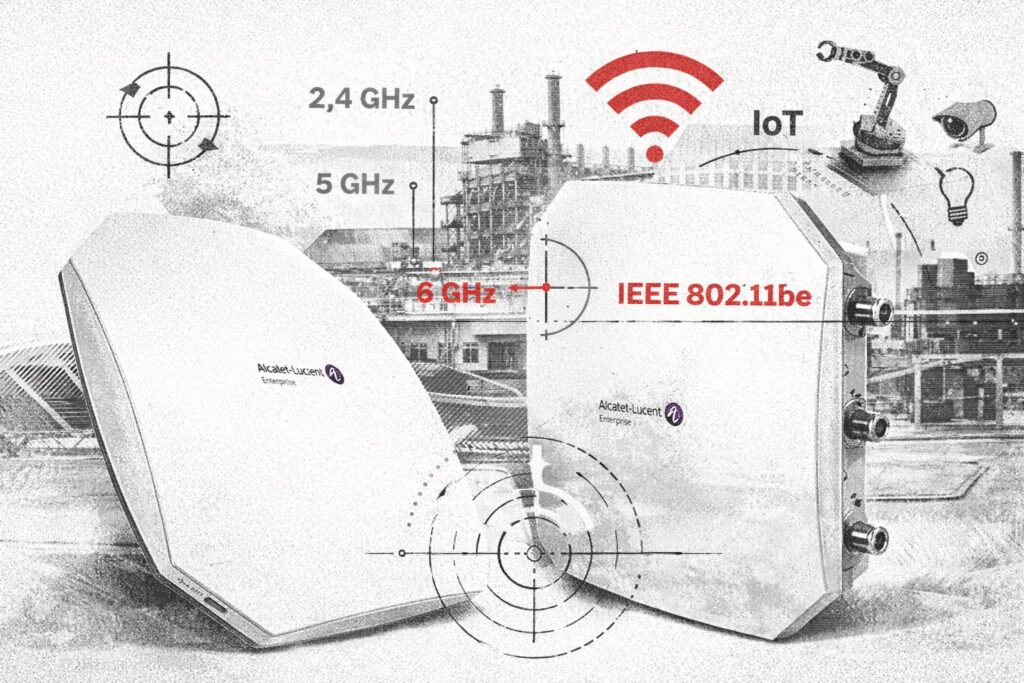
Alcatel-Lucent Enterprise (ALE) has expanded its Wi-Fi 7 portfolio with the introduction of two new access point lines: the AP1501, an entry-level indoor option, and the outdoor AP1561 and AP1570 series, both IP67 certified and available this month. This extension brings the OmniAccess Stellar range to five models, catering to various enterprise deployment environments, from distributed sites to rugged industrial campuses.
These announcements respond to a pressing operational challenge: the increasing demand for wireless usage, fueled by IoT, video collaboration, real-time applications, and workforce mobility, is placing significant strain on legacy network infrastructures. The IEEE 802.11be standard, commonly referred to as Wi-Fi 7, addresses this demand through three key mechanisms: simultaneous utilization of 2.4 GHz, 5 GHz, and 6 GHz bands, a theoretical increase in maximum throughput, and reduced latency compared to Wi-Fi 6E. ALE has structured its offerings around these parameters, clearly differentiating use cases for low-density indoor, medium-density indoor, and industrial outdoor environments.
A distributed control architecture serves as the foundation for the entire range. By eliminating the need for a centralized controller, ALE significantly lowers the total cost of ownership—reducing dedicated orchestration hardware, minimizing single points of failure, and simplifying administration for multi-site organizations. Centralized management is provided through OmniVista, an AI-driven platform available on-premises or in the cloud, which simultaneously manages OmniAccess Stellar access points and OmniSwitch switches.
### Wi-Fi 7 Tri-Band for Branches and Retail Locations
The OmniAccess Stellar AP1501 targets medium-density environments such as branches, retail locations, small campuses, and distributed sites. Compliant with IEEE 802.11be, it leverages all three available bands—2.4 GHz, 5 GHz, and 6 GHz— to optimize spectrum usage and deliver higher speeds than Wi-Fi 6E, especially under mixed loads of IoT and collaboration applications. Its multigigabit 2.5 GbE port with PoE ensures that wired connections do not limit wireless performance, a common bottleneck when upgrading to Wi-Fi 7 on existing Gigabit Ethernet infrastructures.
The AP1501’s pricing aims to address an identified adoption barrier by ALE: perceived costs and complexity often hinder organizations of medium size from transitioning to Wi-Fi 7, even as they continue to rely on Wi-Fi 6 or 6E. Laurent Bouchoucha, VP of Business Development at ALE, emphasizes that “its adoption should not be impeded by cost or complexity concerns.” The AP1501 can be deployed in standalone mode or integrated into a broader OmniAccess Stellar WLAN solution, preserving the architectural flexibility that IT departments require for future expansions.
In terms of security, the AP1501 features WPA3 encryption and optional MACsec support, a link-layer encryption protocol. MACsec safeguards traffic between the access point and the upstream switch against interception on the wired segment, a relevant attack vector in multi-site environments where network connections often pass through less-controlled technical rooms compared to central data centers.
### IP67 Certified AP1561 and AP1570 Access Points
Launched in December 2025, the OmniAccess Stellar outdoor access points, AP1561 and AP1570, tackle use cases that indoor equipment cannot adequately address, such as campus video surveillance, smart lighting, transport systems, and augmented reality guided tours on industrial or tourist sites. The IP67 certification guarantees complete protection against dust and immersion in water up to one meter for 30 minutes, with a wide temperature range accommodating direct sunlight exposure and cold environments. Built-in surge protection reduces the risk of hardware failure in environments lacking stabilized power.
The AP1561, an entry-level outdoor model, combines three tri-band radios and achieves a maximum throughput of 9.3 Gbps, featuring a multigigabit 2.5 G combo uplink Ethernet port. The AP1570 increases density with five radios: the three Wi-Fi 7 bands, a dedicated scanning radio for continuous spectrum monitoring, and Bluetooth and Zigbee radios to support IoT devices and location services. Its 10 GbE combo uplink port removes bandwidth constraints for high-density or high-consumption deployments, typically seen in transportation environments or university campuses with many connected devices.
The dedicated scanning radio of the AP1570 offers a significant operational advantage for IT security leaders: it allows for continuous spectrum monitoring without disrupting service on data radios, enabling real-time detection of unauthorized access points and interferences while maintaining quality for connected users. This capability is especially crucial in open outdoor environments, where radio spectrum is shared with uncontrolled third-party equipment.
### WPA3 and MACsec Address Wireless Attack Vectors
The entire OmniAccess Stellar Wi-Fi 7 lineup incorporates WPA3 as the default authentication and encryption protocol. Compared to WPA2, WPA3 introduces the SAE (Simultaneous Authentication of Equals) protocol, which replaces the PSK key exchange, eliminating vulnerabilities to offline dictionary attacks. An attacker who has captured authentication traffic cannot defer attempts to guess the key without interacting in real time with the access point. This mechanism substantially reduces the risk of network identifier compromise in outdoor environments, where radio traffic is accessible to any device within range.
MACsec, available as an option across all models, operates on a separate vector: it encrypts traffic on the wired segment between the access point and the switch, independent of radio encryption. This dual-layer—radio encryption via WPA3 and wired encryption via MACsec—protects both physical segments of the wireless transmission chain, providing a relevant level of security for deployments on shared infrastructures or sites with limited access control to technical rooms. The inclusion of MACsec support in entry-level access points like the AP1501 marks a notable advancement, as this feature was formerly reserved for higher-end equipment.
### OmniVista: Management Powered by AI Analytics
ALE’s OmniVista platform provides centralized management and monitoring for the entire range of OmniAccess Stellar access points and OmniSwitches, available on-premises or in the cloud. The integration of AI serves two distinct purposes: automating the onboarding of new devices, users, and IoT objects, and continuously optimizing network performance through advanced analytics. For CIOs managing distributed networks across multiple sites, converging wired and wireless management tools onto a single platform reduces administration console fragmentation and simplifies incident correlation between the two domains.
With five Wi-Fi 7 references now covering entry-level and mid-range indoor, as well as entry-level and mid-range outdoor models, ALE has created a cohesive catalog that allows network architects to plan mixed indoor-outdoor deployments without having to juggle multiple suppliers or management platforms. The IP67 certification of the outdoor models, coupled with the WPA3 and MACsec security foundation shared across the entire range, positions these devices favorably for tenders where industrial robustness and network security traceability are explicit selection criteria.



