

A20 Pro: The iPhone 18 Pro to Feature a 7-Core GPU and Faster Memory
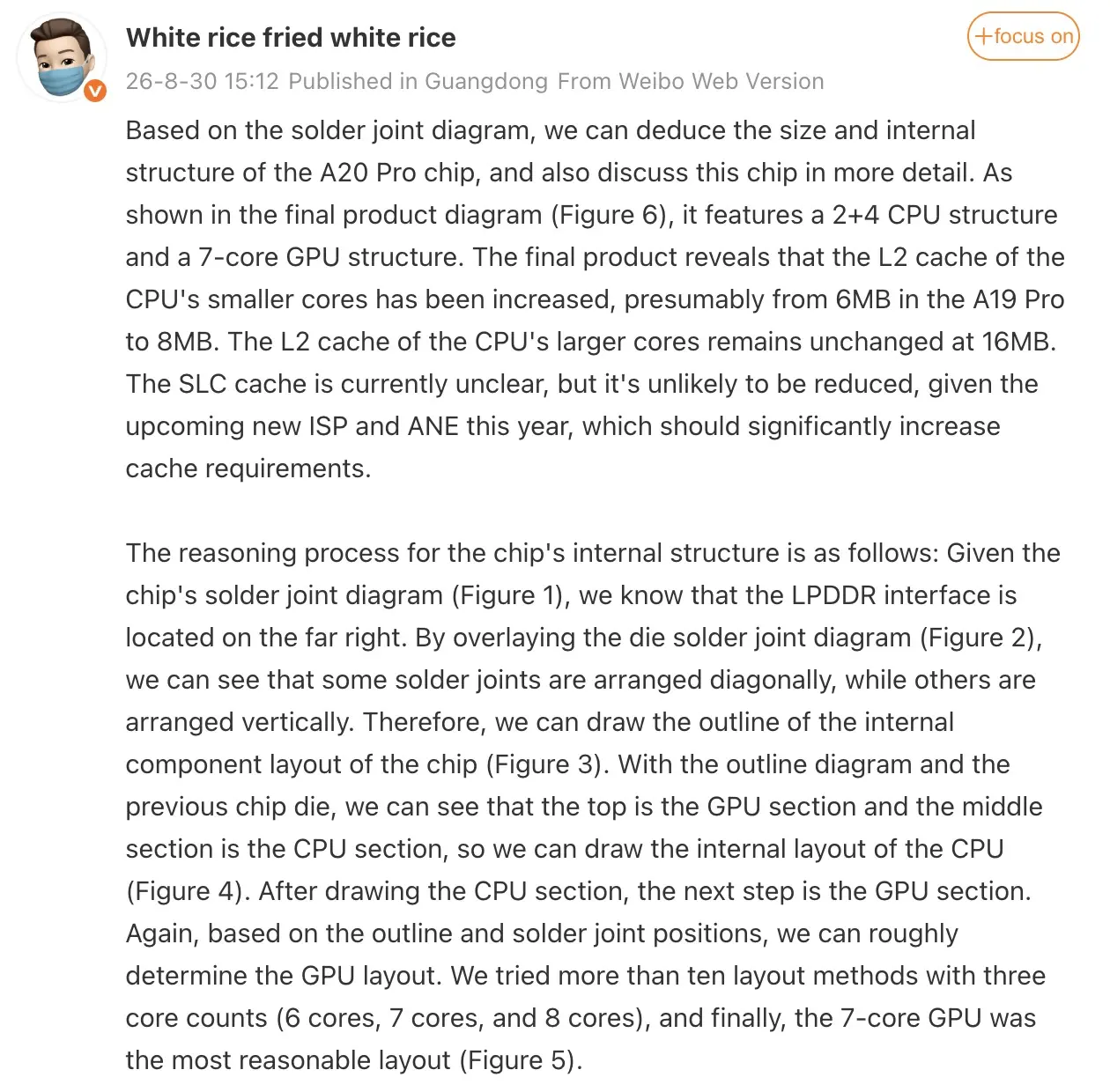
With less than a week until the anticipated unveiling of the iPhone 18 Pro and Apple’s first foldable iPhone, new information has emerged regarding the A20 Pro chip. A reconstruction based on a soldering diagram purportedly related to the component suggests several significant upgrades, including a seven-core GPU, increased cache, and a wider memory interface.
While nothing is officially confirmed, these details should be taken with caution. If this configuration holds true, Apple appears to be gearing up for a chip that is more focused on sustained graphical loads, local AI, and longevity rather than merely achieving impressive benchmark scores.
A CPU Retaining a 2+4 Configuration with More Cache for Efficient Cores
The leak indicates a CPU configuration that still consists of 2 high-performance cores and 4 efficient cores, continuing the architecture Apple has employed in its recent generations.
The main advancement would be the L2 cache for efficient cores, increasing from 6 MB on the A19 Pro to 8 MB on the A20 Pro. The high-performance cores will maintain an L2 cache of 16 MB, while the size of the shared system cache remains unknown.
An increased cache can reduce certain back-and-forth exchanges with the main memory and enhance efficiency when multitasking. While this type of upgrade may be less visible than a frequency increase, it can have a tangible impact on responsiveness and energy consumption.
Apple has long prioritized such gradual architectural optimizations, enabling performance improvements without a significant rise in power consumption.
The GPU Upgrading from 6 to 7 Cores
The most notable evolution pertains to the graphics processing unit. According to this reconstruction, the A20 Pro will feature a 7-core GPU, up from 6 cores on the A19 Pro. This additional core could provide more resources for gaming, video processing, complex graphical effects, or certain GPU-accelerated AI tasks.
However, the core count is only part of the story. The internal architecture, frequencies, cache, and especially memory bandwidth will play a crucial role in the final performance.
It is precisely on this latter point that the A20 Pro could see a significant advancement.
A 96-Bit Memory Interface to Enhance Bandwidth
The chip is expected to adopt a 96-bit memory interface for LPDDR5X, compared to 64 bits in the previous generation. If this information is accurate, Apple would markedly increase the volume of data that can flow between the memory and the processor. This additional bandwidth could be particularly beneficial for the GPU, which heavily relies on the speed at which it can access textures, buffers, and other graphical data.
The impact could also be felt in locally-run AI models, whose performance often hinges on both memory access and raw computing power.
This advancement aligns well with the introduction of a seventh GPU core: enhancing the graphics processor without sufficiently widening memory access could risk creating a bottleneck.
2 nm Fabrication Could Deliver Significant Efficiency Gains
Previous rumors have suggested the A20 Pro will be manufactured using TSMC’s N2 process, marking the first commercially available 2 nm generation from the Taiwanese foundry.
Some leaks claim an up to 18% performance gain and 30% improvement in energy efficiency compared to the A19 Pro. However, these figures remain unconfirmed and will depend significantly on the frequencies, final design, and thermal goals set by Apple. Transitioning to a new fabrication node can allow for more transistors to be placed in the same area while reducing consumption at comparable performance levels.
In smartphones, this second aspect often matters most. A more efficient chip can sustain its performance longer before heating up or throttling its frequencies.
A New Packaging to Bring the Chip and Memory Closer Together
The A20 Pro might also allow Apple to adopt a new packaging approach described in the leaks as a Wafer-Level Multi-Chip Module. The idea would be to integrate the SoC and memory more closely to reduce electrical distances, improve access times, and optimize thermal management.
On paper, this architecture could complement the wider memory interface. Apple is likely seeking to gain both in bandwidth and in the efficiency of exchanges between the processor and the RAM.
This could become particularly important with applications that engage the CPU, GPU, and AI engines simultaneously, especially when the phone runs more models directly on the device.
Once again, we will need to wait for the official technical details to learn the exact nature of this integration.
iPhone 18 Pro, Pro Max, and Possibly the iPhone Ultra
The A20 Pro is expected to logically equip the iPhone 18 Pro and iPhone 18 Pro Max. The first foldable iPhone from Apple, often referred to as the iPhone Ultra in rumors, should also feature the most powerful chip in the lineup if Apple positions it as its premium offering.
This choice would make sense, particularly for a foldable device. The large internal display, multitasking, and use cases more similar to a tablet may require additional graphical resources and memory bandwidth. The thermal challenge, however, will be more complex; a foldable chassis imposes specific internal constraints, with less freedom to distribute components and dissipate heat.
The efficiency of the A20 Pro could therefore be even more crucial in these Pro models.
Qualcomm and Samsung are Already Preparing Their Responses
Apple will certainly not be the only company pushing mobile performance to new heights this year. Qualcomm is expected to unveil its new Snapdragon 8 Elite Gen 6 generation later in September, potentially with a Pro variant aimed at high-end Android smartphones.
Several rumors already suggest significant performance gains for it, while Samsung is also developing its Exynos 2700 for the upcoming Galaxy S27 generation. However, the initial figures circulating are still preliminary and do not allow for strong conclusions. The comparison between the A20 Pro, Snapdragon, and Exynos will be all the more intriguing since the manufacturers are no longer pursuing exactly the same priorities.
Maximum performance remains important, but efficiency, memory, AI accelerators, and stability under sustained load are becoming equally critical.
Apple May Be Primarily Preparing Its iPhones for Longevity
The real appeal of these advancements likely lies not in launching some applications faster today. High-end smartphones are kept for longer durations, and software functions are progressively becoming more demanding. A chip with more graphical headroom, memory, and energy efficiency can better accommodate several years of iOS evolution.
This is particularly true for local AI, where computing and bandwidth needs are advancing rapidly.
A seven-core GPU and a wider memory interface may not serve all users immediately, but they could become increasingly significant in two to three years as embedded models become more intensive and multimodal features become more common.
This is perhaps where the A20 Pro could stand out: not by making the iPhone 18 Pro dramatically faster on day one, but by providing more leeway for the years ahead.
As we approach Apple’s presentation, the final details are still to be confirmed. However, the leaks already outline a chip that seems less focused on achieving occasional records and more on balancing graphical power, bandwidth, and efficiency—exactly the type of evolution that could matter more over time than at launch.



