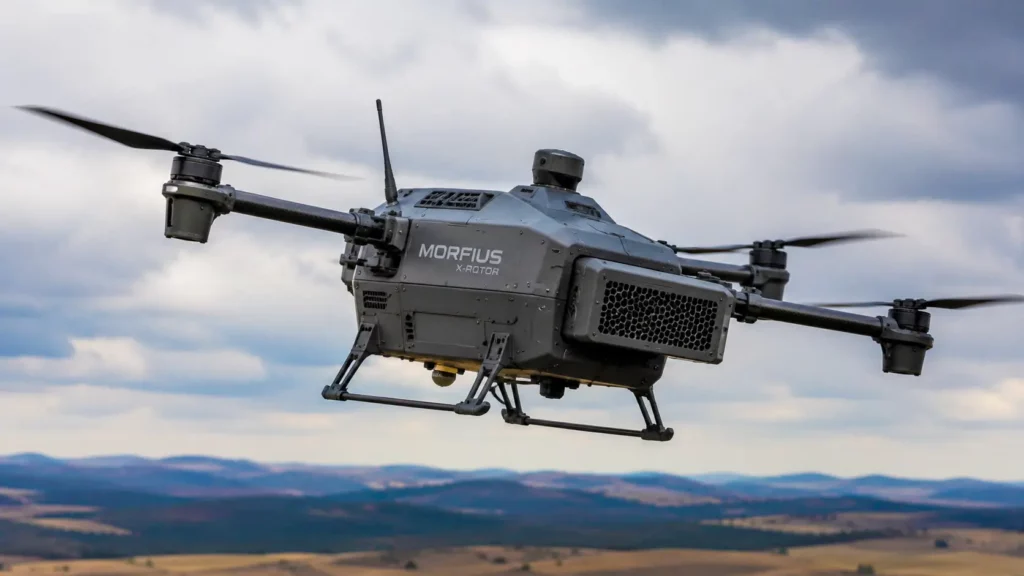
In response to the proliferation of drone swarms in operational theaters, Lockheed Martin counters with the Morfius X-Rotor. This reusable device employs a powerful electromagnetic beam to disable enemy electronics, presenting an economical alternative to traditional interception missiles.
An airborne electromagnetic weapon capable of neutralizing up to fifty devices per flight
Unveiled at the Farnborough Airshow in England, the Morfius X-Rotor breaks away from traditional defense methods. Instead of using kinetic projectiles or expensive missiles, the device disrupts the internal electronics of remote-controlled threats.
The American defense contractor Lockheed Martin claims that its system can handle saturating attacks. By projecting high-power energy, the drone can simultaneously disable multiple targets. This global action capability addresses the massive rise of swarm tactics on the battlefield.
The financial implications are crucial for armed forces. The recurring use of heavy munitions against low-cost micro-drones quickly depletes budgets. The reusability of the Morfius X-Rotor significantly lowers the cost per successful interception.
An accelerated development timeline based on already deployed components
Although the program has not yet reached its final operational stage, Lockheed Martin is rapidly making technical progress. Initial flight tests have validated the overall ergonomics of the platform, its flight stability, and the accuracy of its navigation system.
Simulated engagement tests on real targets followed the flight verifications. This tight schedule is attributed to the maturity of the microwave system, as this electronic neutralization module is derived from solutions already deployed on other platforms since 2017.
A simplified firing architecture that does not rely on heavy radars and precision guidance
The manufacturer keeps several fundamental technical details confidential, including the maximum range of the emitter and the power delivered by the impulse. However, certain operational characteristics have been revealed through specialized press reports.
The manufacturer specifies that the drone operates without the aid of a conventional fire control radar. Similarly, the device does not require millimeter-precise alignment optics. This conceptual choice indicates that the directed energy projection operates within a relatively restricted radius.
By eliminating the need for complex targeting equipment, Lockheed Martin reduces the overall weight of the platform. This material simplification enhances flight agility and lowers the unit manufacturing cost, making the concept viable at scale.
Moving from ground to air: a strategic breakthrough against traditional anti-drone systems
Until now, electromagnetic neutralization has been conducted from the ground using fixed stations or armored vehicles. Projects like the American Leonidas designed by Epirus or the British RFDEW illustrate this first generation of microwave shields.
By embedding this type of equipment directly onto a drone, the Morfius X-Rotor project shifts the conflict into the third dimension. This airborne mobility allows for the projection of electromagnetic threats closer to opposing swarms, well before they reach the zone.