

Synology Expands ActiveProtect Manager 2.0 with Enhanced Backup and Recovery Solutions Across Cloud Platforms
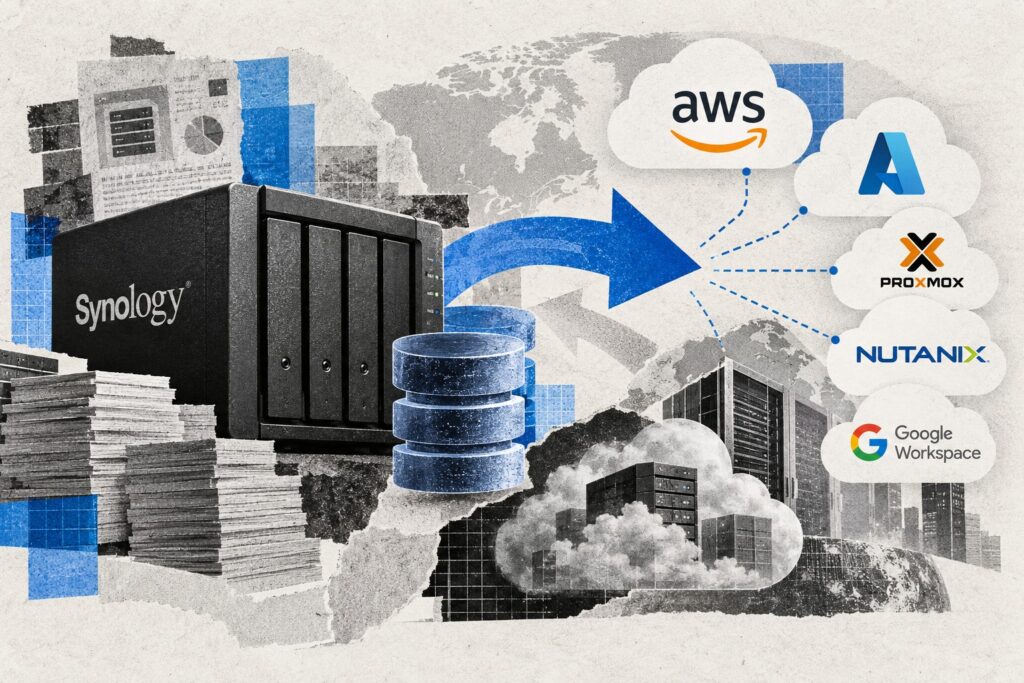
Synology’s ActiveProtect Manager 2.0 is set to revolutionize how businesses manage their data by enabling workload backups in one environment and seamless restores in another. The latest version broadens its support to include Amazon EC2, Azure VM, Proxmox VE, Nutanix AHV, and Google Workspace, while also introducing volume-level storage encryption. This enhancement allows backups stored on Amazon S3 or Azure Blob Storage to be restored directly to a computing instance, eliminating the need for on-site disaster recovery hardware.
Companies that have layered multiple backup tools over years of infrastructure development often find themselves burdened by the complexity when it comes time for restoration. The critical question shifts from “Does the backup exist?” to “Where can the backup be restored, and how quickly?” Synology addresses these challenges by decoupling the backup environment from the restoration environment.
Initially marketed as an out-of-the-box solution, ActiveProtect was geared toward organizations without dedicated data protection teams by combining storage and management software into a single purchase. With the introduction of version 1.2, the platform expanded its capabilities to managed service providers by offering a multi-client management server, thereby enhancing their administered client bases. The new 2.0 version shifts focus to hybrid environments where organizations use on-premises servers, virtual machines from various cloud providers, and office suite applications.
Restoration Beyond Backup Locations
A key feature of APM 2.0 is its cross-platform restoration capability. A workload backed up on one hypervisor can easily be restored to another, facilitating disaster recovery for scenarios where the original environment is unavailable, as well as aiding migration when organizations choose to relocate applications. This functionality integrates two previously separate processes—one often practiced during drills and the other executed under project pressure—into a single seamless mechanism.
The expansion of support also represents a vital commercial and technical choice, as APM 2.0 now protects Amazon EC2, Azure VM, Proxmox VE, Nutanix AHV, and Google Workspace, moving beyond the single focus on on-premises environments and workstations. Additionally, ActiveProtect Vault now accepts a wider range of Synology storage servers, and Azure Blob Storage has joined the list of supported copy and tiering destinations.
This update signals a strategic shift targeting businesses transitioning away from traditional virtualization platforms like VMware, a trend fueled by rising costs over the past two years.
Cloud Recovery Without Backup Sites
Synology is taking a bold step further with the two dominant cloud providers, enabling backups stored on Amazon S3 or Azure Blob Storage to be restored directly to Amazon EC2 or Azure VM instances, bypassing the need for on-site hardware altogether. Organizations that previously maintained secondary sites specifically for backup purposes can now reconsider this expense, pushing it toward computing resources that are activated only during a disaster.
This efficiency is more about minimizing recovery time rather than altering recovery points, as backup frequency remains unchanged. Restoring from object storage to a machine within the same provider’s cloud eliminates lengthy data transfers to an on-site location and back, thereby significantly decreasing recovery times. While Synology touts substantial improvements in recovery times, exact metrics have not been disclosed, leaving it to clients to gauge performance based on their own environments.
However, this relief from needing a secondary site raises critical considerations for organizations subject to sovereignty requirements, as backups stored with a U.S. provider and restored back to the same provider place the entire recovery chain under the Cloud Act jurisdiction. The implications remain similar to those regarding primary storage but arrive at a moment when organizations have less flexibility.
Features of the New Release and Future Prospects
Volume-level software encryption marks another key addition in version 2.0. This feature secures data at rest, ensuring that the theft of a disk or loss of hardware renders both backups and system configurations useless to unauthorized users. This addresses a known vulnerability in many backup systems, where backup copies are often less protected than production data, despite the necessity for detection and restoration to be part of the same security framework.
Anomaly detection is slated for release in APM 2.1, which Synology has announced but without a specified launch date. Each backup version will undergo analysis to detect changes in change rates, file modifications, mass deletions, or abnormal entropy, leading to quarantining of any suspicious copies. Third-party antivirus engines, including Microsoft Defender, Bitdefender, and ESET, will assess backups prior to restoration, with a fallback option restoring the last healthy version if the most recent is compromised.
It’s crucial for decision-makers to differentiate between these capabilities, as a security officer seeking to detect ransomware in their backups won’t necessarily purchase those features today but will opt for the multicloud coverage and cross-restoration capabilities while anticipating future updates. ActiveProtect Manager 2.0 is available at no extra cost for existing DP-series hardware, easing budget concerns for organizations already equipped with these systems.



