

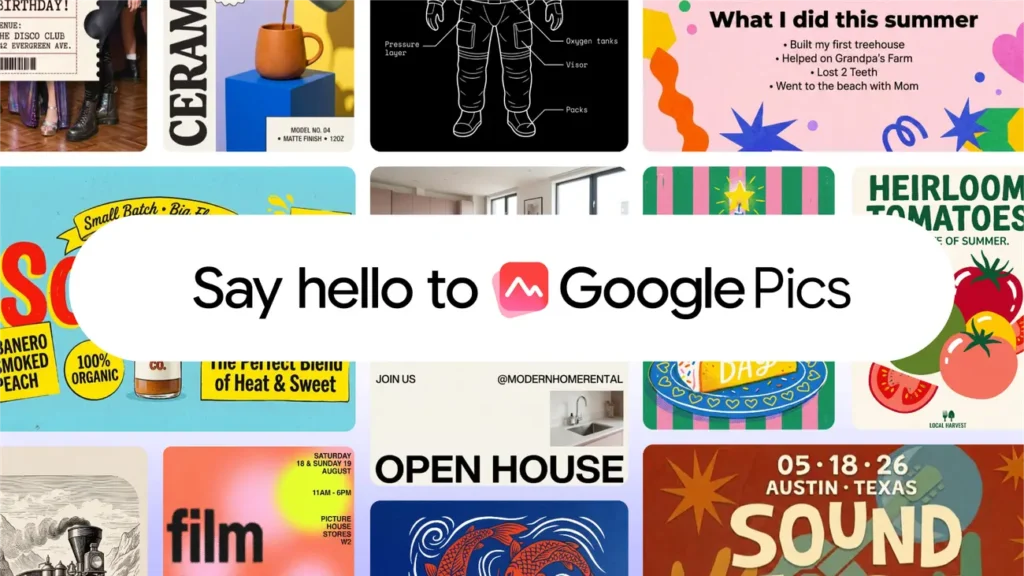
Google Pics aims to compete with Canva and Adobe Express with a visual creation tool entirely centered around AI
Google is venturing into a new domain: graphic creation. With Google Pics, the company is launching an image generation and editing tool integrated into Google Workspace, aimed at both professionals and subscribers of Google AI Pro and Ultra.
The positioning immediately recalls Canva or Adobe Express, but Google is taking a different approach. While these platforms still rely heavily on templates, graphic libraries, and traditional composition tools, Google Pics primarily focuses on AI generation, with Nano Banana as the main engine.
Google Pics Arrives in Workspace
Google plans to deploy Google Pics over the next few weeks to most of its Workspace customers, as well as users subscribed to Google AI Pro or Google AI Ultra. The tool will be directly integrated into the existing company ecosystem, with an initial rollout in Google Docs and Google Slides, followed by an intended expansion into Google Drive.
This integration is strategic. Google is not just aiming to launch a new standalone graphic editor; it wants to embed visual creation directly into the tools that businesses already use daily.
A user will be able to create a graphic for a presentation or document without having to go through an external application, export the file, and then re-import it.
A Tool Designed for Everyday Visual Needs
Google presents Google Pics as a solution meant for relatively common graphic tasks: creating posters, social media posts, illustrations, or other visual materials.
The goal is not necessarily to compete with Photoshop for advanced editing or Illustrator for vector drawing. Instead, Google is targeting the space currently occupied by Canva and Adobe Express, where speed of execution often matters more than technical sophistication.
For a marketing team, a communications manager, or a small business, the concept is simple: describe what you want to achieve, let the AI generate several options, and then adjust the output.
Nano Banana Becomes Google Workspace’s Creative Engine
Google Pics relies on Nano Banana, Google’s image generation model. This integration demonstrates how the company is now seeking to transform its generative models into concrete functions throughout Workspace.
The logic is no longer simply to offer a chatbot capable of producing text or a standalone image. Google aims to connect its models directly to workflows.
In Google Pics, AI is not a secondary tool. It is the starting point for creation. This is precisely what sets the product apart from many traditional graphic editors.
Starting With a Prompt Rather Than a Blank Page
Canva and Adobe Express already offer generative functions, but their interfaces are still largely built around the manipulation of visual elements.
You choose a layout, add text, move a photo, change a color, or adapt an existing template.
Google Pics flips this logic. The user primarily starts by explaining what they want to achieve. The AI then produces a proposal that can be refined. This approach greatly lowers the technical barrier for those who are not proficient with graphic design tools.
However, it also transforms the very notion of creation.
Google Aims Not Just to Simplify Design, but to Automate It
The real challenge for Google Pics is not merely making tools more accessible. The product seeks to automate part of the creative process. Instead of spending minutes selecting a typeface, background, or composition, users can simply request a visual that meets a specific goal.
This promise is appealing for quick professional needs. Creating an internal poster, preparing an illustration for a presentation, or generating several variations of a social media post—all these tasks can be expedited if the AI provides an immediately usable base.
Multiple Generations Can Be Created for the Same Visual
Google Pics also allows users to generate multiple versions of the same request. Users can compare different interpretations and select the one that best fits their needs. This approach is becoming standard in generative tools, but it is particularly relevant in design.
The first proposal is not always the best. Being able to explore multiple visual directions without starting from scratch allows users to transform generation into a selection process rather than just a single outcome.
Editing Is Not Limited to Initial Generation
Google is also adding several tools for directly modifying produced or imported images. Google Pics will be able to isolate certain objects, transform them, alter visual elements, or edit text in an image.
The software will also allow for translating this text. This feature can be particularly useful for companies producing content for multiple markets.
Instead of recreating each linguistic version of a visual manually, Google aims to facilitate quicker content adaptation.
Collaboration Adopts Google Docs’ Codes
Unsurprisingly, Google Pics also includes collaborative editing. Multiple people can work on the same project, closely mirroring the well-known functionalities of Docs or Slides.
This may be one of Google’s most significant advantages over certain competitors. Businesses are already utilizing Workspace for collaboration on documents, presentations, and files.
Adding a native graphic tool allows this logic to persist without changing platforms. Visual creation thus becomes another type of shared document.
Google Directly Targets Canva’s Territory
The connection to Canva is inevitable. Canva has established itself precisely because it simplified graphic creation for non-designers. The platform offers templates, images, fonts, visual elements, and a multitude of tools for quickly producing content for web or print.
Google Pics targets the same audience but with a different entry point: generative AI. This distinction could become significant if users gradually prefer to describe the desired outcome rather than sift through thousands of templates.
However, Canva Has a Creative Community That Google Lacks
The comparison also highlights a major strategic difference. Canva partially relies on an ecosystem of creators who publish templates, illustrations, photos, and other resources on its platform. Some may be compensated when their content is used.
Google Pics does not follow this logic. The product is centered on AI generation, with a model trained on large quantities of visual content. This reduces the direct role of human creators in the production chain.
This aspect may ignite the ongoing debates surrounding compensation, consent, and the use of works in training generative models.
Adobe Express Follows a Different Philosophy
Adobe Express occupies a middle ground. The platform also integrates many AI functions but remains deeply linked to Adobe’s creative ecosystem. Users can start from a design, modify specific elements, import resources, or utilize Firefly tools.
Google Pics appears much more radical in its approach. Creation begins with the generative model. The user’s role is more about guiding, selecting, and correcting rather than fully constructing the visual from scratch.
The Battle Shifts From Design to Intention
This may be the most intriguing transformation. For a long time, creating an image required knowing how to use software. One had to understand layers, shapes, typography, grids, or selection tools.
Platforms like Canva have reduced this complexity through templates. Google Pics aims to go further by eliminating some of this intermediary interface.
The user expresses an intention, and the system attempts to convert it directly into a result. Design becomes less about technical mastery and more about formulation and selection.
This Could Democratize Creation but Also Uniform Results
This simplification has an obvious advantage: much more people can produce decent visuals without specific training. However, it also carries a risk. If millions of users rely on the same generative models, productions could gradually adopt the same codes, compositions, and styles.
Creativity does not disappear, but it may become more homogenous. Generative tools are particularly effective at producing something visually acceptable.
They are less naturally suited for creating a truly original graphic identity.
Designers Won’t Disappear, but Their Role May Evolve
Google Pics primarily targets daily tasks that do not always justify the intervention of a professional designer. This may reduce certain simple requests: internal visuals, quick publications, generic illustrations, or presentations. However, brands seeking to build a strong identity will still require human creative skills.
The value of the designer may gradually shift toward art direction, brand coherence, and the ability to produce distinctive ideas.
In other words, AI automates more execution than creative strategy.
The Integration Into Docs and Slides May Be Google’s Most Powerful Tool
The real advantage of Google Pics might ultimately be its presence in Workspace. A user already preparing a presentation in Slides has no reason to leave their environment if an integrated function can immediately generate an appropriate illustration.
The same logic applies to Docs. This friction reduction is fundamental. Canva and Adobe can offer better specialized tools, but Google has direct access to hundreds of millions of professional users already present in its ecosystem.
Google Seeks to Avoid Application Switching
This strategy is becoming increasingly common in Workspace. Gemini can write in Docs, summarize in Gmail, analyze data in Sheets, and generate content in Slides. Pics now adds a visual layer to this suite.
The user no longer necessarily needs to think about which tool they need. They stay in Workspace and ask the system to produce the result. Google is gradually transforming its office suite into an environment where AI links various types of content. Text, data, presentations, and images thus begin to converge.
Google Pics Could Be Particularly Fearsome in Businesses
The professional market is likely the most interesting for this product. In many businesses, a large portion of visuals does not require exceptional artistic quality. They primarily need to be produced quickly, adhere to a few branding rules, and be clean enough for use in a presentation or internal communication.
Google Pics precisely meets this need. If the product allows a marketing manager or HR to quickly create a visual previously assigned to an agency or a specialized colleague, the time savings could be substantial.
This is precisely the type of scenario where generative tools begin to transform workflows.
The Question of Rights Remains Unavoidable
However, the product arrives in a context where image generation models are still heavily contested. Artists and photographers have questioned for years how their works have been used to train certain AIs.
Google Pics cannot escape this debate. The more the company presents the tool as an alternative to platforms relying on human creators, the more sensitive the issue of training data origin becomes.
Businesses using the service will also have to consider what guarantees they obtain concerning generated content, particularly when it is intended for commercial use.
Brand Consistency Will Be Another Challenge
To appeal to businesses, Google will also need to allow precise control over visual identity. Colors, fonts, logos, styles, and composition rules. An AI that produces attractive visuals but ignores brand codes remains limited in a professional context.
Canva and Adobe have heavily invested in brand kits and tools for teams. Google will need to quickly offer comparable management if it wants to become a genuine production tool and not just an illustration generator integrated into Workspace.
Google Aims to Transform Workspace into a Comprehensive Creative Suite
Ultimately, Google Pics goes beyond merely launching a new application. It reveals a broader ambition: to make Workspace an environment capable of handling almost all content production for a business. Docs for text, Sheets for data, Slides for presentations, Drive for files, and now Pics for visual creation. Gemini serves as a common layer connecting all these tools.
This approach is particularly coherent, but it could also pose a significant threat to specialized players.
Google is unlikely to immediately replace Canva or Adobe Express. These platforms have communities, libraries, advanced functions, and specific expertise that Workspace currently lacks. However, Google Pics shifts the balance of power.
For many professional users, the best tool is not necessarily the one that offers the most functions. It is the one that is already open at the moment the need arises. And Google possesses precisely this advantage.
If Google Pics becomes capable enough to quickly produce 80% of everyday visuals, some users may simply decide that an additional tool is no longer necessary.
Design Joins the Prompt Logic
Following text, code, research, and presentations, Google is now fully applying conversational interfaces to graphic creation. This evolution does not signify the disappearance of traditional tools. It marks the advent of a new level of abstraction.
The user no longer necessarily manipulates every element of the design. They describe what they want and then correct the result. For experienced creators, this approach may seem limiting. For millions of people who simply want to quickly produce a professional visual, it could become extremely efficient.
Google Pics could thus become less a direct competitor to Photoshop and more a competitor to those moments when one opened Canva “just to quickly create something clean.”
And that is likely what makes it potentially much more significant than just another image generator.



