


Vivo X500 Pro: The future Dimensity 9600 Pro in 2nm aims to revolutionize mobile video
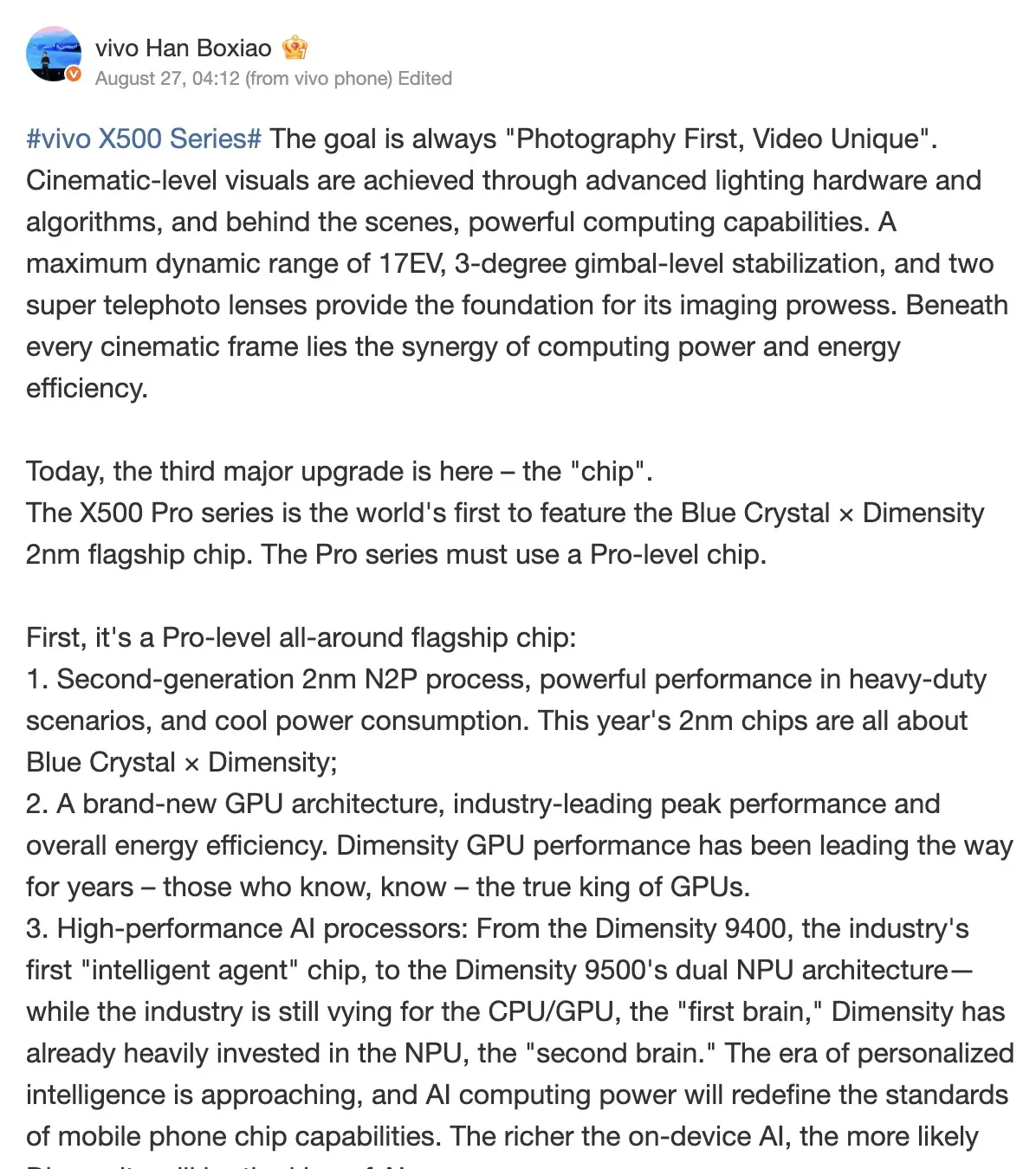
Vivo is gradually revealing the secrets of its upcoming vivo X500 Pro series. After detailing its new periscope zoom lenses, the company has confirmed that its next flagships will be the first smartphones to utilize a Blue Crystal × Dimensity chip manufactured in a 2nm process, co-developed with MediaTek.
The commercial name is not yet official, as MediaTek has yet to present its next generation of SoCs. However, all signs indicate that it is the forthcoming Dimensity 9600 Pro. Vivo is not merely framing it as a more powerful chip; the company aims to make it the driving force behind a new generation of mobile video.
Vivo Confirms A 2nm Dimensity SoC For The X500 Pro
Han Boxiao, Product Manager at Vivo, confirmed that the vivo X500 Pro and vivo X500 Pro Max will globally debut this new Blue Crystal × Dimensity platform. The exact reference of the chip remains intentionally undisclosed in official communications. MediaTek still needs to unveil its next flagship chipset, but available information points to the Dimensity 9600 Pro.
The SoC is expected to be manufactured using TSMC’s N2P process, an evolution of the 2nm node, which should enhance both performance and energy efficiency. For Vivo, efficiency will be particularly crucial given the photographic and video ambitions of the X500 Pro series.
An Expected 2+3+3 CPU Architecture
Specific characteristics of the processor are currently based on leaks and should not be considered official. The Dimensity 9600 Pro is rumored to adopt a new 2+3+3 configuration, consisting of two ARM C2-Ultra cores for heavy workloads, three C2-Premium cores, and three C2-Pro cores.
In this way, MediaTek continues its strategy of prioritizing high-performance cores over the traditional big-little core distinction. A new GPU architecture is also expected.
Some leaks even suggest a frequency nearing 5 GHz for the most powerful cores, but this point remains to be confirmed during MediaTek’s official presentation.
Vivo Doesn’t Just Want To Talk Benchmarks
The most intriguing aspect of the announcement lies elsewhere. Vivo presents this chip as an imaging platform as much as a performance engine. The brand explains it has developed five specific technologies with MediaTek aimed at enhancing video capabilities. This approach reflects a broader evolution in the premium smartphone market.
Raw CPU performance is nearing levels where differentiation occurs elsewhere: photo processing, video, local AI, and energy efficiency. Vivo intends to leverage silicon to reinforce its historical stronghold: the camera.
A Dedicated Circuit For 4K 120 fps Video
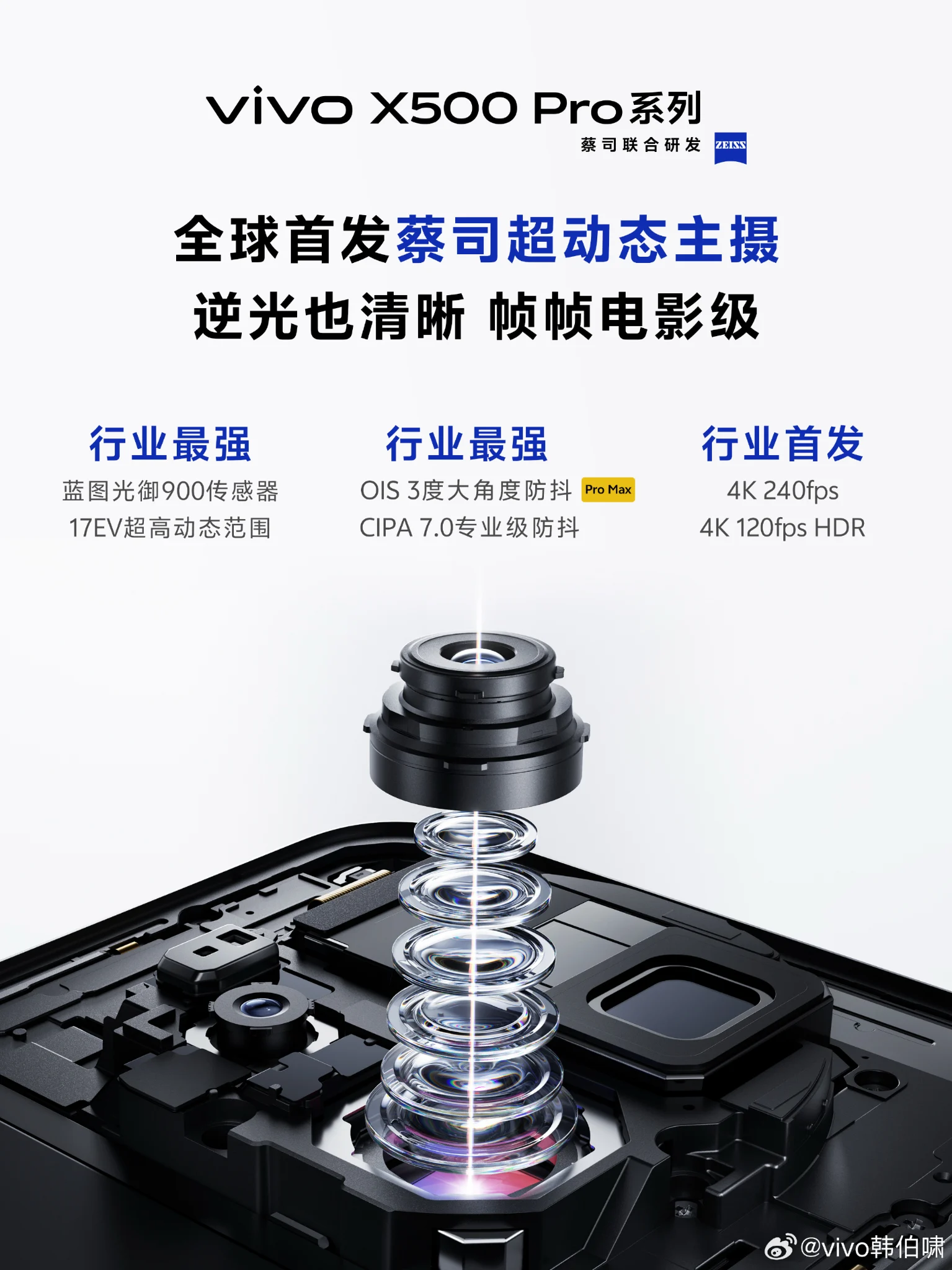
The first innovation announced by Vivo is a hardware zone dedicated to 4K recording at 120 frames per second in Log 10 bits. Log format retains more information in highlights and shadows, providing greater flexibility during color grading.
This feature is particularly favored by videographers who wish to apply their own color grading post-shoot.
Having a hardware block specifically optimized for this processing should also reduce energy consumption compared to a more software-heavy approach. Vivo clearly aims to position its smartphone as a true video production tool.
60 fps Autofocus Across All 4K Focal Lengths
The new NPU dedicated to imaging is expected to enhance autofocus tracking. Vivo claims tracking capability at 60 frames per second across all focal lengths in 4K. With a smartphone featuring multiple cameras and zoom levels, achieving smooth focus becomes particularly challenging. The processing needs to track the subject while potentially switching sensors and maintaining a natural transition between different focal lengths.
This feature could be particularly beneficial for sports scenes, animals, or fast-moving subjects.
Vivo Claims A First With 4K Dolby Portrait Video
The vivo X500 Pro series will also utilize a custom imaging chip developed in-house by Vivo. This will enable what the company presents as the industry’s first 4K Dolby portrait video. The goal is to process skin tones, dynamic range, and lighting ambiance simultaneously to produce a readily usable image without extensive post-production work.
As is often the case with “world-first” claims, we’ll need to wait for complete presentations and independent tests to accurately assess the significance of this feature.
However, the direction is clear: Vivo aims to apply the same level of computational processing in video portraits that is already common in photography.
The AI Will Automatically Create Highlights
A new AI processing unit will also be responsible for automatically generating video highlights. The concept is to analyze recorded sequences and identify the most interesting moments. Thus, users could obtain a montage or a selection of key moments without having to sift through several minutes of footage manually.
This type of function already exists in various forms in modern photo galleries.
The difference lies in the much deeper integration of processing directly within the hardware platform.
The XDZ Engine Aims To Enhance Zoomed Videos
Vivo and MediaTek have also jointly developed a feature called XDZ. This engine provides a form of hardware super-resolution for videos recorded with a high level of zoom. Digital zoom remains one of the most challenging areas for smartphones.
Even with an excellent telephoto lens, exceeding optical focal length quickly requires reconstructing details from limited information. The XDZ engine aims to combine hardware processing and reconstruction algorithms to preserve more sharpness.
Its actual effectiveness will depend significantly on the sensors and shooting conditions.
An Announced Dynamic Range Of Up To 17 EV
These features complement the photographic characteristics already revealed by Vivo. The vivo X500 series is expected to offer a dynamic range of up to 17 EV, according to the manufacturer’s measurements. This is an extraordinarily high figure for a smartphone. In practice, this capability should help maintain more details when a scene contains very bright spots alongside very dark ones.
This is typically the case in portraits taken in front of a window, sunsets, or nighttime scenes with strong light sources. As always, the exact dynamic range measurements will need to be verified through real-world tests.
Announced Stabilization Of Three Degrees
Vivo also highlights stabilization capable of compensating for up to three degrees of movement, presented as akin to gimbal behavior. The company has been working for several generations on particularly advanced stabilization systems. In the context of 4K video at 120 fps and long focal lengths, this technology becomes crucial.
The more you zoom in, the more visible even the slightest hand movement becomes.
The combination of optical stabilization, electronic processing, and AI analysis could therefore play a significant role in the final output.
Zoom Lenses Will Remain Central To The X500 Pro
Vivo previously dedicated its last announcement to the zoom lenses of the vivo X500 Pro and X500 Pro Max. The brand confirms that zoom will remain one of the hallmarks of this generation. This strategy aligns with the integration of the XDZ engine. An effective telephoto lens is not only intended for taking long-distance photos. It must now function in video, portrait, low light, and during rapid focal length changes.
The image processor thus becomes nearly as crucial as the optics themselves.
The 2nm Process Must Also Address Consumption Issues
All these features come with significant energy costs. Filming in 4K at a high frame rate, constantly tracking a subject, and performing real-time super-resolution heavily tax the CPU, GPU, NPU, and ISP. This is precisely where transitioning to 2nm N2P could make a difference.
Enhanced efficiency theoretically allows for higher loads to be sustained for longer without causing as much heat or frequency drop.
For a video-oriented smartphone, this endurance under load is often more crucial than a peak performance observed for just a few seconds during a benchmark.
Vivo Deepens Its Relationship With MediaTek
The term Blue Crystal also illustrates Vivo’s strategy. The company no longer merely wishes to purchase a standard MediaTek processor and integrate it into its phone. It is directly participating in optimizing certain hardware and software components. This co-design is gradually resembling the operation of the most integrated ecosystems in the market.
Apple fully controls its chips, Samsung develops Exynos, Google customizes Tensor, and while Vivo has yet to introduce its own complete flagship SoC, it seeks to gain some of the same advantages through a much closer partnership with MediaTek.
The Dimensity 9600 Pro Will Face Qualcomm’s 2nm Offer
This new generation will arrive facing a particularly ambitious competitor. Qualcomm is also preparing its next flagship platform in 2nm, featuring the Snapdragon 8 Elite Gen 6. Initial information regarding this chip mentions a new generation of Oryon cores capable of achieving very high frequencies, along with new cache optimizations.
The battle between MediaTek and Qualcomm will thus no longer focus exclusively on CPU benchmarks. Image processing, local AI, consumption, and sustained performance will likely be equally vital.
Vivo appears to have already chosen its field of battle: video.
A Launch Scheduled For September
Vivo has confirmed that the vivo X500 series will launch in September 2026 in China. The company is currently executing a series of daily announcements gradually introducing its key innovations. Following photography and the chipset, Han Boxiao indicated that the next focus will be on the display.
We should soon learn more specifics about the vivo X500 Pro and Pro Max prior to their full presentation.
Vivo Aims To Become The Android Reference For Video
The strategy behind this barrage of features is ultimately quite clear. For several years, Vivo has built its reputation around mobile photography, particularly through its partnership with Zeiss. With the vivo X500 Pro series, the company aims to extend this legitimacy to video. Log 10 bits, Dolby Portrait, 60 fps autofocus, hardware super-resolution, and advanced stabilization: all the newly announced features converge toward the same objective.
For Vivo, the future Dimensity 9600 Pro will only be of interest if it can maintain these complex processes in real time without turning the smartphone into a heater. The transition to 2nm could precisely make this scenario possible.
If the promises hold true during tests, the next flagship battle in the Android realm may not revolve around achieving the best AnTuTu score, but about which device can film the longest with quality closest to that of a true camera.



