


The Play Store Will Impose Memory Limits on Apps to Better Manage RAM Shortages
The surge in memory prices is having tangible effects on Android. Google is set to impose new rules on apps and games distributed on the Play Store to limit their RAM consumption, with the first deadline set for February 2027.
This decision stems from a fundamental shift in the semiconductor market. The rise of AI-focused data centers is diverting production capacity towards more profitable HBM memory, while LPDDR used in smartphones is becoming more expensive.
Android must now adapt to a reality where simply adding more RAM is no longer a straightforward solution.
Google Play Store aims to prevent apps from monopolizing RAM
Starting in February 2027, Google Play will introduce new performance thresholds for apps and games. Three key areas will be closely monitored: the dynamic memory used by the application, the memory occupied by bitmaps, and the level of optimization of DEX code.
The goal is clear: to stop poorly optimized apps from consuming enough memory to slow down the entire system.
When software hogs too much RAM, Android may need to compress more data, close background processes, or reload certain applications more frequently.
This can result in slowdowns, increased energy consumption, and a degraded multitasking experience.
Memory-hungry apps will see reduced visibility on the Play Store
Google is not directly discussing an automatic ban for merely excessive memory consumption. However, apps that regularly exceed the new thresholds may experience a decrease in their visibility and publishing capabilities on Google Play.
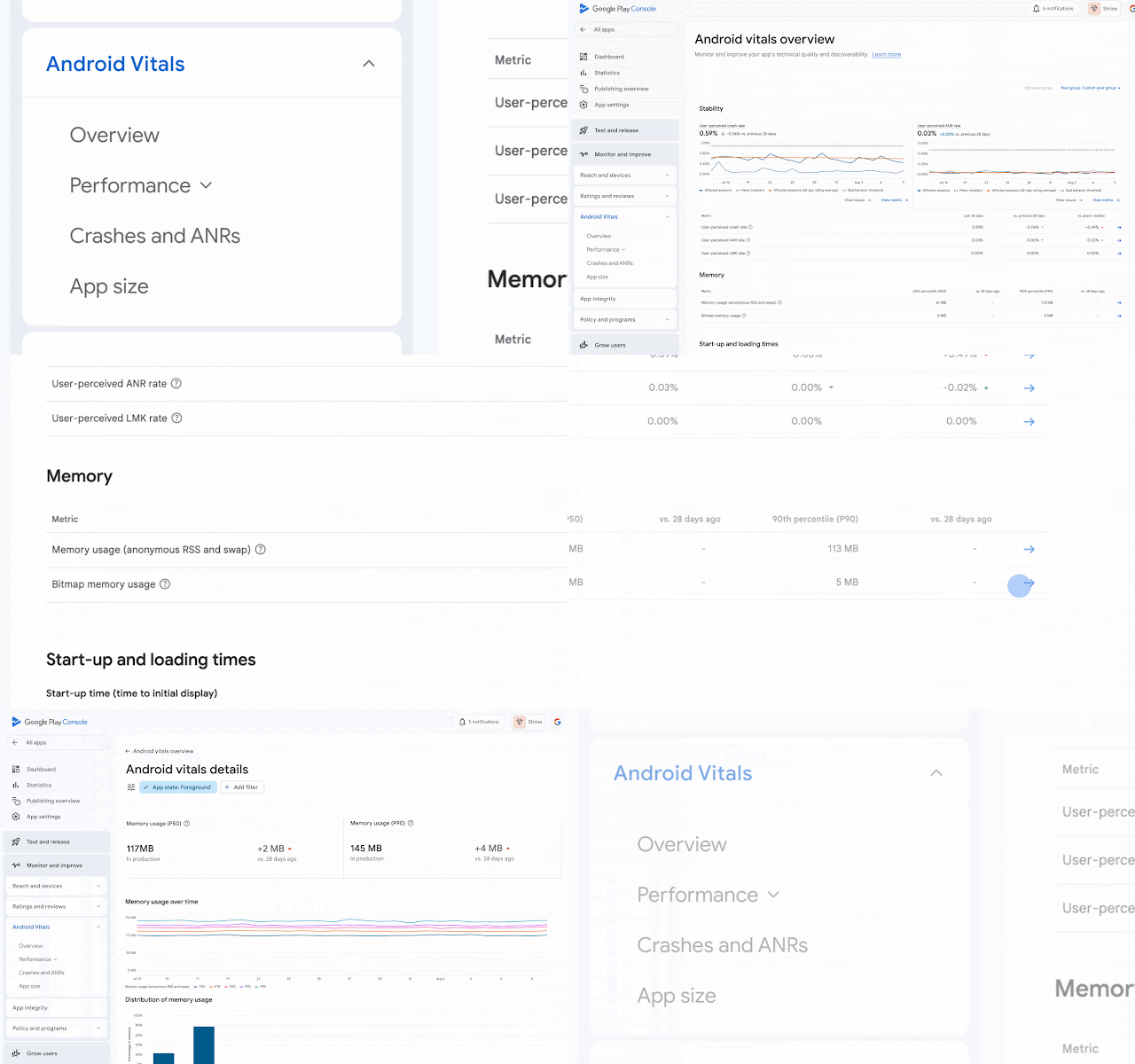
This mechanism aligns with Android Vitals, the system used by Google to assess various quality indicators. An app that is too resource-hungry may thus suffer a disadvantage in distribution if its behavior genuinely degrades the user experience.
For developers, the stakes become commercial as well as technical: poor RAM management could directly impact an app’s discoverability.
Android will monitor memory based on application state
Google does not want to impose a blanket cap in all situations. Memory consumption will be evaluated based on the state of the software and the characteristics of the device. An app in the foreground can naturally use more memory than a process cached in the background.
Android will thus differentiate between various scenarios. Google will particularly monitor the app’s private memory, which includes both active memory and certain compressed data or data placed in swap.
The behavior will also be assessed based on different categories of smartphones, from budget devices to models with more than 16 GB of RAM.
Images will be a primary focus
Bitmap management will be one of the key control points. High-resolution images, game textures, and graphical elements can consume vast amounts of memory when not properly released. While this usage is often justified when an app is visible, the issue arises when it retains large graphical elements in memory while running in the background or in cache.
Google specifically aims to discourage such behavior.
For example, a game should not keep several hundred megabytes of active textures when it is no longer displayed.
DEX code will also require greater optimization
The third requirement pertains to the Android code itself. Google wants Android App Bundles to more consistently utilize the reduction, optimization, and obfuscation mechanisms available in tools like R8.
A better-optimized code reduces the size of structures loaded into memory, speeds up app launch times, and can minimize certain slowdowns.
Google will set a minimum coverage level for these optimizations. The company aims to reduce memory consumption on all fronts: dynamic data, graphic resources, and executable code.
Android 17 already introduces a memory limiter by app
These new Play Store requirements build on a deeper change introduced with Android 17. The system now has individual memory limits for each app. When a process exceeds the set limit for the device in use, Android can shut it down before it causes issues for the entire system.
The goal is to prevent a single app from compromising the performance of others. Google has started rolling out this approach on Pixel devices but plans for an increasing number of manufacturers to adopt it in the coming months.
The limits can be applied to both devices with 4 GB of RAM and those equipped with 16 GB or more.
Google aims to make Android’s behavior more predictable
Historically, Android managed memory pressure by terminating certain processes as needed. While this approach remains essential, it could create unpredictable situations for developers. A particularly resource-hungry app could force the system to close several other well-designed programs.
The Memory Limiter seeks to reverse this logic. Instead of sacrificing neighboring applications, Android can identify the process responsible for excessive consumption and intervene directly.
This approach should improve overall stability and reduce application restarts during multitasking.
The memory crisis is shifting industry priorities
The timing chosen by Google is notable. The sector is currently experiencing significant tension regarding the availability and pricing of memory. The explosion of demand for artificial intelligence has created a massive need for HBM, or High-Bandwidth Memory, used with data center accelerators.
Samsung, SK Hynix, and Micron thus have an interest in allocating more production capacity to the most profitable products. This mechanically reduces the available flexibility for certain memory types intended for smartphones, PCs, and other consumer devices.
The price of LPDDR5X skyrocketed in 2026
This tension is already visible in industrial contracts. In Q2 2026, some market estimates placed the average price of a 12 GB LPDDR5X module at around $145.90, compared to about $77 in the previous quarter. This represents an increase of approximately 89% in just three months for this category. Prices naturally vary based on contracts, volumes, and specifications, but the trend is clear: mobile memory has become significantly more expensive.
For smartphone manufacturers, systematically increasing RAM from one generation to the next becomes much less appealing.
Smartphones may halt their race to 16 or 24 GB
For several years, Android manufacturers have used the amount of memory as a marketing point. 12 GB has become common in the high-end market. Some devices even boast 16 or 24 GB. However, the rising costs could slow this race. Google acknowledges that some new devices are now maintaining their RAM capacity or even reducing it in response to component costs.
Software optimization then becomes essential.
A smartphone with 8 or 12 GB, if well managed, can deliver a better experience than a model with more memory that leaves applications unchecked.
AI paradoxically contributes to the problem
The situation holds a degree of irony. Artificial intelligence drives smartphones to demand more memory to run models locally. Yet, this same AI revolution is consuming an increasing share of global memory manufacturing capacity through data centers.
Manufacturers find themselves caught between two contradictory trends. They want more RAM to run generative models on devices while facing rising costs for that very memory.
Google’s response is to tackle the other side of the equation: if available quantity cannot increase indefinitely, software must become more efficient.
Developers will gain more diagnostic tools
Google does not simply want to impose rules. Play Console is also starting to offer new indicators that help developers understand where their memory is being consumed. They will be able to monitor dynamic memory, bitmap usage, and identify certain crashes related to excessive pressure.
Google also plans to provide more information on the time spent by the app in each state as well as the behavior of the Memory Limiter.
Developers will thus be able to more easily distinguish legitimate consumption in the foreground from a memory leak in the background.
Android Studio is also getting enhancements
Android 17 brings several tools aimed at facilitating optimization. The integration of LeakCanary in Android Studio particularly helps identify objects held unnecessarily in memory. Android also has new mechanisms for detecting anomalies and automatically capturing certain information when the Memory Limiter is engaged.
This way, Google aims to make issues reproducible before they impact millions of users.
A new garbage collector management
Android 17 also enhances the functioning of ART, its runtime environment. The garbage collector can now perform more frequent, smaller operations targeting recent objects instead of routinely conducting much heavier scans of the entire memory heap.
This generational approach reduces CPU load and can decrease the micro-lags caused by memory cleaning.
Google also claims it helps reduce the maximum amount of RAM used in certain situations.
Some of these improvements may be delivered to older devices via Google Play system updates.
Zero Tap Sign-In will come next in April 2027
Google is using this update to its requirements to introduce a second obligation regarding smartphone migration. Starting in April 2027, applications offering user login must adhere to the Zero Tap Sign-In standard to maintain their full publishing capabilities and optimal visibility on Google Play.
The aim is to avoid requiring users to manually log in to all their applications when changing smartphones. With the Restore Credentials API, the login state can be securely transferred to the new device.
Open an app and be automatically logged in
The concept is particularly straightforward from the user’s perspective. After transferring their data to a new Android smartphone, they open their app for the first time.
If the developer has correctly implemented Zero Tap Sign-In, the account can be restored automatically. There’s no need to search for a password or reregister through the authentication process. Google thus aims to make Android migrations much more seamless. Games are currently exempt from this requirement, although Google plans to provide specific recommendations for their authentication systems in 2027.
This new policy illustrates how the component crisis is beginning to directly influence system design. For a long time, the industry could compensate for heavier applications by simply adding more memory. This strategy is becoming much more costly. Google is therefore responding by imposing additional discipline on developers.
Android 17 now directly limits the consumption of each application, while Google Play may penalize in visibility those applications that routinely exceed the considered acceptable thresholds.
As a result, RAM is once again becoming a resource that must be properly managed.
And as AI increasingly monopolizes a larger share of global memory production, optimization could become one of the most essential skills in mobile development.



