

Apple M6 and M5 Ultra: The 2 nm chip ushers in a new era for Macs
Apple is once again advancing its in-house silicon. The company has just announced M6, its first chip manufactured using a 2 nm process, and M5 Ultra, touted as the most powerful chip ever created by Apple.
These two architectures have different ambitions but share a common goal: significantly enhance graphic performance and prepare Macs for a new generation of locally-executed AI computations.
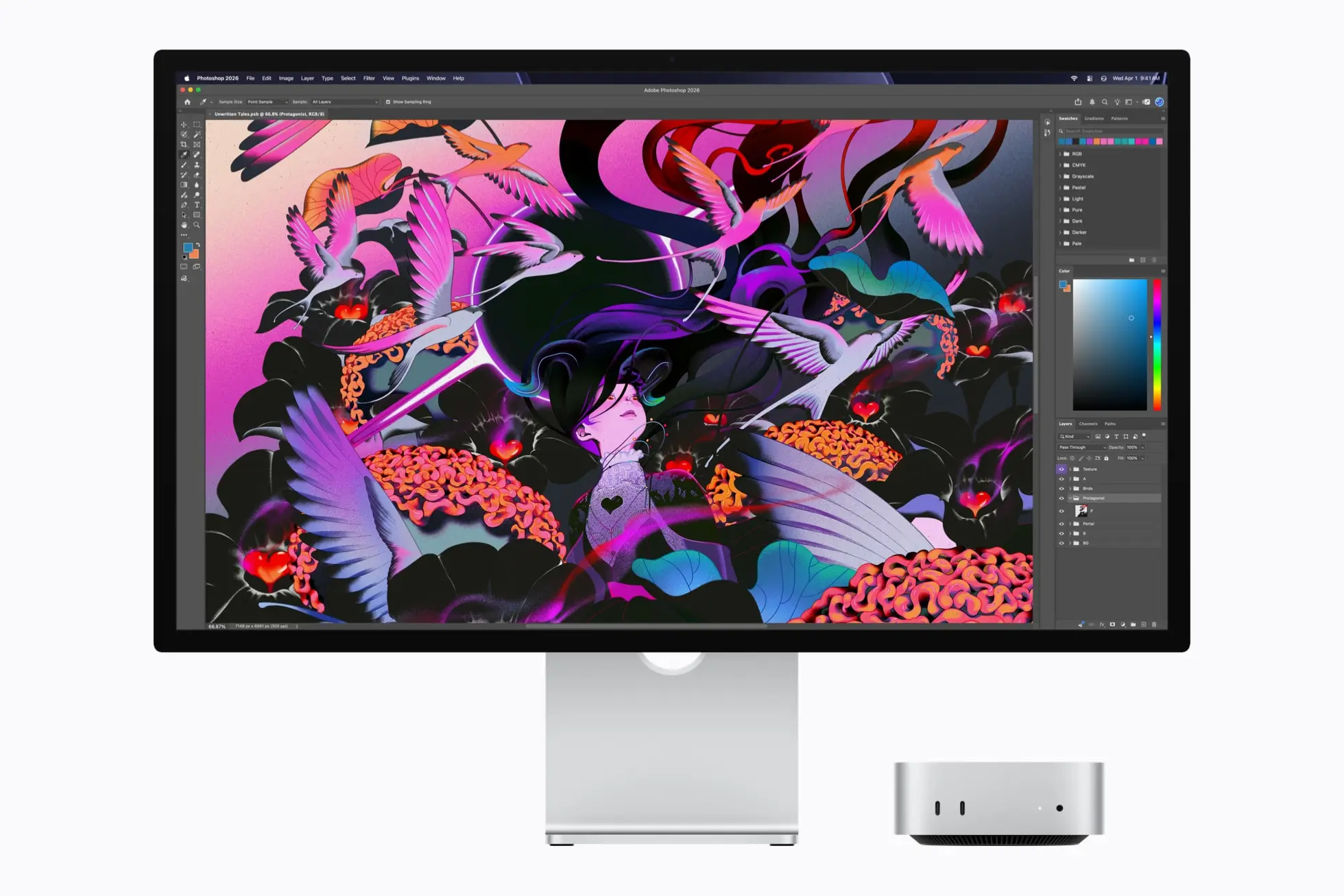
The M6 will debut in the new Mac mini, while the M5 Ultra will be featured in the updated Mac Studio. This move allows Apple to refresh two extremes of its desktop lineup simultaneously: the compact computer on one end and the workstation on the other.
M6: Apple transitions to 2 nm for the first time
The major technological leap of this generation comes with the M6. Apple adopts a 2 nm manufacturing process for the first time, moving from the 3 nm process used in previous generations. This critical transition will enable the integration of more transistors while improving performance and energy efficiency.
The chip now features a 12-core CPU, up from 10 in the M5.
Apple has categorized these cores into three types: two “super cores,” four performance cores, and six high-efficiency cores.
This new configuration illustrates how Apple is progressively refining the architecture of its processors. The “super cores,” which appeared in the M5 Pro and M5 Max lineup, now sit at the top of the hierarchy and are designed to handle tasks that require maximum performance.
Apple claims that the M6 delivers the best single-thread performance in the world and offers up to 1.2 times the multithread performance of the M5. As always, these claims will need to be validated through independent benchmarks, but they demonstrate that the shift to 2 nm is not solely aimed at reducing consumption.

A 12-core GPU with integrated AI accelerators
The graphical evolution is equally intriguing. The M6 features a 12-core GPU, up from 10 in the M5, but the most significant change lies within the GPU cores themselves. Each GPU core now integrates a Neural Accelerator, a specialized unit designed for the matrix operations utilized in AI models.
Apple started this transformation with the M5 generation. With the M6, the strategy becomes much clearer: the Mac GPU is no longer only designed for display, 3D rendering, or gaming.
It is gradually evolving into a true AI computation accelerator.
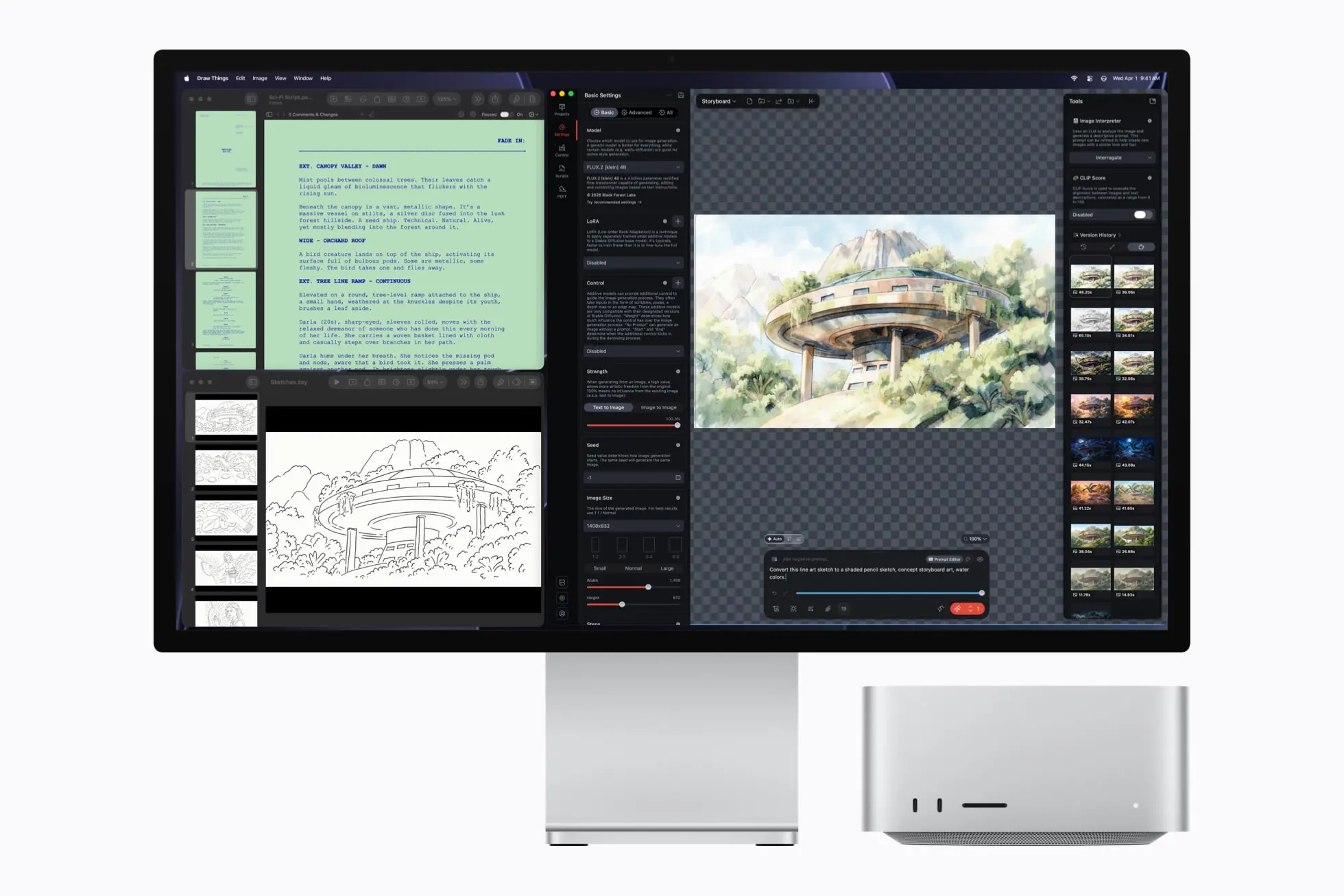
This architecture can benefit local execution of large language models, diffusion models generating images, video upscaling, and various Apple Intelligence functions.
A dual 16-core Neural Engine
Apple is also bolstering the other essential component of its AI architecture: the Neural Engine. The M6 comes equipped with a Dual 16-core Neural Engine, an enhancement aimed at significantly increasing the processing capacity for models executed directly on the device.
This power increase coincides with Apple’s intention to shift more AI functions towards its devices. The benefits go beyond speed. Running models locally on a Mac reduces reliance on the cloud, minimizes latency, and in some scenarios, allows for more local data retention.
The M6 supports up to 32 GB of unified memory, a capacity that remains relatively modest compared to the Max and Ultra pro series chips but is adequate for running numerous locally optimized models.
M5 Ultra: Two M5 Max chips combined through UltraFusion
At the opposite end of the spectrum, Apple unveils a chip of a whole new magnitude. The M5 Ultra relies on UltraFusion technology, which connects two M5 Max chips and enables them to operate as a single architecture. However, this construction is particularly ambitious.
Each M5 Max employs a design consisting of two dies. By combining two of these chips, Apple achieves a quad-die architecture, comprising four silicon blocks working as a unified platform.
This approach allows macOS and applications to perceive the entire system as a single chip rather than multiple distinct processors. For developers, this alleviates some of the complexity typically associated with multiprocessor or multi-GPU configurations.
Up to 36 CPU cores and 80 GPU cores
The specifications immediately highlight the scale achieved by the M5 Ultra. In its maximum configuration, the chip features a 36-core CPU comprising 12 super cores and 24 performance cores. The GPU can reach up to 80 cores. Additionally, it includes a Neural Engine with 32 cores, dedicated to accelerating various machine learning operations.
This combination positions the M5 Ultra in a very different category than the Apple Silicon chips meant for laptops or consumer machines. The Mac Studio housing it is clearly targeting professionals in 3D rendering, video, research, and increasingly, artificial intelligence.
Up to 512 GB of unified memory
The most impressive feature of the M5 Ultra is arguably its memory. Apple allows the chip to be configured with up to 512 GB of high-bandwidth unified memory.
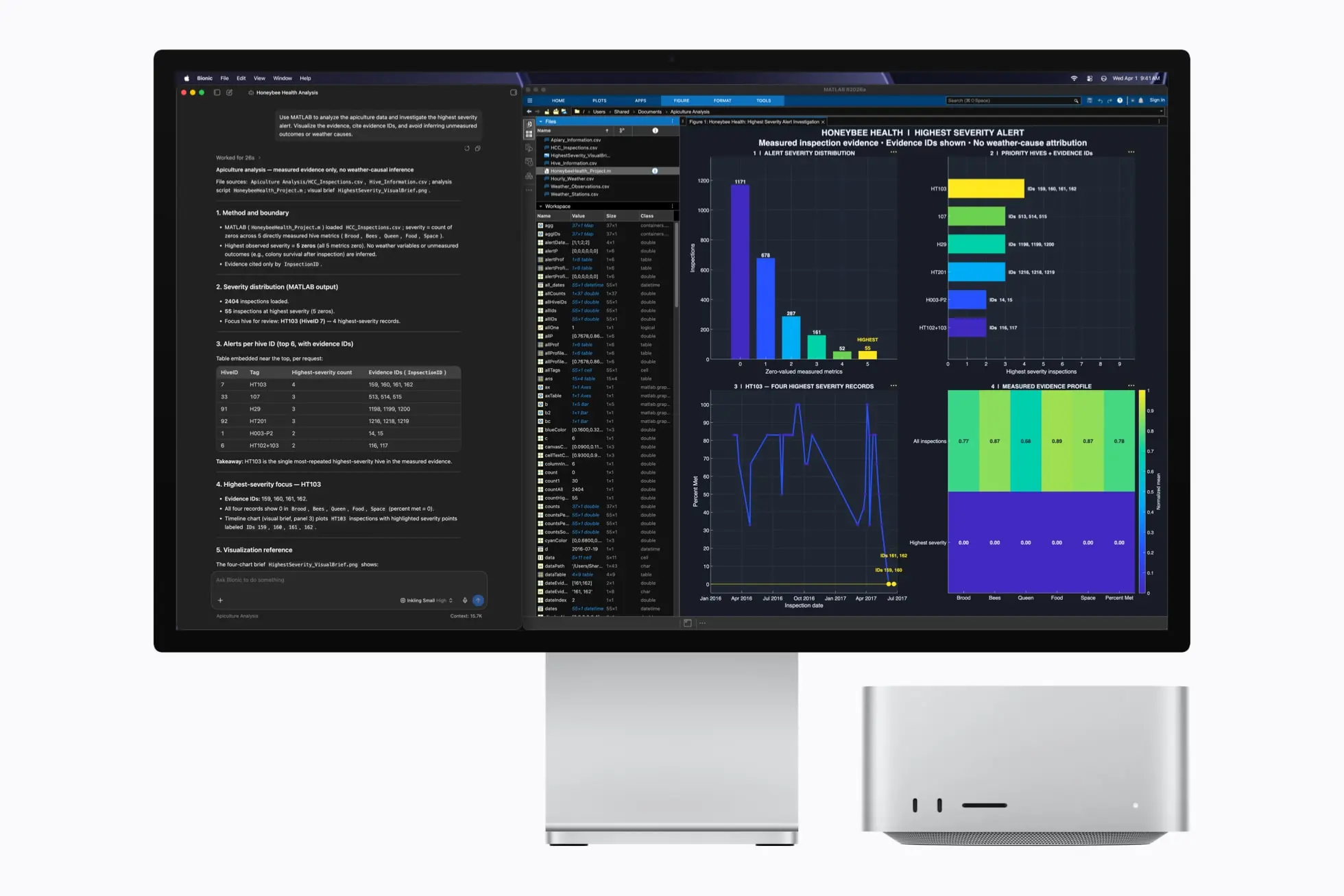
Unlike a traditional workstation, where the CPU uses system memory while the GPU has its own VRAM, Apple Silicon’s architecture allows different compute blocks to access the same memory pool. This characteristic becomes particularly valuable for AI applications.
Large generative models can require dozens or even hundreds of gigabytes of memory. On a traditional architecture, this usually necessitates the use of multiple professional GPUs, each with a limited amount of VRAM.
With 512 GB accessible to the GPU, CPU, and specialized accelerators, Apple can run significantly larger models locally. The company directly references the ability to execute frontier AI models, highlighting how central artificial intelligence has become in positioning the Mac Studio.
Memory that is soldered to the machine
However, this architecture comes with a significant caveat. As with all Apple Silicon Macs, the memory is integrated into the system and cannot be upgraded after purchase. Users choosing 128 GB, 256 GB, or 512 GB must anticipate their needs at the time of ordering. This limitation is not new, but it becomes much more significant when considering a professional workstation intended to remain in service for several years.
Apple favors a model of maximum integration here: memory, CPU, GPU, and accelerators communicate very rapidly, at the cost of virtually no scalability.
Two chips, two visions of the Mac in the age of AI
The M6 and M5 Ultra occupy very different positions, yet their designs ultimately convey the same narrative. With the M6, Apple is increasing core counts, adopting the 2 nm process, and multiplying units dedicated to machine learning. With the M5 Ultra, the company pushes this logic much further with 80 GPU cores, hundreds of gigabytes of unified memory, and an architecture designed to accommodate particularly large AI models.
Artificial intelligence is no longer merely a specialized block added to Apple Silicon chips. It is starting to influence the very organization of the GPU, Neural Engine, memory, and interconnections between dies.
This is perhaps the most significant transformation of this generation.
Mac mini and Mac Studio lead the charge
The M6 will debut in the new Mac mini, while the M5 Ultra will be exclusive to the Mac Studio. Both computers will be available for pre-order starting August 25, 2026, ahead of their expected launch on September 22.
Apple thus chooses to introduce its new architectures directly on its desktop computers.
This strategy is intriguing: the Mac mini becomes the accessible showcase of the new M6 generation, while the Mac Studio immediately demonstrates how far Apple can push its architecture when unbound by the thermal restrictions of a laptop.
Apple Silicon enters a new phase
Since the arrival of the first M1 chip in 2020, Apple has gradually regained control over almost all hardware architecture for its computers. The M6 marks a new milestone with the transition to 2 nm, but the true evolution may lie elsewhere.
Apple is no longer simply aiming to produce faster processors than the previous generation. The company is now developing an architecture where the CPU, GPU, Neural Engine, and memory are thoughtfully designed together to handle workloads increasingly dominated by artificial intelligence.
The M5 Ultra represents the most dramatic version of this: a chip capable of accommodating half a terabyte of memory and executing AI models directly on a machine compact enough to fit under a screen.
With the M6 and M5 Ultra, Apple Silicon is not only redefining the Mac processor. It is beginning to redefine what Apple considers a computing workstation in the age of AI.



