

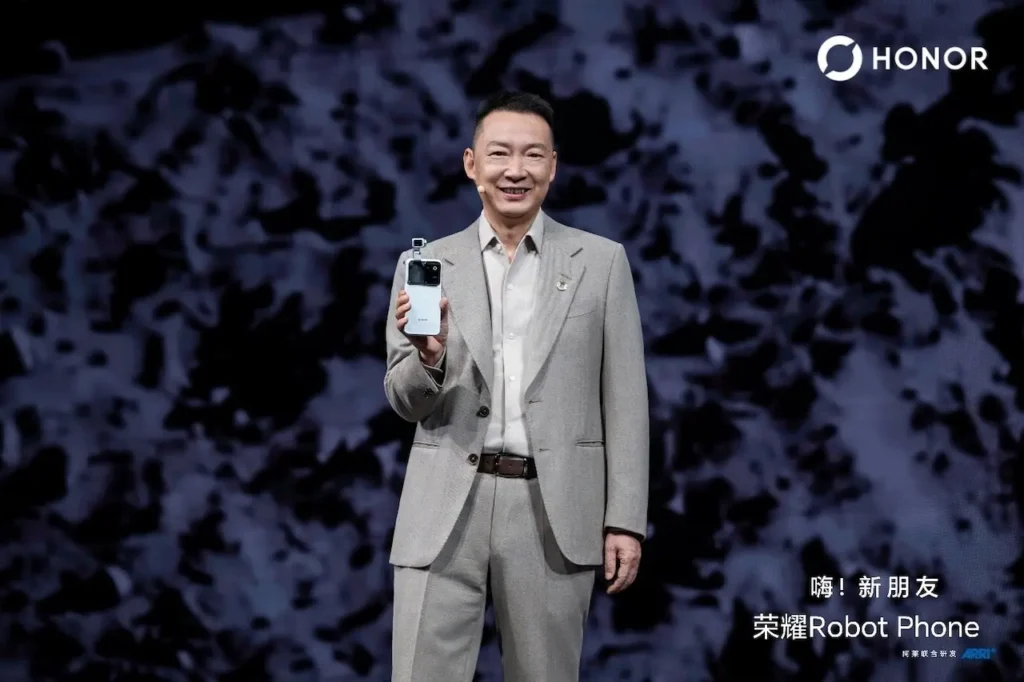
Honor Robot Phone: A Robotic Camera with 200 Megapixels and YOYO Pro AI to Reinvent Smartphones
After months of teasing, Honor has turned its futuristic concept into a commercial product. The Robot Phone features a 200-megapixel camera mounted on a motorized gimbal capable of rotating at high speeds, in collaboration with ARRI, along with a new-generation AI called YOYO Pro.
This impressive offering deliberately blurs the lines between smartphone, standalone camera, and personal robot.
A Truly Integrated Robotic Camera in the Smartphone
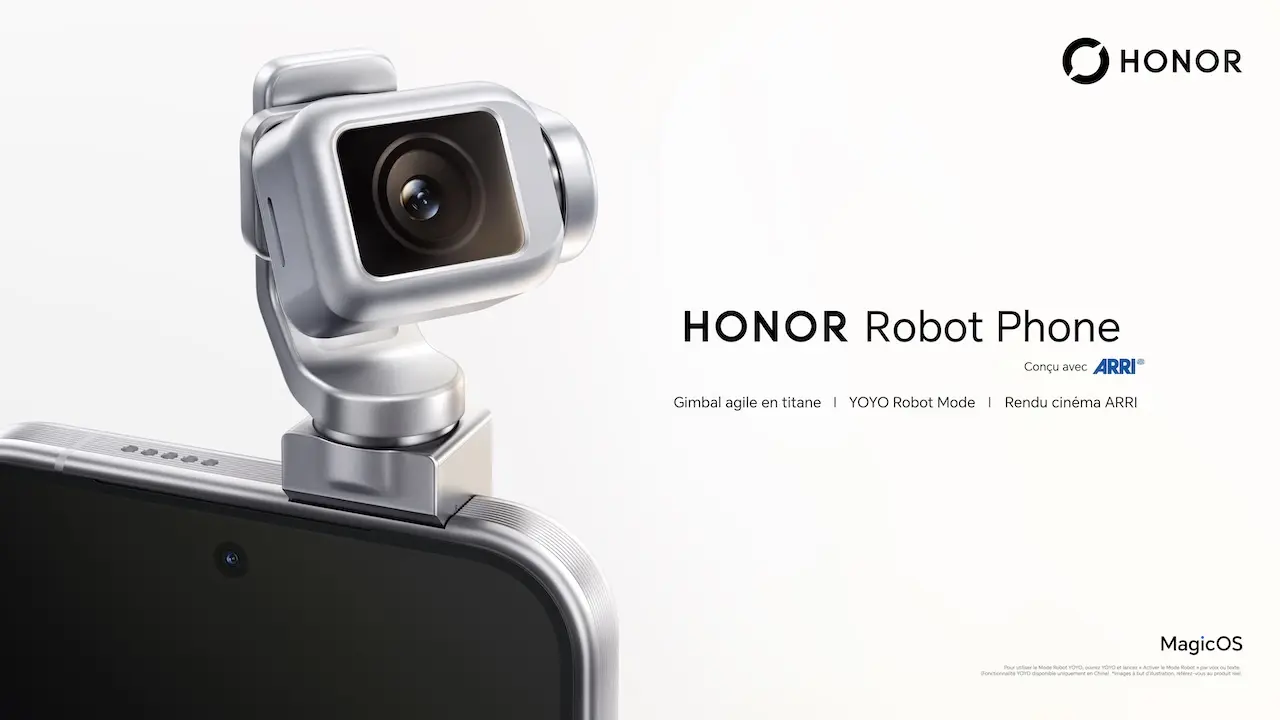
The core of the Honor Robot Phone isn’t its screen or processor, but rather its impressive motorized photographic system. Honor has developed a titanium alloy gimbal that is directly integrated into the chassis. According to the manufacturer, the mechanism uses aerospace-grade titanium and has been miniaturized by 65% compared to stabilizers typically used with standalone cameras.
The assembly includes over 100 precision parts and requires more than 60 different manufacturing processes. Honor also claims to have developed over a hundred patents surrounding this architecture.
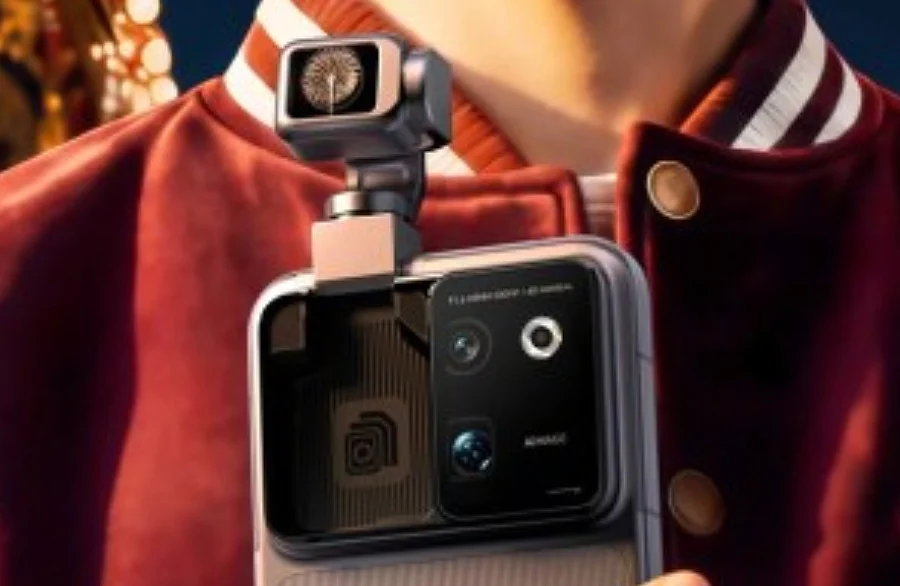
The motor weighs only 2.6 grams but allows the camera to achieve a rotation speed of up to 360 degrees per second. The objective is clear: to automatically follow a person or object in motion, perform quick pans, and keep the subject in frame without requiring the user to constantly reposition their phone.
This mechanism fundamentally transforms the philosophy of mobile cameras. Instead of moving the smartphone to aim the lens, it’s now the lens that moves independently of the phone.
Two 200 Megapixel Sensors and an In-House Imaging Chip
Honor has not compromised on the photographic aspect. The main camera mounted on the gimbal boasts a 200-megapixel sensor, accompanied by a 50-megapixel ultra-wide lens covering 122 degrees and a periscopic telephoto lens with a 200-megapixel sensor offering a 2.7x optical zoom.
The manufacturer has also added its own dedicated imaging processing chip, named Driving Light H1.
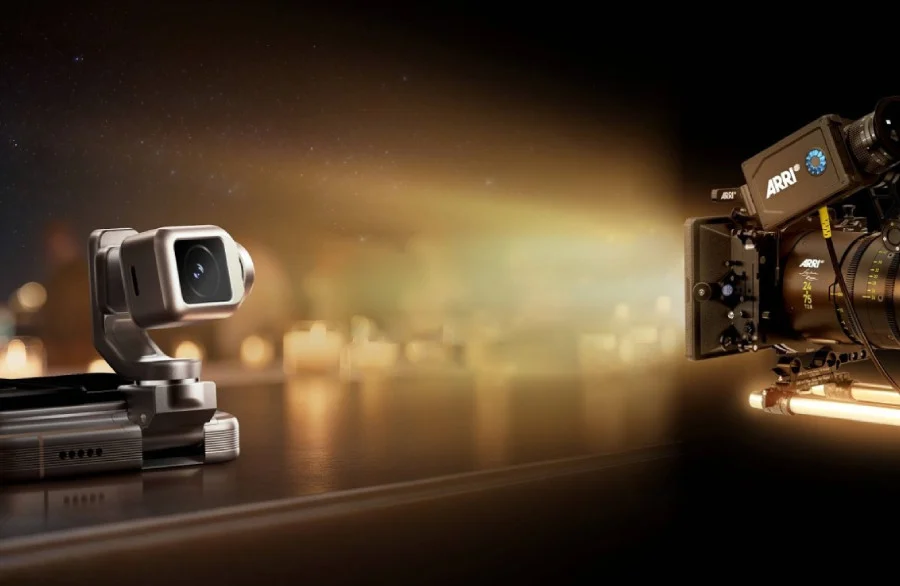
The critical element comes from the collaboration with ARRI. The Robot Phone notably supports ARRI LogC3, which provides more latitude for users looking to perform their own color grading, along with LUT files.
ARRI Look allows users to apply various cinematic color renditions directly. Honor goes even further with an ARRI Cinema Mode that includes features like focus peaking, false color display, and different cinematic aspect ratios. These functions are much closer to the tools of a professional camera than the video filters typically found on smartphones.
The true value of the ARRI partnership lies not only in color rendering: Honor aims to transport part of the professional video production workflow into a pocket-sized device.
YOYO Pro Aims to Transform the Phone into an Autonomous Agent
The second major innovation lies in the software. Honor introduces YOYO Pro as a significant evolution of its assistant, capable of executing long and complex tasks with far fewer human interventions.
According to Honor, a single command can trigger a sequence involving over 100 successive steps.
The manufacturer is also working with Alibaba’s Qwen model to develop an AI solution tailored to the constraints of mobile devices.
This ambition goes beyond the traditional voice assistant. Honor claims that YOYO Pro can consider the user’s context, habits, and environment to adapt its actions.
Here, the robotic camera takes on another dimension. Coupled with an AI capable of interpreting its surroundings, it no longer serves merely to stabilize a video. It potentially becomes a mobile sensor that the software can physically orient toward points of interest.
Honor refers to this as “embodied intelligence”: the idea that an AI does not just generate a response on the screen but has physical means to observe and interact with its environment.
A Store to Add New Skills to YOYO
Honor is also launching a YOYO Skills Store. Users can install new capabilities for their assistant, while developers will have access to over a hundred system resources to create their own functions.
This approach recalls the logic of app stores but applied to AI agents: rather than just installing software with its own interface, users add extra capabilities to their assistant.
If Honor manages to attract enough developers, this architecture could become more significant in the long run than some of the Robot Phone’s hardware features.
Snapdragon 8 Elite Gen 5 and Up to 1 TB of Storage
Despite its unusual architecture, the Robot Phone remains a high-end Android smartphone.
It features a flat 6.31-inch LTPO display, with a resolution of 2,640 x 1,216 pixels. Honor claims a peak brightness of 6,800 nits and AR anti-reflective treatment.
The smartphone is powered by Qualcomm’s Snapdragon 8 Elite Gen 5 and can accommodate up to 16 GB of RAM and 1 TB of storage.
Honor has also installed four microphones paired with a directional capture algorithm. Notably, the audio capturing direction can follow that of the robotic camera. Therefore, the photo system and microphones can theoretically track the subject being filmed together.
However, all this mechanics comes at a physical cost. The Robot Phone weighs 248 grams and measures 9.59 mm thick. It is certainly not an ultralight smartphone, but these dimensions are remarkable given the presence of the motorized mechanism.
An Experimental Smartphone at the Price of a Premium Device
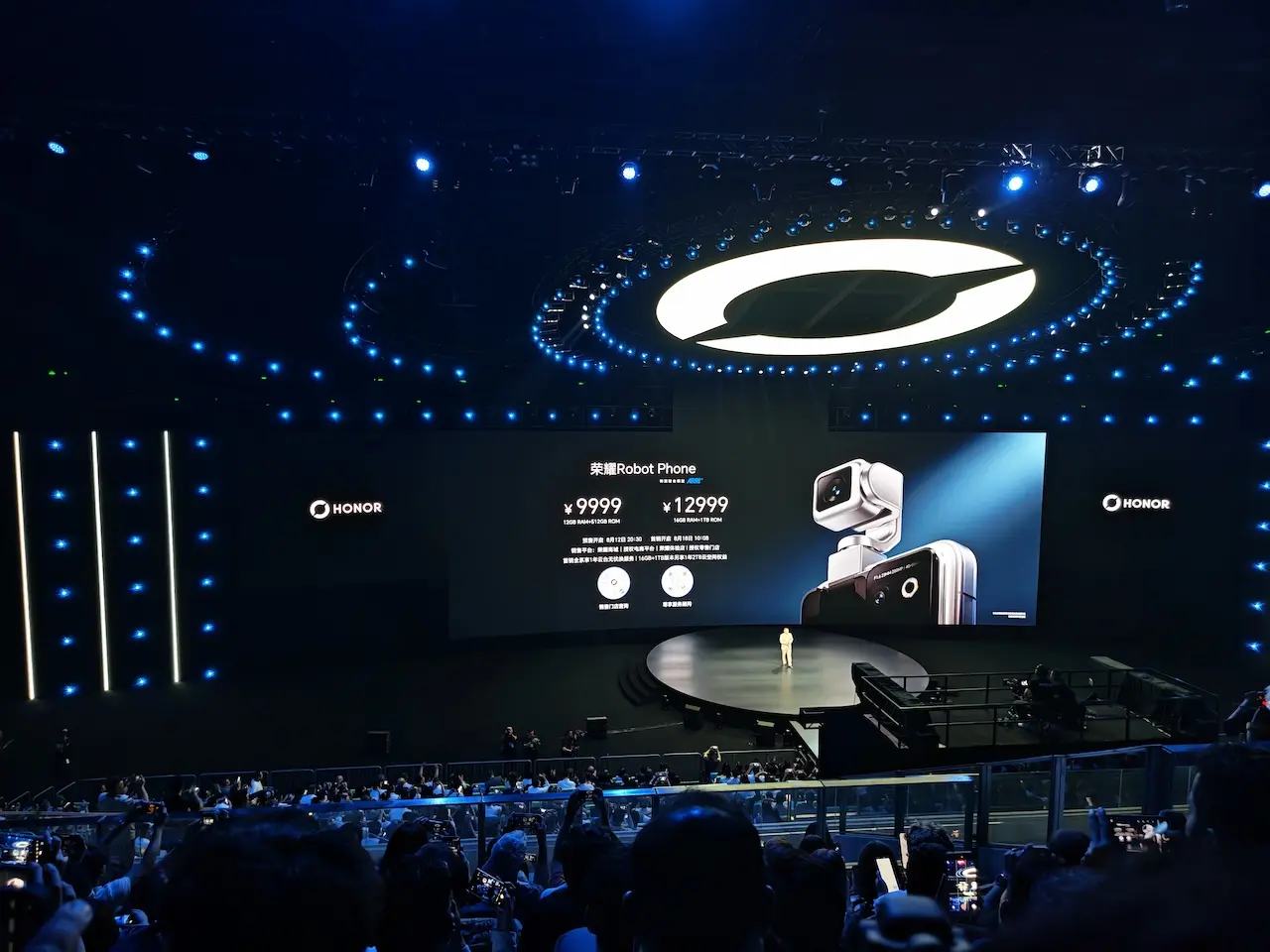
The HONOR Robot Phone will be available in two configurations: 12 GB + 512 GB and 16 GB + 1 TB, priced respectively at 9,999¥ (approximately €1,282) and 12,999¥ (approximately €1,667). Pre-orders will begin in China on August 12 at 8:30 PM, while official sales will start on August 18 at 10:08 AM.
Two colors are announced, Star Trail Silver and Moon Shadow Gray, with availability set to begin in China on August 18.
At this price point, Honor is clearly not aiming to immediately turn the Robot Phone into a mass product. The device seems more like a commercialized technological demonstration: advanced enough for consumers, yet radical enough to test new uses.
Smartphones Are Beginning to Acquire Physical Capabilities
Ultimately, this makes the Robot Phone far more interesting than just a mechanical curiosity. For the past two years, manufacturers have been adding increasingly powerful AI models to smartphones whose form and physical capabilities have largely remained unchanged. Honor is experimenting with the opposite approach: giving the smartphone a new mechanical organ that its artificial intelligence can control.
The camera can follow a subject. The microphones can align with its orientation. YOYO can interpret context and execute actions. And a skills store is expected to gradually expand these possibilities.
Of course, the reliability of the gimbal, its impact on battery life, the actual quality of tracking, and the daily utility of YOYO Pro will need to be evaluated. A mechanism comprising over a hundred mobile components also raises obvious questions regarding durability and repairability.
Nevertheless, Honor has materialized a rarely explored idea in smartphones: what if the next mobile revolution involves not just making AI smarter, but giving it the ability to move?



