

Google tests a new AI home page: the ‘Google Search’ button could disappear
For over twenty years, Google’s homepage has stood as one of the most iconic examples of simplicity on the web. A search bar, two buttons, and immediate access to information have been its hallmarks. However, this philosophy appears to be evolving. Google is currently experimenting with a new interface where artificial intelligence takes center stage.
The change is subtle and limited to a handful of users, but it speaks volumes about the direction the Mountain View giant is heading.
A new interface that highlights Gemini
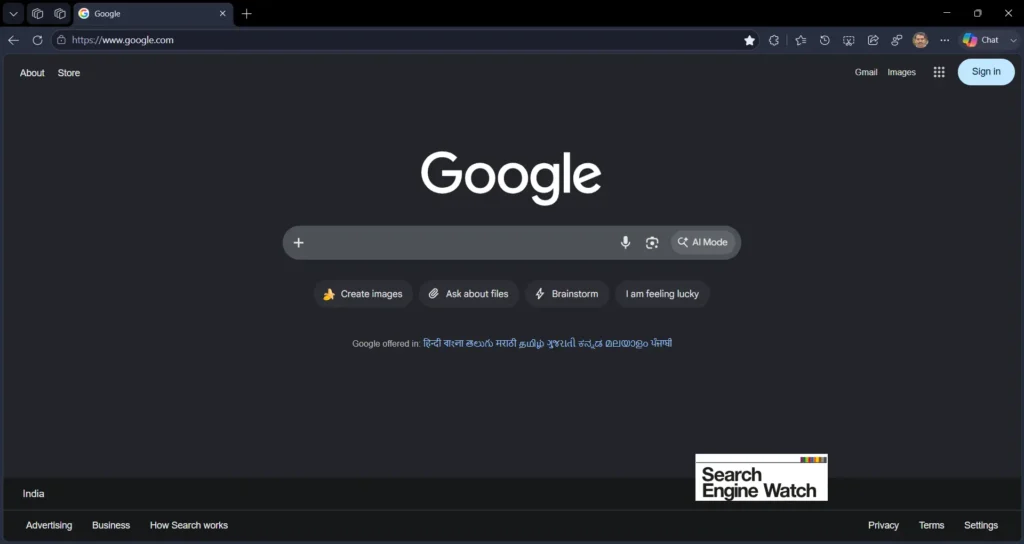
According to various reports from Search Engine Watch, Google is testing a novel version of its homepage for select visitors not signed into their accounts. The famous ‘Google Search’ button is being replaced by three new actions focused on artificial intelligence:
- Create images
- Question a document
- Brainstorm ideas
The ‘I’m Feeling Lucky’ button remains available, while AI Mode is integrated within the search bar itself. This arrangement closely aligns the traditional search experience with that offered by Gemini, indicating that Google aims to gradually merge its historic search engine with its generative AI tools.
AI becomes accessible right from the homepage
One of the most surprising elements is the accessibility of certain features. The ‘Question a document’ and ‘Brainstorm’ options could work even without signing into a Google account. Users can import a document or PDF and ask questions directly to Gemini without going through the conventional chatbot interface.
However, image generation remains exclusive to logged-in users. This decision seems logical: creating images demands significant computational resources, and Google likely prefers to tie this consumption to an authenticated account.
This segmentation also indicates that not all AI functionalities incur the same operational costs.
An evolution that transcends mere interface change
At first glance, this appears to be merely a graphical test. In truth, this experimentation reflects a much deeper shift in Google’s strategy. Since its launch in 1998, the search engine’s homepage was built on a straightforward idea: allowing users to freely formulate their queries. Now, Google seems inclined to guide this interaction from the outset by presenting concrete uses for artificial intelligence.
Traditional search is no longer depicted as the sole starting point; it becomes just one of several AI-assisted experiences.
Google is preparing for the post-search engine era
This evolution comes as Google accelerates the integration of Gemini across its ecosystem. AI Mode, AI Overviews, multimodal search, conversational assistants, and content creation tools: all of these initiatives share the same goal. Transforming the search engine into a true assistant capable of not only finding information but also understanding, summarizing, creating, or manipulating it.
The current test perfectly illustrates this ambition.
Rather than waiting for a query, Google is now proactively suggesting what users might want to accomplish with AI.
A simple test… for now
However, caution is advised. This new interface currently appears only for a segment of non-logged-in users, and Google has not disclosed the scope of the experiment or any potential global rollout.
As with many A/B tests conducted by the company, this version could be modified, expanded… or perhaps simply abandoned.
A transition that now seems inevitable
Even if this interface never becomes the norm, the message is clear. Google no longer perceives its search engine as just a text field providing access to the web. It aims to make its homepage a gateway to a suite of services powered by artificial intelligence.
The ‘Google Search’ button, once a symbol of modern Internet, might lose its central status in favor of an experience where conversation, creation, and assistance progressively take precedence. This evolution perfectly exemplifies the new battle among tech giants: to make AI not just a feature but the starting point of every interaction.



