

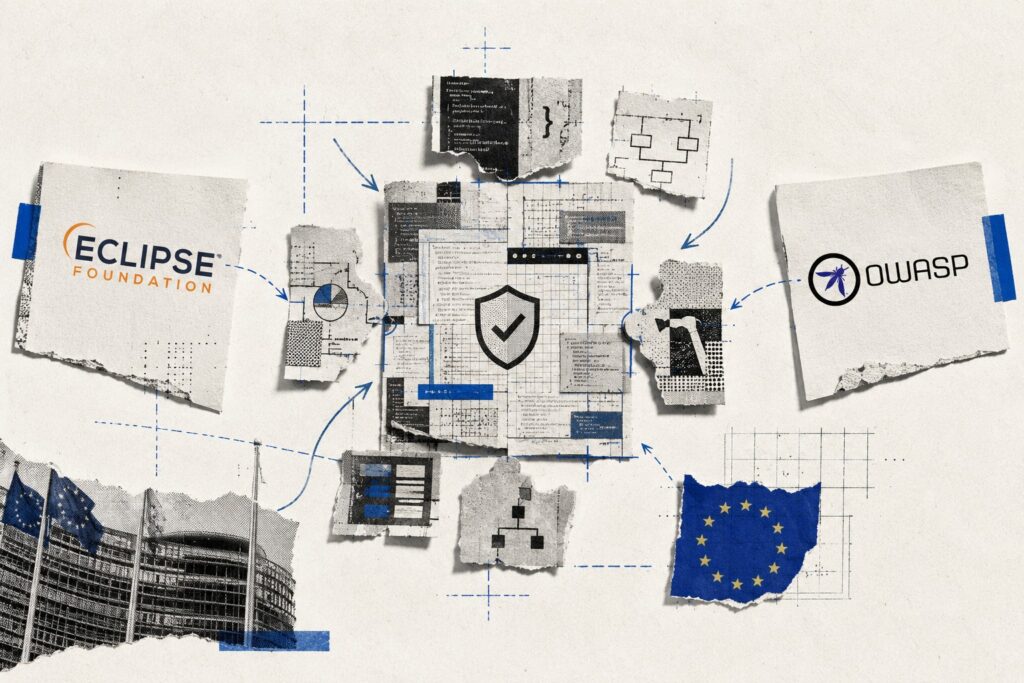
Eclipse Foundation and OWASP Join Forces to Address European Cyber Resilience Act
The Eclipse Foundation and the Open Web Application Security Project (OWASP) have signed a memorandum of understanding aimed at developing security and compliance recommendations in response to the European Cyber Resilience Act (CRA). Starting September 11, 2026, manufacturers will be required to report vulnerabilities and incidents, a significant concern given that 96% of commercial codebases incorporate open-source components. This agreement seeks to streamline the guidelines provided to maintainers, reducing the burden on integrators who ultimately bear the costs of compliance.
Open-source software does not receive the same level of support or resources as commercial applications. It relies on maintainers, often volunteers, and a hosting foundation that does not assume responsibility for the software’s application. To address this gap, the European legislator has established a special category for open-source within the CRA, adopted on October 23, 2024. This designation, known as the open-source software steward, imposes lighter obligations compared to manufacturers. Given the absence of a corporate publisher to hold accountable for a component, a clear operational framework for this status was needed. Announced on July 30, the Eclipse Foundation and OWASP are set to collaboratively create this guidance.
Five Areas of Collaboration
The cooperation between the Eclipse Foundation and OWASP will focus on five key areas: preparing the open-source ecosystem for the CRA, aligning security standards, fostering community engagement, supporting stewards and maintainers, and educating stakeholders about the regulations. Initial efforts will concentrate on providing recommendations for stewards, hosting seminars leading up to the September deadline, and developing resources related to Software Bill of Materials (SBOM). Both organizations have committed to avoiding the establishment of competing standards and will instead enhance existing frameworks.
A Still-Underdeveloped Stewardship Status
The regulation delineates two distinct roles: manufacturers who release digital products into the European market and are fully accountable for compliance—including CE marking, conformity assessment, and technical documentation—and stewards who support the sustainable development of open-source software intended for commercial use without profiting directly. Stewards are required to maintain a written security policy, collaborate with oversight authorities, and actively report known exploited vulnerabilities, while other obligations do not apply.
However, a foundation like Eclipse, which hosts over 450 projects, does not view this responsibility as the sole maintainer of a library downloaded millions of times monthly. The regulation does not specify the format for a security policy, the channels of cooperation, nor the criteria for ongoing support. To address these complexities, both foundations plan to fill these gaps through doctrine and educational initiatives, building on the free training center launched by Eclipse in conjunction with its regulatory compliance working group.
“Open-source is a critical digital infrastructure, yet the responsibility for its security is distributed across a complex global ecosystem,” commented Mike Milinkovich, Executive Director of the Eclipse Foundation. “With artificial intelligence accelerating both software development and the discovery of vulnerabilities, the initial obligations of the regulation are imminent. The need for coordinated, practical action is urgent.”
Reporting Vulnerabilities: A 24-Hour Deadline Starting September
The September 11, 2026 deadline does not concern CE marking or conformity assessment—both have been postponed to December 2027. It focuses specifically on information reporting. A manufacturer discovering an actively exploited vulnerability in their product, or a significant incident affecting its security, will be required to alert their national incident response center and the European Union Agency for Cybersecurity (ENISA) within 24 hours and submit a detailed notification within 72 hours. IT Social has previously detailed this vulnerability reporting mechanism.
This timeline mirrors that of NIS2 and DORA, which compliance teams are already familiar with. The challenge shifts to detection, as reporting necessitates an understanding of the components in use. According to OpenLogic’s 2026 State of Open Source report, 96% of commercial codebases contain open-source code, often layered with dependencies not explicitly chosen by the team.
Addressing these concerns is a priority within the memorandum, with shared resources focusing on SBOM adoption and supply chain security. The French National Cybersecurity Agency (ANSSI) has also emphasized that compliance requirements must be met ahead of the publication of harmonized standards, especially given the packed regulatory calendar leading up to 2028.
Cost Implications for Integrators
The regulation applies to any product featuring digital components available in the EU, regardless of the code’s origin. A component abandoned by its maintainers transforms from a manageable technical risk to a compliance risk subject to penalties for those who use it. While the recognition of stewards lightens the obligations on maintainers, it does not transfer responsibility to Brussels.
“The effectiveness of security recommendations relies on developers, maintainers, and organizations’ ability to implement them,” stated Andrew van der Stock, Executive Director of the OWASP Foundation, which encompasses over 260 local chapters. Both organizations are already collaborating in Eclipse’s regulatory compliance working group.
The memorandum focuses on establishing doctrine, providing training, and hosting roundtable discussions. However, it does not offer maintenance commitments for specific components, funding for maintainers, or a comprehensive inventory of software assets—responsibilities that remain with the organizations that market the products.
For Chief Information Officers (CIOs) and Chief Information Security Officers (CISOs), preparation leading up to September 11 will hinge on three essential steps: cataloging the components in their market offerings, identifying those with designated stewards versus those without, and linking their reporting process to CERT-FR. The Eclipse Foundation and OWASP will provide the necessary vocabulary, but accountability ultimately remains with product naming.



