

Genci to Launch AMD’s Helios Platform by Late 2026 in Montpellier
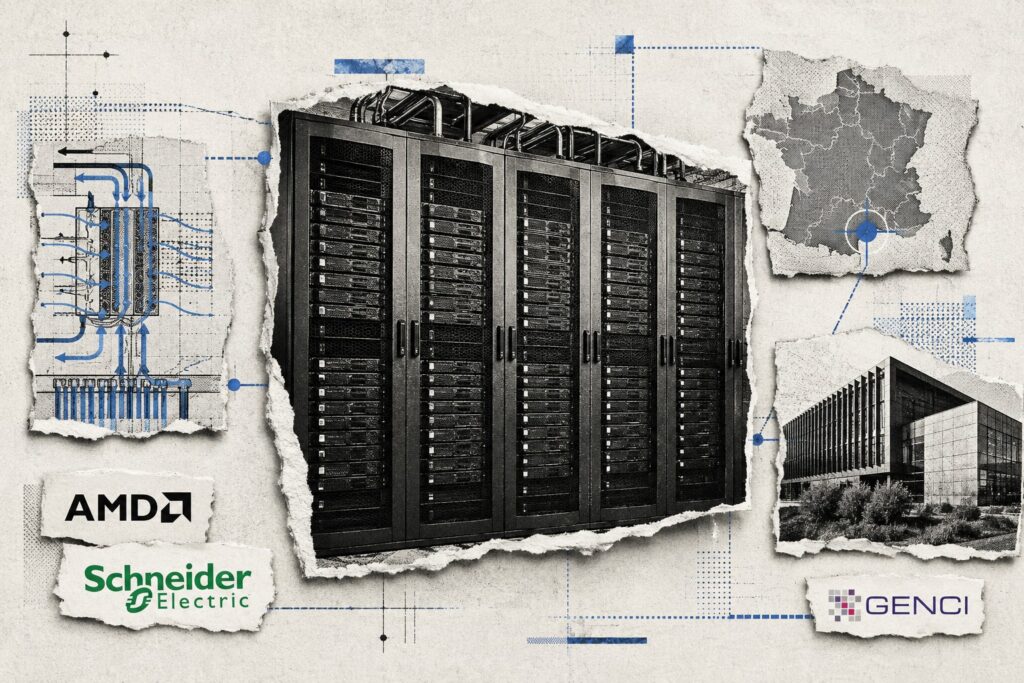
Genci is set to deploy AMD’s Helios platform at the CINES in Montpellier by the end of 2026, alongside the operational supercomputer Adastra. This new computing system will serve as a precursor to Alice Recoque, France’s first expected exascale supercomputer, scheduled for launch in the second half of 2027. Schneider Electric and AMD have unveiled the first reference architecture for Helios, designed for racks with a capacity of 246 kW.
Since 2022, CINES has been operating the Adastra supercomputer, which boasts over 74 petaflops of peak performance. Built on AMD Instinct MI250X GPUs, EPYC processors, and MI300A accelerators, this system has positioned the Montpellier center as a key player in AMD’s high-performance computing ecosystem in France. Helios will extend this trajectory, with its deployment announced for the end of the year, marking what is touted as a European first for this platform.
AMD first showcased Helios on July 23 during its Advancing AI conference in San Francisco. The system integrates 72 MI455X GPUs across eighteen compute drawers, sixth-generation EPYC processors, Pensando Vulcano 800 network cards, and the ROCm software stack. The chipmaker claims peak performance of 2.9 exaflops with FP4 precision, 31 terabytes of high-bandwidth memory (HBM4), and 1.7 petabytes per second of memory bandwidth per rack, figures confirmed by its internal labs and compared to Nvidia’s Vera Rubin NVL72 specifications.
A Step Towards Alice Recoque
Alice Recoque will be France’s first exascale supercomputer and the second in Europe. Genci is leading the initiative, with the CEA (French Alternative Energies and Atomic Energy Commission) set to operate it at TGCC. The machine will combine next-generation EPYC processors with MI430X GPUs to surpass exaflop performance on the HPL benchmark, with operational readiness expected in the second half of 2027.
Helios will provide scientific teams with nearly a year to adapt their software codes. This transition is anything but automatic. Applications optimized for a specific generation of GPUs require a complete rewrite of their computing kernels, memory distribution adjustments, and a numerical revalidation of results. CINES will offer early access to French and European research communities, based on a system architecture similar to Alice Recoque, albeit with differences in GPU models.
AMD’s open programming environment, ROCm, supports both generations of GPUs, facilitating code portability between systems. Thus, continuity hinges more on the software stack than on the silicon itself. IT Social has detailed this shift in the landscape of proprietary AI computing and its segmentation.
Energy Efficiency Takes Center Stage
Schneider Electric and AMD collaboratively validated Helios’s first design architecture, released on July 23. This document addresses four primary areas: building power supply, cooling systems, data center layout, and lifecycle management software. It includes racks capable of handling up to 246 kW and modular clusters with a total computing load of up to 10.4 megawatts.
The proposed architecture utilizes liquid cooling through Motivair distribution units, complemented by hybrid air-liquid methods that can dissipate up to 84% of generated heat. These densities exceed the capacity where air cooling alone is sufficient. Schneider Electric projects an energy efficiency indicator (PUE) of approximately 1.12 at full load, with electrical and thermal schematics validated using their ETAP and EcoStruxure IT Design simulation tools, alongside a digital electrical twin.
“Organizations today demand AI-ready reference architectures that expedite the planning and deployment process while minimizing risks,” said Manish Kumar, Executive Vice President of Secure Power and Data Center Solutions at Schneider Electric. Validation has been conducted according to American ANSI standards, with plans to extend to IEC standards for international deployments, requiring European operators to adapt accordingly.
An Open Alternative to Proprietary Ecosystems
Helios operates on UALink connections over Ethernet for internal rack interconnectivity, alongside standard Ethernet aligned with the Ultra Ethernet Consortium’s efforts for cluster expansion. AMD positions this open stack against the proprietary interconnects of competitors, a point previously noted by IT Social during the presentation of the chipmaker’s comprehensive CPU-GPU stack.
For CINES, as with any public computing center, the open interconnection options significantly influence capital expenditure. A system built on shared standards can be replaced with another vendor at the end of its lifecycle, while a proprietary protocol system necessitates renegotiation with the same provider. This rationale applies equally to private buyers, especially as accelerator costs become a major component of infrastructure expenses.
Of course, the performance metrics reported are based on AMD’s lab assessments and await validation in production environments. The CINES deployment will provide precisely this measure, leveraging public scientific applications whose results are published.
For CIOs preparing an inference room, this announcement offers two key benchmarks relevant outside the academic sphere. The 246 kW density per rack establishes the upper limit beyond which liquid cooling becomes essential, while the 10.4-megawatt cluster capacity indicates the scale of electrical connections to negotiate with power grid operators. These figures should be considered prior to selecting accelerators, not afterward.



