

Google enrichit Gemini Spark : l’IA peut désormais naviguer sur le Web et effectuer des tâches dans Chrome
Google continues its vision of an artificial intelligence capable of acting on behalf of users. With a new update for Gemini Spark, the American giant takes a significant step by integrating its AI agent directly into Google Chrome. This evolution allows the assistant to perform complex actions on the web, navigating autonomously between multiple pages without the need for constant user intervention.
Simultaneously, Google also announces the expansion of Gemini Spark to Google AI Pro subscribers in over 160 new countries, indicating that the company is accelerating the global deployment of its intelligent agents.
Chrome becomes a true playground for Gemini
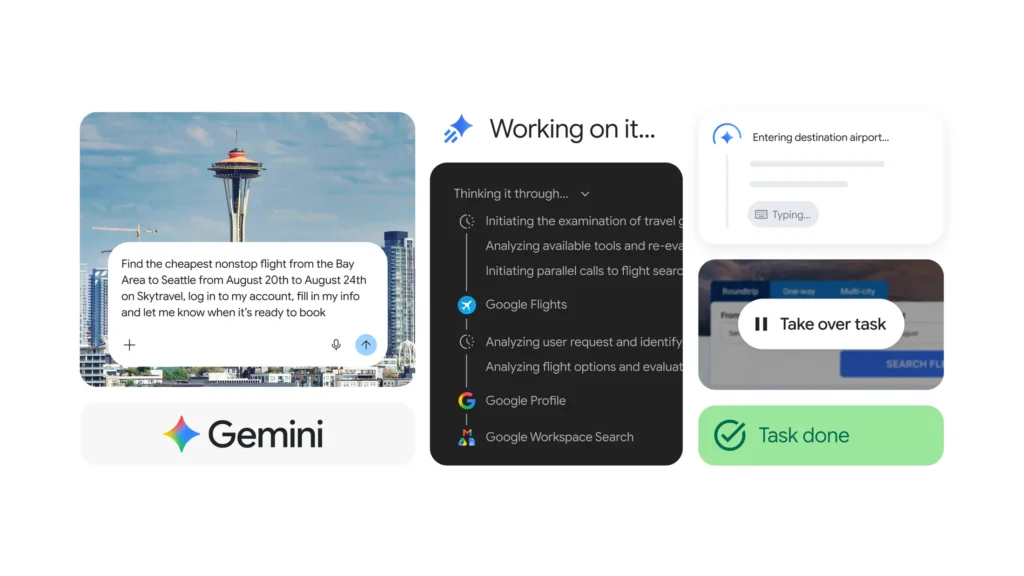
Until now, Gemini Spark was primarily able to interact with services within the Google ecosystem and certain partner applications. With the introduction of Chrome Auto Browse, the agent is now capable of acting directly on the websites visited in the browser.
After obtaining explicit permission from the user, Spark can utilize the accounts already connected in Chrome, the stored credentials, and the active sessions.
The aim is to allow the AI to perform a series of actions without requiring user involvement at every step.
Book, compare, or organize online processes
Google illustrates this new capability through several use cases. Gemini Spark can notably check saved real estate listings, schedule a visit, compare various flight offers, and initiate an online reservation. The assistant automatically navigates between multiple web pages, gathers necessary information, and proceeds through different steps autonomously.
This approach gradually brings Gemini Spark closer to true AI agents, capable not only of answering questions but also of executing complete tasks on the internet.
The user retains control over sensitive actions
However, Google emphasizes an essential point: the artificial intelligence does not have complete freedom. Before any sensitive operation, such as a payment or a final validation, Gemini Spark automatically returns control to the user. This step ensures that human oversight remains in place for decisions involving financial or personal data.
The company also notes that Chrome Auto Browse is never activated by default and requires explicit permission before use.
Google strengthens defenses against AI agent-targeted attacks
With assistants capable of directly interacting with the web, new risks arise. Google has announced that it has integrated mechanisms designed to counter prompt injection attacks. This technique involves embedding invisible instructions in a web page intended to manipulate the behavior of an AI to execute unintended actions.
The browser now analyzes these attempts to prevent any malicious site from hijacking Gemini Spark’s capabilities. This security aspect becomes crucial as AI agents gain autonomy.
Gemini Spark continues its international expansion
Aside from the new features, Google is significantly expanding the availability of its assistant. Google AI Pro subscribers in over 160 new countries can now access Gemini Spark. However, the full integration with Chrome initially remains limited to users based in the United States.
Google has not yet provided a specific timeline for a global rollout of this feature.
Introduced at Google I/O 2026, Gemini Spark represents one of Google’s most ambitious initiatives in the field of intelligent agents. The service has gradually gained new capabilities, including interaction with Gmail, Docs, Drive, Calendar, and Keep, support for third-party applications, availability on macOS with access to local files, and opening up to Google AI Pro subscribers after initially being reserved for the Ultra offer.
The integration into Chrome, however, marks the most significant evolution since its launch.
By allowing the agent to continue a task directly on the internet, Google removes one of the main limitations of current AI assistants, often confined to a narrow set of applications.
Google accelerates the transition toward autonomous agents
With Chrome Auto Browse, Google confirms that the future of artificial intelligence lies not solely in conversational assistants. The goal now is to develop agents capable of executing complex tasks autonomously, navigating between applications, cloud services, and websites as a user would.
This evolution signifies a crucial shift in our relationship with web browsers. Chrome is no longer merely a platform for displaying web pages; it is gradually becoming a workspace where artificial intelligence can act, organize, and complete tasks on our behalf. If Google can ensure a sufficient level of security, this approach could profoundly alter how we interact with the web in the coming years.



