

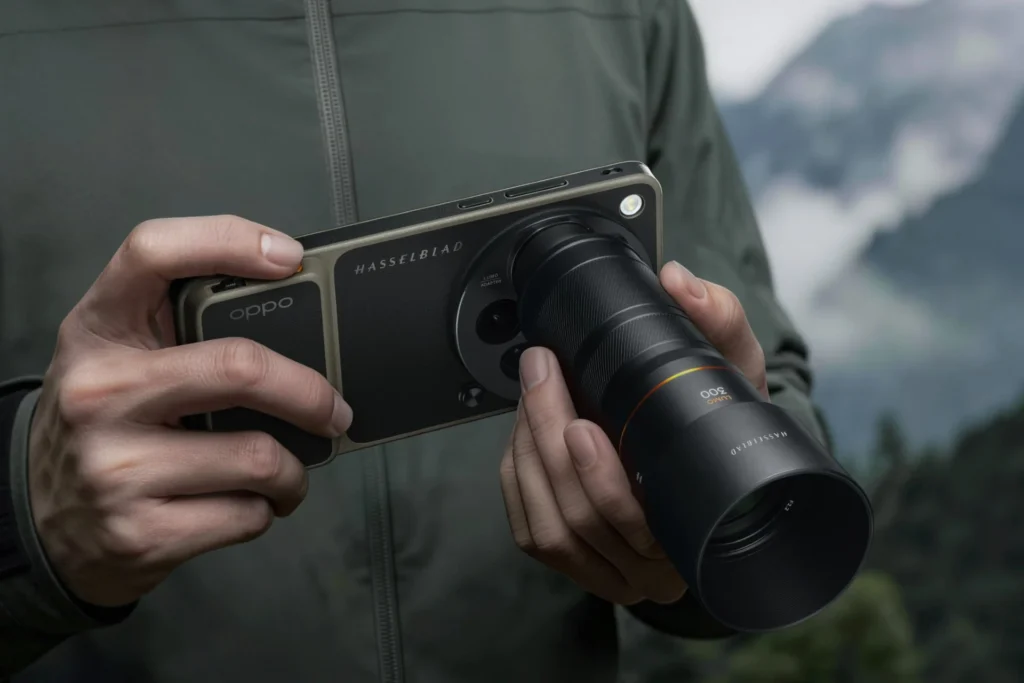
OPPO Find X9 Ultra: A Camera of Exceptional Quality, But Not the Best on the Market
Equipped with two 200-megapixel sensors and calibration by Hasselblad, the OPPO Find X9 Ultra had all the credentials to claim the mobile photography throne. Its review on DxOMark confirms a high level, but highlights an unavoidable reality: in the high-end market, quality is not solely dependent on hardware.
With a score of 170 points, OPPO’s flagship model ranks third in the world, tied with the vivo X300 Ultra and five points behind the Huawei Pura 80 Ultra.
A Third Place That Confirms Its Status as a Benchmark
The result achieved by the Find X9 Ultra is impressive. Its score of 170 points places it among the elite of the best camera phones on the market. However, it is not enough to surpass the Huawei Pura 80 Ultra, which remains at the top of the chart with a five-point lead.
OPPO also shares this position with the vivo X300 Ultra, another Chinese model that heavily emphasizes computational photography and large focal lengths.

This ranking illustrates how tightly competitive the market has become. The most advanced smartphones now all feature large sensors, periscope telephoto lenses, and sophisticated image processing. Therefore, the difference lies in overall consistency rather than a single standout feature.
A Photo Setup Among the Most Ambitious on the Market
The Find X9 Ultra is built on a particularly comprehensive four-sensor system. It includes a 200-megapixel main sensor with an aperture of f/1.5, a 50-megapixel ultra-wide lens with an aperture of f/2.0, a first 200-megapixel periscope telephoto lens equivalent to 70mm, and a second 50-megapixel periscope telephoto lens offering a 10x optical zoom at 230mm.
This architecture allows the smartphone to cover a wide range of focal lengths, from landscapes to portraits and distant subjects.
The inclusion of two 200-megapixel sensors is one of its key selling points. OPPO aims to maintain high detail levels across the most commonly used focal lengths while enhancing zoom flexibility.

Hasselblad Brings Convincing Color Accuracy
The collaboration with Hasselblad directly contributes to the smartphone’s strong performance. DxOMark highlights, in particular, a precise color rendition in bright light, generally well-controlled noise levels, a strong portrait mode, good skin tone reproduction, and consistent exposure in most situations.
The Find X9 Ultra thus proves particularly robust in bright scenes, where its large sensors and color imaging processing produce detailed and balanced images.
The portrait mode is also among its strengths, offering convincing subject-background separation.
The Lack of Variable Aperture Limits Group Portraits
The primary drawback noted by DxOMark pertains to the main sensor. It lacks a variable aperture. With a fixed aperture of f/1.5, depth of field can become too shallow in certain contexts, especially during group portraits. When several people are at slightly different distances, the smartphone may struggle to keep all faces perfectly sharp.
This issue becomes more apparent when the background is busy or in low-light scenes.
A variable aperture would have allowed the system to better adapt depth of field to shooting conditions, albeit at the cost of a more complex mechanism.

AI Processing Sometimes Lacks Naturalness
OPPO heavily relies on artificial intelligence to reconstruct details and enhance sharpness. In some scenarios, however, this processing becomes too aggressive. The image may then appear artificial, with over-accentuated textures or unnaturally recreated details.
This phenomenon highlights one of the current challenges in mobile photography: improving images without making them look overly processed.
The power of algorithms today can compensate for certain optical limitations, but it can also introduce artifacts or create a sense of overprocessing.
Weaknesses in Low Light
The Find X9 Ultra also encounters certain difficulties when lighting conditions decline. DxOMark particularly points out occasionally too-warm hues, unstable white balance under certain artificial lighting, visible grain when light sources appear in the background, and less homogenous noise reduction in complex scenes.
These flaws do not make the device poor in low light; they simply prevent it from achieving the same level of consistency as the best competitors.
In this category, every color variation or residual noise can be enough to result in a loss of points in the final ranking.
Two Effective Telephoto Lenses, But an Intermediate Zoom That Falls Short
The 70mm and 230mm focal lengths offer a high level of detail. The 10x telephoto lens is notably a significant advantage for travel photography, architecture, or capturing distant subjects. Its 50-megapixel sensor allows for good definition at long distances.
However, the intermediate range around 135mm proves to be less effective.
In this range, the smartphone relies more on digital zoom and data fusion from multiple sensors. The output remains usable but lacks precision compared to some rivals. This weakness is not exclusive to OPPO; even models like the vivo X300 Ultra rely on similar digital processing across their native optical focal lengths.
Hardware Alone Is No Longer Enough to Dominate Mobile Photography
The Find X9 Ultra confirms a prevailing trend in the premium smartphone market: sensor size alone no longer guarantees a top spot. Manufacturers now possess components that are extremely close in potential. The difference lies more in the coherence among the various sensors, exposure management, color balance, noise reduction, zoom behavior across optical focal lengths, and the quality of computational processing.
Partnerships with historic brands like Hasselblad can enhance a device’s visual identity, but they cannot replace a well-executed software approach.
Updates Could Further Enhance Results
Several shortcomings identified by DxOMark appear tied to software processing rather than hardware. OPPO could thus address some of these limitations with future updates, particularly to adjust white balance, reduce overemphasis effects, improve noise handling in strong lighting, and enhance intermediate zoom quality.
A new evaluation after several fixes could narrow the gap with the top two in the ranking.
An Elite Camera Phone, Yet Not the Absolute Benchmark
The Find X9 Ultra may not claim the top spot, but it signifies OPPO’s growing expertise in mobile photography. Its versatility, dual 200-megapixel sensors, and 10x zoom position it as one of the most comprehensive devices on the market. Its limitations primarily surface in complex scenarios, where the best models excel with their consistency.
At this level of competition, the five points separating it from the Huawei Pura 80 Ultra do not indicate failure. Instead, they suggest that the next battle will hinge on unseen details: the finesse of processing, mastery of AI, and the ability to produce natural images across all situations.



