

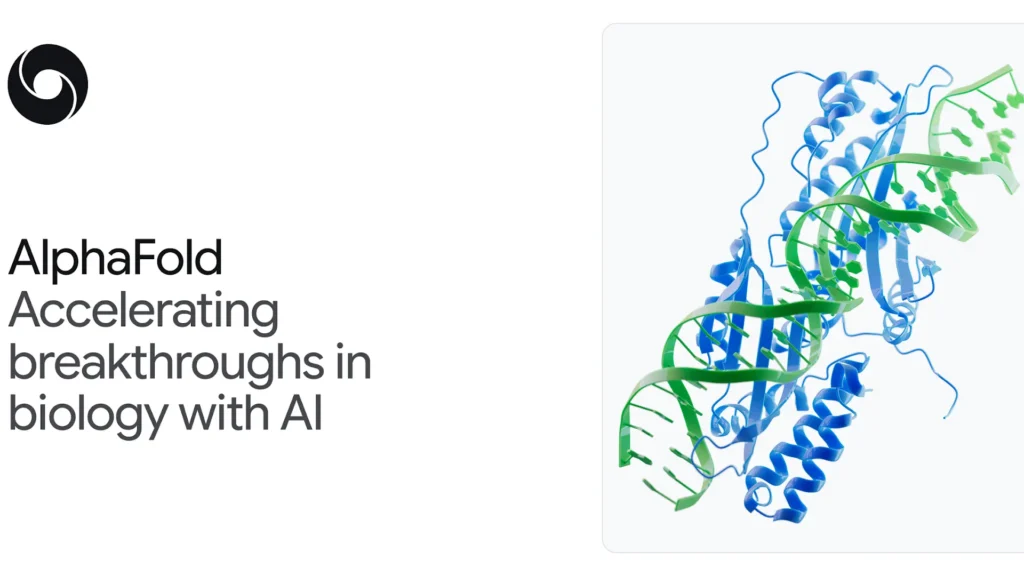
Google Ends AlphaFold Program: AI Research Shifts to Gemini
A pivotal decision has been made in Google’s artificial intelligence strategy. According to the Financial Times, the company has ended the AlphaFold program, one of Google DeepMind’s most iconic scientific projects. Some researchers have been reassigned to teams working on Gemini, while others have left the company altogether.
This reorganization does not imply that the advancements achieved by AlphaFold will be lost; rather, it reflects Google’s intent to focus its resources on its new generation of general AI.
AlphaFold: A Revolution in Molecular Biology
Launched in 2018 by DeepMind, AlphaFold tackled one of modern biology’s biggest challenges: predicting the three-dimensional structure of proteins based on their amino acid sequences. For decades, this task relied on lengthy and costly experimental techniques, such as X-ray crystallography or cryo-electron microscopy.
With the help of artificial intelligence, AlphaFold revolutionized this process.
The system produced predictions that previously required days or even years of research in just minutes. In 2021, DeepMind made the AlphaFold Protein Structure Database publicly available, gathering hundreds of millions of protein structure predictions accessible to the global scientific community.
A Technology That Won a Nobel Prize
The scientific impact of AlphaFold quickly transcended the realm of artificial intelligence research. In 2024, Demis Hassabis, CEO of DeepMind, and John Jumper received the Nobel Prize in Chemistry for their contributions to AlphaFold.
The project is now utilized in various fields, including the discovery of new medications, vaccine research, studying neurodegenerative diseases like Alzheimer’s and Parkinson’s, and analyzing protein interactions.
Many researchers credit AlphaFold with significantly accelerating structural biology work, reducing complex calculations to mere minutes of execution.
Google Redirects Teams Towards Gemini
According to the Financial Times, several internal changes have taken place in recent months. John Jumper recently left DeepMind to join Anthropic, taking several colleagues with him. Those researchers who remained at Google have been partly reassigned to projects related to Gemini, the generative AI platform being developed by the company.
This shift emphasizes Google’s strategic priority in conversational AI and intelligent agents, a domain growing increasingly competitive with OpenAI, Anthropic, and Microsoft.
AlphaFold Will Not Disappear Completely
However, the program’s closure does not equate to the loss of its results. The AlphaFold database remains accessible to researchers worldwide. Additionally, some specialists who worked on the project are expected to continue their work within Isomorphic Labs, Alphabet’s drug discovery company focused on artificial intelligence.
Research related to molecular biology will, therefore, continue, albeit in a different organizational structure.
A Decision Reflective of Evolving AI Priorities
This move, beyond just AlphaFold, illustrates a broader trend across the tech industry. Following the rise of generative AI, major companies are redirecting their investments heavily toward language models, intelligent assistants, and platforms capable of reaching a wide audience.
Long-term scientific projects, even those with proven value, must now contend with these new industrial priorities.
Between Fundamental Research and Consumer AI, Google Makes a Strategic Choice
The reorganization of AlphaFold does not undermine its scientific legacy. Over a few years, the program profoundly transformed structural biology research and opened new avenues in treatment discovery. Its influence will likely continue to be felt through the public database and the work being done at Isomorphic Labs.
Conversely, this decision signals a strategic pivot for Google. As competition intensifies in the field of generative AI, human and financial resources are increasingly concentrated on platforms like Gemini. The challenge for the company will be to balance this race in consumer AI with the maintenance of fundamental research capable of yielding future significant scientific breakthroughs.



