

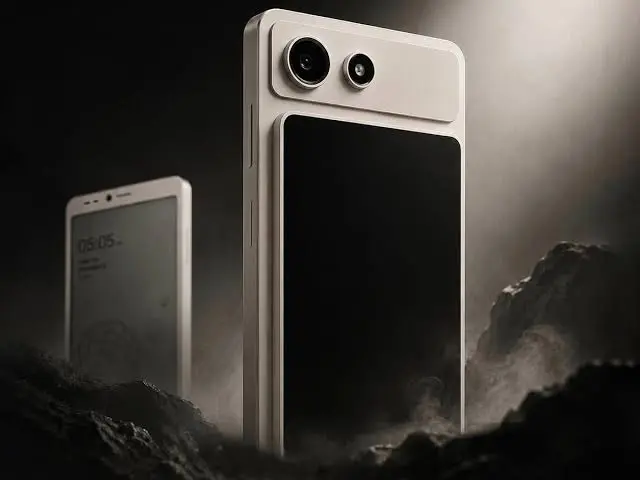
Hisense A10: The E Ink smartphone unveils new features before its launch
Hisense continues to develop its unique smartphone featuring an E Ink display. Following its initial unveiling in June, the Chinese manufacturer has revealed additional details about the Hisense A10, a device primarily designed for reading, note-taking, and productivity.
Unlike traditional Android smartphones, the Hisense A10 targets a specific audience: users who prioritize visual comfort, battery life, and a less distracting digital experience.
A Qualcomm chip designed for energy efficiency
At the heart of the Hisense A10 lies the Qualcomm QCM6690, a platform built on a 4-nanometer process typically used for professional solutions.
This processor is optimized for the specific needs of the E Ink display and supports several features aimed at enhancing the reading and working experience:
- Smooth PDF document display;
- Multi-document sharing on-screen;
- Low-latency handwriting annotation;
- Intelligent screen refresh management.
Hisense also notes that the chip automatically adjusts its frequency when the device is in reading mode to reduce power consumption and significantly extend battery life.
Android 16 and extended software support
The Hisense A10 will be shipped with Android 16. The manufacturer also commits to long-term software support, including system updates and security patches, a feature often overlooked in niche devices.

An E Ink display designed for reading… and an optional color secondary screen
The smartphone maintains the approach revealed in its initial teaser. On the front, it features a 6.13-inch E Ink display, designed to replicate the reading comfort of paper.
The device can also be equipped with a color LCD screen on the back, making it easier to use applications that require a standard display.
Users can seamlessly switch between the two screens based on their needs:
- Reading eBooks
- Consulting documents
- Note-taking
- Displaying photos
- Comics
- Social media
This dual approach aims to combine the benefits of electronic paper with the versatility of a traditional Android smartphone.
Practical features for everyday use
Hisense also highlights several integrated functionalities in the A10. The smartphone will support NFC, an infrared transmitter to control TVs, air conditioners, or projectors without an Internet connection, native cloning of certain applications, call recording, wireless magnetic charging, and a fast refresh mode designed to minimize latency and ghosting effects typical of E Ink displays.
The manufacturer states that the processor also controls an intelligent thermal management system to reduce the “ghosting” phenomenon, one of the main challenges of electronic ink screens.
An original alternative to conventional smartphones
The Hisense A10 represents the first significant evolution of the lineup since the return of the Hisense A9 in select markets, with an updated technical specification.
Rather than attempting to compete with premium smartphones from Samsung, Google, or Apple, Hisense is pursuing a differentiation strategy by developing a device intended for specific uses: intensive reading, note-taking, focus, and battery life.
At a time when most manufacturers are focusing on ever-brighter screens and higher performance, the Chinese manufacturer is taking a radically different path by emphasizing visual comfort and energy efficiency as its main selling points.
The official launch of the Hisense A10 is expected in August, with sales anticipated in the final days of the month. However, the price has yet to be disclosed.



