


Google officially launches AI Mode and AI Overviews in France: search enters a new dimension
The world’s most used search engine is poised for significant changes in France. Indeed, it marks a major turning point for the most widely utilized search engine worldwide. Google officially deploys AI Mode and AI Overviews in France, two new experiences based on the Gemini models that transform how users search for information online.
After months of gradual rollout in the United States and several other countries, these features are now available to users in France on desktops, smartphones, and the Google app.
AI Overviews Appear in Search Results
The first noticeable innovation is AI Overviews. When Google determines that a query deserves a synthesized answer, the search engine now displays an AI-generated summary directly at the top of the results.
The goal is to provide key information swiftly while still maintaining links to the websites that contributed to the answer. Unlike a traditional search, users can continue the conversation by asking follow-up questions without needing to initiate a new search.
Google clarifies that these overviews do not appear systematically but only when its systems deem that an AI-generated response adds real value.
AI Mode Becomes Google’s New Conversational Engine
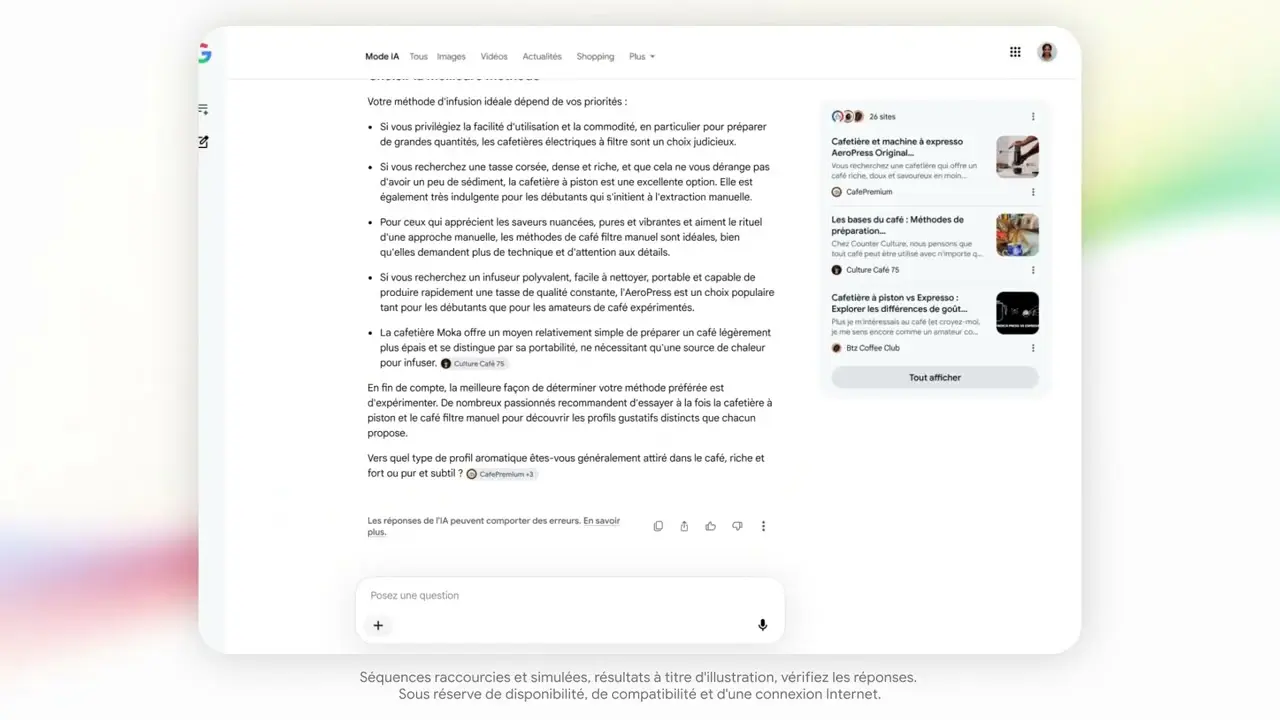
The true evolution lies in AI Mode, which Google presents as its most advanced search experience. Relying on the Gemini 3.5 family of models, this new interface enables users to interact with the search engine more naturally.
Users can ask questions through text, voice, images, or even using files as starting points. The AI is capable of handling long and complex queries that would previously require multiple successive searches.

According to Google, a query made in AI Mode is on average three times longer than a traditional search.
The company illustrates this approach with an example about coffee brewing methods, where the AI can create a comparative table and then continue the exchange without losing the context of the conversation.
A Smarter Search with Gemini
To address these complex requests, Google relies on a technology called query fan-out. The system automatically breaks down a question into several sub-themes, performs numerous searches on the web simultaneously, and then compiles the information to produce a more comprehensive answer.
This approach also allows for the identification of more relevant sources than a conventional search.
Google emphasizes that links to sites remain fully integrated into the experience to allow users to delve deeper into each topic.
Search Live Adds Voice Conversation
AI Mode also introduces Search Live, a feature that brings Google even closer to a true personal assistant. Users can now converse verbally with the AI and share their smartphone camera feed to add visual context to their questions.
This multimodal approach opens up new possibilities, such as asking for explanations about an object observed live or getting advice based on a scene recorded with their phone.
A New Search Field Designed for AI
Google also accompanies this launch with an evolution of its interface. The search field becomes more dynamic and automatically expands to encourage users to formulate more detailed queries. The aim is to move beyond the historical keyword logic towards a much more conversational search mode.
Searches can now combine text, images, and files in a single query.
Google Tries to Assure Publishers
Aware of the concerns expressed by many media outlets and content creators, Google also announces new tools for website owners. A new control available in Google Search Console now allows site owners to choose whether their site can be used in the generative AI features integrated into Search.
According to Google, this setting will not impact traditional ranking beyond the AI-generated answers. This update complements other mechanisms already provided by the company, such as Google-Extended or controls related to search snippets.
A Profound Transformation of Internet Search
With AI Mode and AI Overviews, Google is not just evolving its search engine; it is redefining its operation. For over twenty years, Search primarily involved ranking web pages and directing users to third-party sites. Now, the engine can understand a question, reason, synthesize several sources, and maintain an ongoing conversation with users.
This evolution represents Google’s most ambitious response to the rise of conversational assistants like ChatGPT. It remains to be seen how it will impact the web ecosystem. While Google promises to continue valuing links to original sites, publishers will closely monitor changes in their traffic in the coming months. One thing is certain: online search has officially entered a new era, where artificial intelligence is becoming the primary entry point for information.



