

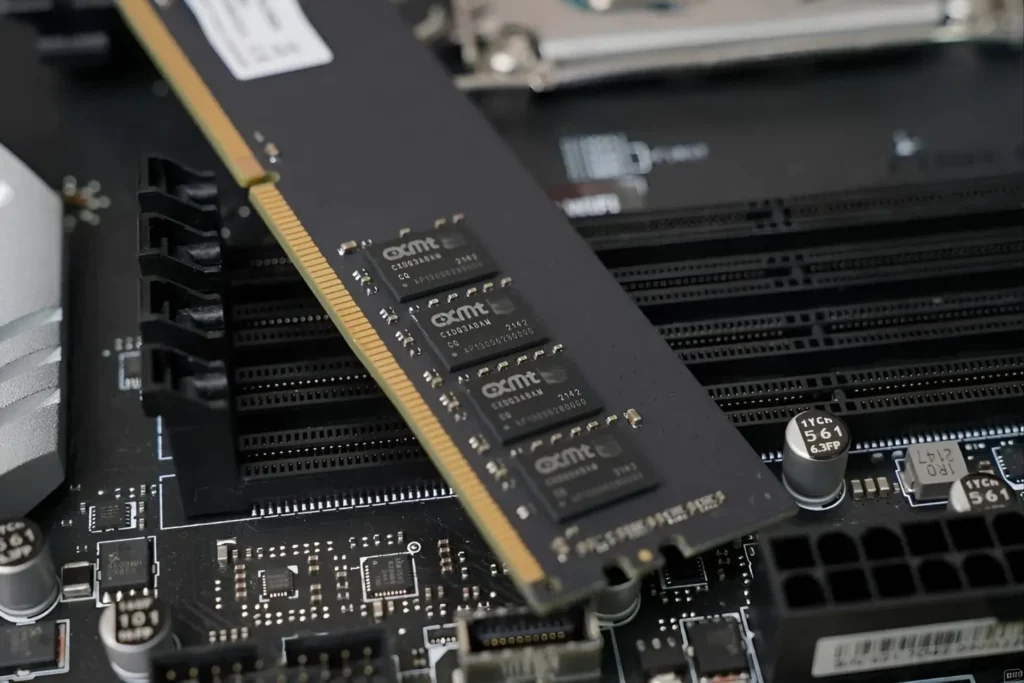
Apple tests CXMT memory chips in China: a strategic choice under scrutiny
Apple is discreetly exploring a new avenue to secure its supply of volatile memory. According to a report from the Financial Times, Apple is currently testing DRAM chips from the Chinese manufacturer ChangXin Memory Technologies (CXMT) on some devices aimed at the Chinese market. This decision goes far beyond merely selecting a supplier and is central to the technological tensions between Washington and Beijing.
This initiative comes just days after initial rumors indicated Apple’s interest in a Chinese memory supplier, amidst rising component costs and increasing prices for several of the brand’s products.
CXMT: An Indispensable Player in DRAM Memory
Based in Hefei, ChangXin Memory Technologies (CXMT) has established itself as the fourth-largest DRAM manufacturer globally, behind Samsung, SK Hynix, and Micron. Its chips could potentially equip a wide range of devices, from smartphones to laptops and servers.
According to the Financial Times, Apple has already initiated testing of CXMT components for devices sold exclusively in China.
The publication also notes that several American tech companies are currently engaging with U.S. authorities to seek more flexibility regarding the use of CXMT products.
A Politically Sensitive Matter
If this experimentation is confirmed, scaling it up remains far from certain. CXMT is listed among the Chinese Military Companies by the U.S. Department of Defense.
This classification does not constitute an automatic trade ban, but it exposes American companies to significant political and reputational risks when collaborating with the listed firms.
Apple faced a similar situation in 2022 when it considered using chips produced by YMTC, another Chinese memory manufacturer. The proposal drew widespread criticism within the United States.
A Solution That May Not Lower Prices
The potential use of CXMT chips does not necessarily mean that Apple products will become cheaper. According to analysts at SemiAnalysis, nearly all of CXMT’s current production is already committed. Despite new production capacities opening in Hefei, Shanghai, and Beijing, the manufacturer is expected to continue experiencing supply constraints for at least another two years.
CXMT currently accounts for about 11% of global DRAM production capacity, a share that could rise to 15% in the coming years.
In this context, available volumes remain insufficient to significantly alter the global market balance.
A Strategy Primarily for the Chinese Market
At this stage, there is no indication that CXMT chips will be used in Apple devices sold internationally. Available information suggests a targeted strategy aimed at strengthening the supply chain for products intended for the Chinese market, where Apple aims to mitigate its exposure to trade tensions while diversifying its suppliers.
This approach could also enable the company to better align with local authorities’ expectations, which increasingly encourage the use of components produced domestically.
Balancing Industrial Diversification and Geopolitical Tensions
The CXMT case illustrates a broader trend within the semiconductor industry. In light of geopolitical uncertainties and trade tensions between the U.S. and China, major tech firms are seeking to diversify their supply chains without jeopardizing their industrial balances.
For Apple, the stakes extend beyond simple cost reduction. It is primarily about securing access to strategic components in one of its most important markets, while navigating a particularly sensitive political landscape.
It remains to be seen whether U.S. authorities will permit a broader reliance on CXMT chips, or if, as seen in previous cases, geopolitical considerations will ultimately hinder the manufacturer’s ambitions.



