

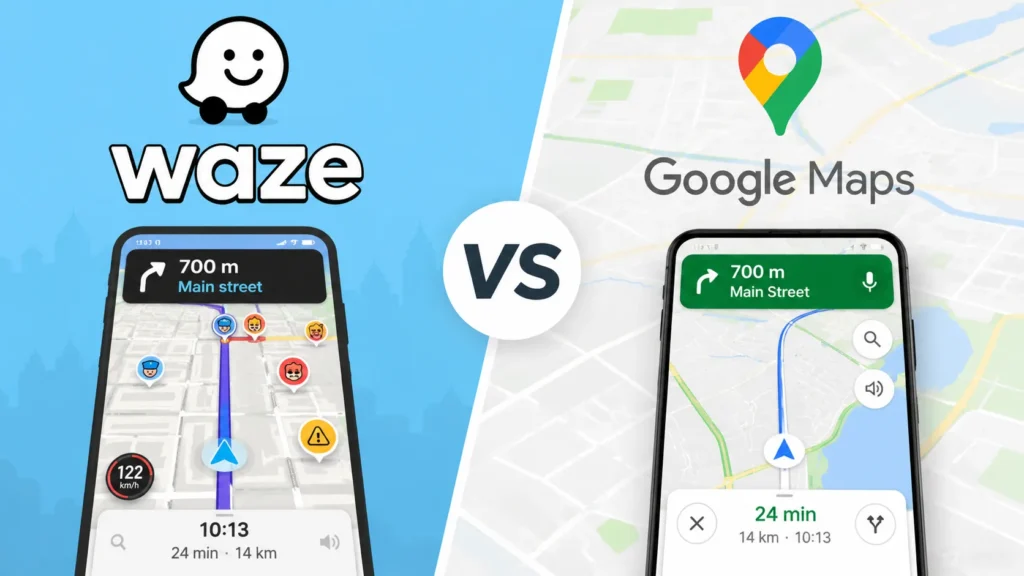
Waze or Google Maps? The Best Solution in 2026 Is Ultimately to Use Both
For years, the debate seemed straightforward: should one choose Waze or Google Maps? Today, the answer has become more nuanced. Despite the gradual integration of many features from Waze into Google Maps, both applications continue to excel in different areas.
And that is exactly what makes them complementary.
More than a decade after Google’s acquisition of Waze, the American giant’s strategy has become clearer than ever: maintaining two distinct products serving two specific needs.
Waze remains the king of road navigation
When it comes to driving, Waze retains an advantage that is hard to ignore. Its strength lies in its active community, which continuously reports traffic jams, accidents, stranded vehicles, construction, speed traps, and road hazards. This collaborative approach enables Waze to adapt routes almost in real-time.
The application is often more aggressive than Google Maps in its rerouting suggestions, which may sometimes seem surprising, but it also helps avoid hours wasted in traffic jams.
For regular drivers, particularly on highways or in large urban areas, this ability to react instantly remains one of Waze’s main selling points.
Google Maps excels elsewhere
While Waze dominates car navigation, Google Maps maintains a lead in nearly all other uses. When traveling in an unfamiliar city, Google Maps quickly becomes indispensable.
The application allows users to discover nearby restaurants, read user reviews, view photos of places, access menus, find tourist attractions, use public transportation, and even obtain detailed walking routes. This wealth of information goes far beyond simple navigation.
Today, Google Maps acts as a genuine local discovery engine.

Offline maps make a significant difference
One of the most underrated advantages of Google Maps is its offline mapping system. Before a trip, it’s easy to download an entire region to retain access to maps, local searches, certain routes, and essential information.
This feature becomes invaluable in various situations: traveling abroad, rural areas, hiking, camping, and regions with little network coverage. While Waze does offer a limited form of continuity when a route has been pre-planned, its functionality heavily relies on an active connection.
Once the signal is lost, its effectiveness declines rapidly.
Two different visions of navigation
The contrast between the two applications is deliberately intentional. Google could integrate more Google Maps features into Waze. Conversely, Maps could adopt even more community elements from Waze.
Nevertheless, the company maintains a clear separation. Waze is designed for drivers, motor trips, real-time road information, and optimizing travel time. Google Maps is built for local exploration, tourism, multimodal transport, offline mapping, and finding places and businesses.
This differentiation allows Google to cover nearly all mobility-related uses without entirely cannibalizing its own products.
Android Auto and CarPlay further enhance this complementarity
The advent of embedded platforms like Android Auto and Apple CarPlay has made this coexistence even more relevant. Many users now utilize Waze for driving to their destination and Google Maps for exploring the neighborhood once they arrive. This scenario is particularly common during travels, sporting events, concerts, or business trips.
Some functionalities of Google Maps become extremely useful, such as saving the vehicle’s location, pedestrian routes, and discovering nearby businesses.
Google likely doesn’t want to merge its two applications
From a strategic standpoint, it is unlikely that Google will completely merge Waze and Maps. The two products now serve complementary roles: Waze is the real-time driving assistant, while Google Maps is the universal mobility and discovery platform.
This approach also allows Google to test certain innovations in one environment before gradually integrating them into the other application.
The best choice? Don’t choose
The conclusion is ultimately quite simple. For driving trips, Waze often remains the most efficient solution due to its community alerts and real-time traffic intelligence. For everything else — restaurants, tourism, public transport, offline maps, or walking routes — Google Maps is the most comprehensive tool.
In 2026, the real question is no longer “Waze or Google Maps?”. The best experience is to use both, each in the area where it excels.



