

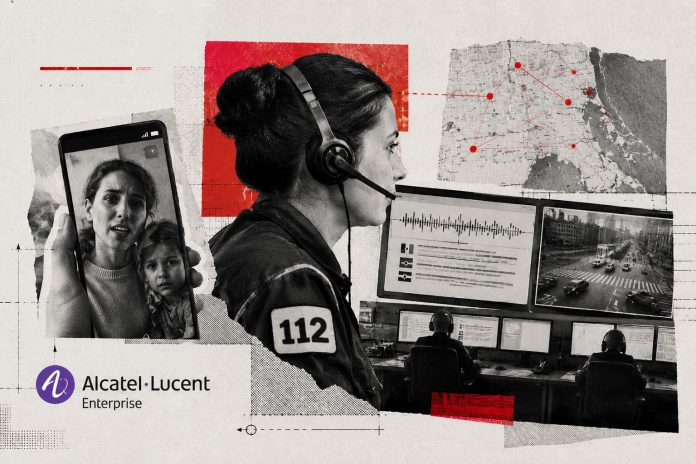
Alcatel-Lucent Enterprise has introduced two innovative AI-driven solutions for emergency call centers: real-time transcription with multilingual translation and character-by-character communication, as well as an instant switch from voice to live video without the need for applications or authentication. Designed for public safety agencies, these solutions aim to reduce response times in critical situations, particularly by overcoming language barriers.
Emergency communication platforms — including reception centers for emergency services like 15, 17, and 18, police command rooms, and disaster response coordination centers — operate under an absolute requirement for availability and reliability. Any communication breakdown or misunderstanding during an incoming call can prolong response times and exacerbate critical situations. In this context, integrating AI capabilities into voice communication streams represents a significant evolution for public safety organizations in Europe.
ALE International has established itself as a key player in this sector after acquiring Alcatel-Lucent’s enterprise networking division. The company currently provides services to a wide range of public and private organizations across Europe, many of which operate national emergency services. From this position, ALE International is announcing two new capabilities designed to modernize the communication architectures of command centers.
Breaking Down Language Barriers in Emergencies
The first innovation focuses on real-time transcription coupled with automatic multilingual translation. This solution instantly converts spoken exchanges into text in the operator’s language, regardless of the caller’s language. Dispatchers can thus access a readable account of the call’s content without needing an external interpretation service, which may not align with rapid emergency response times.
The Real-Time Text (RTT) technology complements this solution by enabling character-by-character communication when voice communication is not feasible — due to immediate danger, ambient noise, or temporary speech impairment. Unlike traditional text messaging, RTT transmits each character as it is typed, providing uninterrupted and fluid exchanges in critical situations where every second counts. This feature also enhances access to emergency services for individuals who are deaf or hard of hearing.
Instant Voice-to-Video Switching
The second innovation allows dispatchers to transition from a voice call to a live video stream without requiring the caller to download an application or authenticate. The dispatcher sends a link, which the caller opens in their mobile browser, and the video stream begins immediately while audio communication remains active. This ensures that contact is maintained throughout the transition.
For command teams, this capability significantly transforms incident assessment. Instead of reconstructing a situation from verbal descriptions, dispatchers gain real-time visual insight into the unfolding event. This allows for a more accurate assessment of severity, more effectively mobilizing appropriate resources, and coordinating responders with greater precision. The most documented use cases involve road accidents, urban fires, and emergencies in industrial settings.
Certified Sovereign Infrastructure
ALE International emphasizes a “certified European infrastructure” and “full data control” as the foundation of its solutions for emergency agencies. These assertions address a crucial requirement: data processed by command centers often falls under the category of sensitive information as defined by GDPR. Additionally, essential service operators are subject to resilience obligations outlined by the NIS2 Directive, which will be transposed into French law by October 2024.
The press release does not specify the exact nature of the referenced certification or confirm whether the proposed architecture has been qualified by ANSSI (National Cybersecurity Agency of France). Notably, ALE International is legally registered in the United States, placing it within the scope of the U.S. Cloud Act for data stored or transmitted through its infrastructure. Public safety agency CIOs and CISOs considering deployment will need to verify, beyond marketing claims, the precise level of certification acquired, the actual location of real-time processing data, and the contractual guarantees offered regarding access governance.
Announcement of Direction without Firm Dates
ALE International has not provided a general availability date for its two new capabilities. The announcement positions itself as a milestone in incorporating AI into its emergency communication platforms, yet it does not clarify if pilot deployments are already underway with European clients. Commercial availability has yet to be disclosed.
For organizations currently conducting calls for tenders or modernizing their command centers, this announcement raises questions about integration timelines within existing infrastructure renewal cycles, which are often constrained by specific qualification and certification deadlines for critical systems. ALE International’s ability to document the compliance of these new features with the requirements of European regulatory authorities — including ENISA, ANSSI, and their national counterparts — will be a determining factor for the CIOs involved.



