Google cuts prices of its AI subscriptions: a strategic offensive against OpenAI and Anthropic
By significantly reducing the price of its premium AI offering, Google aims not only to attract more users but also to regain ground in the increasingly crucial AI subscription battle for the future of technology.
Technology subscriptions typically rise over time, but Google is taking a different approach.
During its Google I/O conference, the company unveiled a complete overhaul of its Google AI offerings, featuring a dramatic price drop for its highest-tier subscription, new pricing tiers, and an expansion of included services.
This reorganization reflects a growing reality: artificial intelligence is evolving from just a feature to a full-fledged business model.
Google Aligns Its Prices with the New AI War
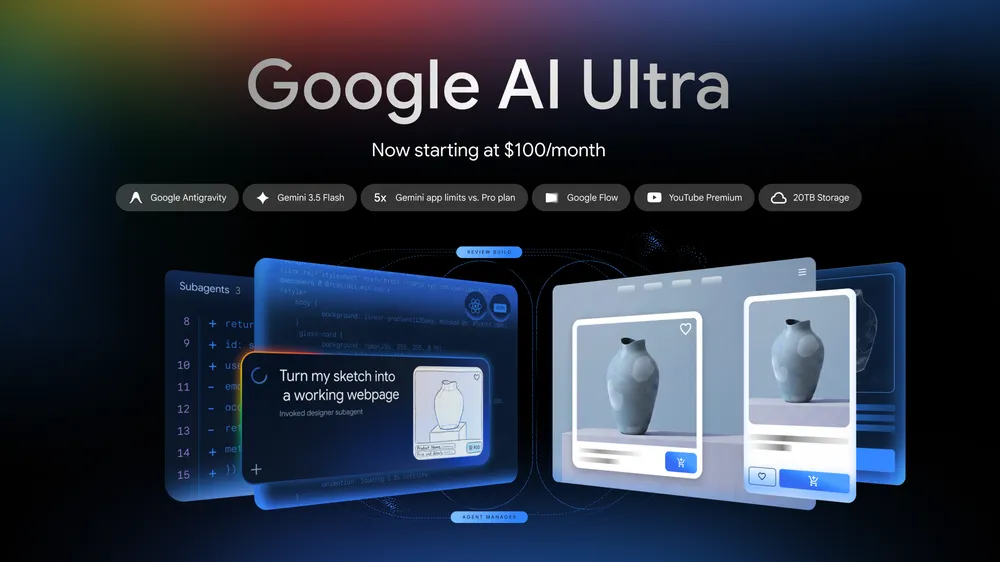
The most notable change is with the AI Ultra subscription. Once priced at $250 per month, it is now reduced to $200, maintaining its core features. Subscribers will continue to enjoy significantly higher usage limits compared to the Pro plan, as well as exclusive access to experimental tools like Google Antigravity.
A $50 monthly reduction for a premium service is quite rare in the tech industry. However, this move seems less like a giveaway and more like a strategic realignment.
Google had become somewhat of an outlier in the market. Anthropic had structured its offerings with pricing tiers of $20, $100, and $200 per month with its Claude service. OpenAI followed suit in April with its own ChatGPT subscriptions for intensive users.
By remaining at $250, Google risked being seen as the most expensive player in the market—without a sufficient differentiation to justify this gap.
A New Tier at $100 for Advanced Users
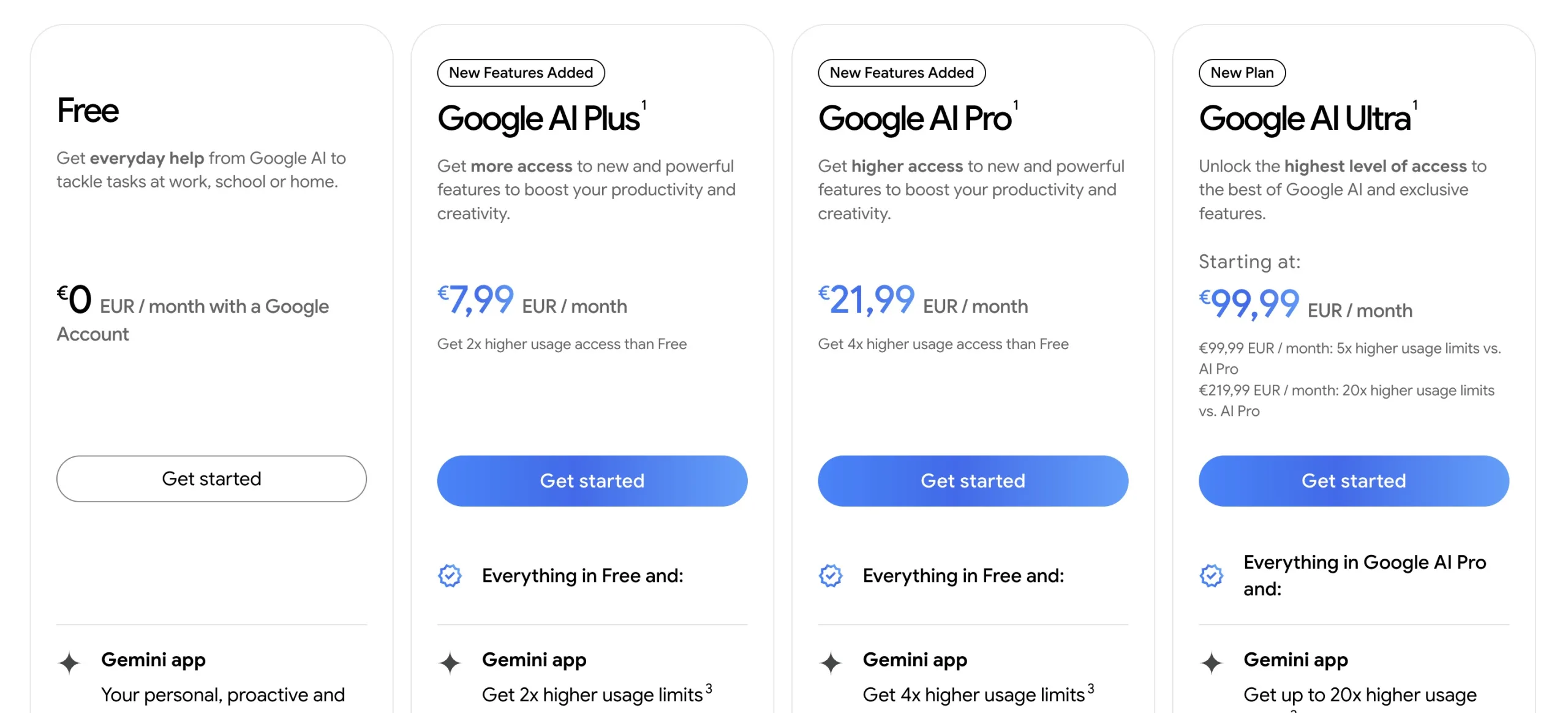
Google is also introducing a new mid-tier subscription priced at $100 per month. This plan is clearly aimed at developers, content creators, and technical users who require more power without fully committing to the Ultra subscription.
The plan includes:
- a usage limit five times that of the Pro plan
- access to the Gemini 3.5 Flash model
- priority access to Google Antigravity
- 20 TB of cloud storage
- an integrated individual YouTube Premium subscription
This strategy indicates that Google seeks to transform Gemini into a central platform rather than just a chatbot. Subscriptions are increasingly evolving into digital bundles combining AI, storage, video, productivity, and connected services.
Gemini Becomes an AI-Powered Personal Hub
Additionally, Google is leveraging this overhaul to extend several AI features across all its paid subscribers. Users can now access the latest Gemini models, including Gemini Omni for video and Gemini 3.5 Flash for faster responses.
Two new productivity assistants are also being introduced:
- AI Inbox in Gmail, capable of prioritizing messages and drafting replies;
- Daily Brief, a daily summary powered by Gmail, Calendar, and Gemini conversations.
This approach reflects a broader ambition: to make Gemini a cross-platform layer capable of orchestrating all Google services.
AI is no longer just a conversational interface but is evolving into a personal operating system connected to email, documents, calendars, video, and soon, the smart home environment.
Project Genie Illustrates Google’s New Vision
The $200 Ultra subscription also grants exclusive access to Project Genie, an experimental initiative that allows users to create and explore AI-generated worlds.
Google even integrates a feature based on Street View to build virtual environments anchored in real locations.
This type of initiative underscores how tech giants are now seeking to broaden the role of generative AI beyond text or images. The goal is to create comprehensive interactive experiences that blend simulation, video, mapping, and digital creation.
The Real Challenge: Dependence on Computational Limits
However, beneath these new prices lies a more sensitive issue: the question of usage limits. Like its competitors, Google is implementing thresholds based on the “complexity” of requests and computational consumption. This system is sufficiently vague to evolve quietly over time without necessarily altering the displayed prices.
This is likely where the next battle in the premium AI market will take place.
Price may be a marketing tool, but the true value of a subscription will ultimately depend on the actual amount of power, multimodal generation, and automation available on a daily basis.
One thing seems certain: following the cloud and streaming wars, Silicon Valley has officially entered the era of consumer AI subscriptions.