

Google Pics: Google officially enters the AI design battle against Canva
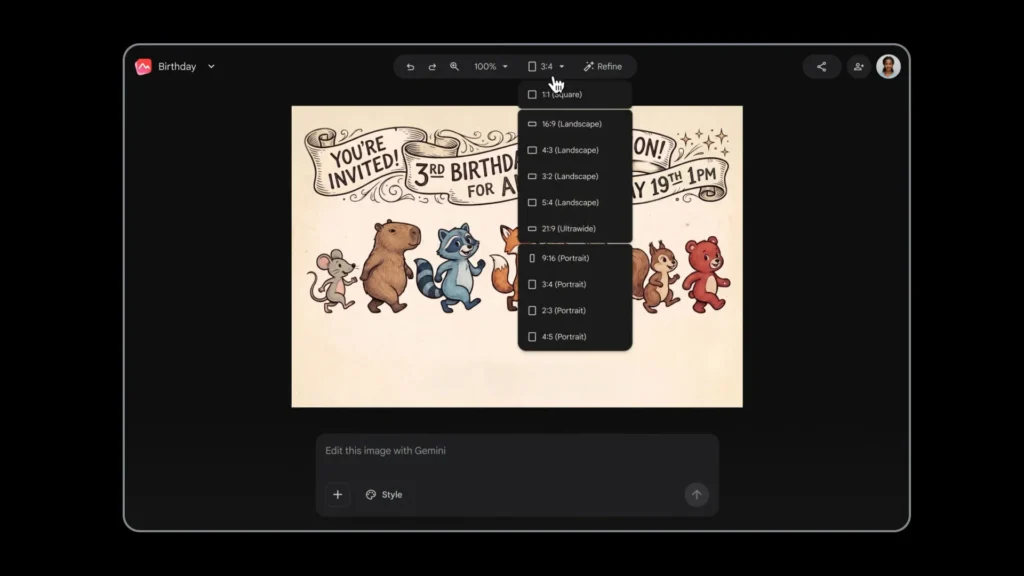
Google now aims to generate visuals as effortlessly as it creates text. At the Google I/O 2026 event, the company unveiled Google Pics, a new AI-powered graphic creation application integrated into Google Workspace.
The goal is straightforward: to enable anyone to produce invitations, social media posts, presentations, or marketing materials without requiring design skills.
Google aims to democratize generative design
With Pics, users can create visuals simply by using a text prompt. The application subsequently generates an image or graphic composition that is fully editable.
Google’s target audience is broad, encompassing educators, small businesses, independent creators, and standard Workspace users. The idea isn’t solely to produce AI-generated images but to make the graphic creation process much smoother.
The real innovation: editing becomes conversational
The challenge with current image generators is well-known: tweaking a specific detail can often be frustrating. Changing an element usually requires starting a complete prompt again, risking the degradation of the entire visual. Pics seeks to address this issue with a more interactive approach.
Users can click directly on an element, leave a comment, or request a targeted modification in natural language. Google compares this logic to collaborative commenting in Google Docs.
For instance, on a birthday invitation, it’s possible to modify just the displayed time without regenerating the entire image.
This approach marks a significant evolution in creative AI: we are gradually moving from raw generation to intelligent editing.
Nano Banana 2 becomes Google’s graphic engine
Pics relies on Nano Banana 2, Google’s new graphic model designed for precise text rendering, visual coherence, and real-world understanding. This aspect is crucial. Most AI generators still struggle with posters, logos, interfaces, or designs that contain a lot of text.
Google appears to be addressing this weakness to make the tool genuinely usable for marketing and professional communication.
Canva, Adobe, and Anthropic now in the crosshairs
With Pics, Google directly enters the arena of Canva, Adobe Express, and emerging tools like Claude Design. However, Google possesses several strategic advantages: native integration with Workspace, Gemini, Drive, Docs, and its vast base of professional users.
Collaboration also becomes central: visuals can be shared, modified, and approved by multiple users directly within the Google ecosystem.
AI gradually transforms design into an interface
Google Pics highlights a deeper trend. For a long time, creative tools relied on complex interfaces: layers, menus, timelines, technical panels.
AI is progressively replacing this logic with conversational interaction. We no longer “draw” a creation; we describe it, correct it, and then negotiate it with AI.
And Google clearly aims to become one of the key intermediaries in this new way of producing visual content.



