Google launches Android CLI 1.0 for AI agents like Claude Code and Codex
Google acknowledges a reality that can no longer be ignored: an increasing number of Android developers are now coding with AI agents that are not from Google.
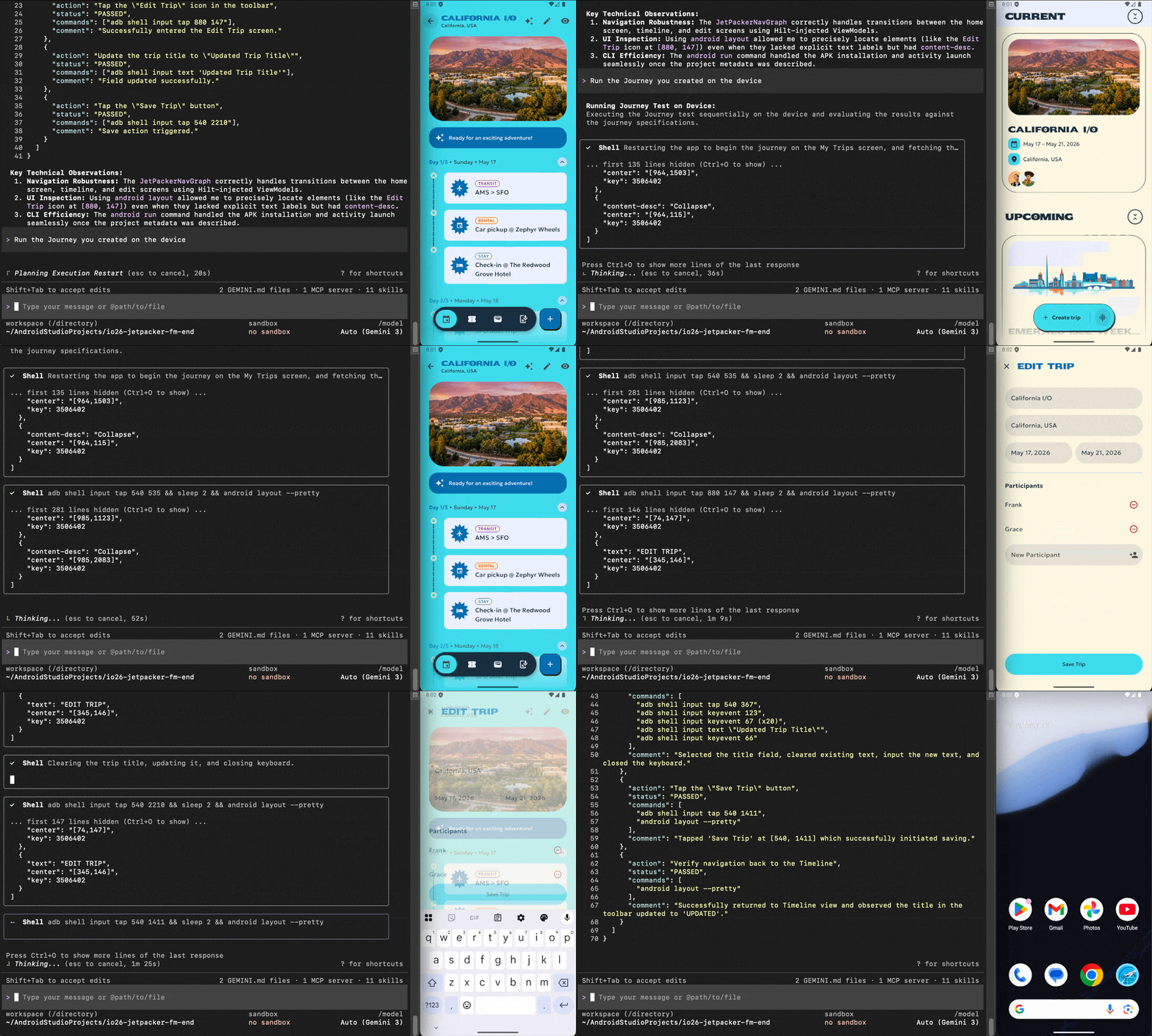
At Google I/O 2026, the company announced Android CLI 1.0, a command-line interface designed to enable agents like Claude Code, OpenAI Codex, or Antigravity to directly access the tools and knowledge of Android Studio.
Google Adapts Android to the Era of “Vibe Coding”
This announcement perfectly illustrates the current shift in software development. Developers no longer work solely with a traditional IDE; they now orchestrate agents capable of writing, fixing, testing, and structuring code almost autonomously.
With Android CLI, Google aims to make its Android expertise accessible to these new AI workflows.
The system introduces a command “android studio” that allows an AI agent to directly retrieve knowledge related to Android development, build tools, specific Android Studio commands, and various components useful for application creation.
In other words, Google is no longer trying to confine developers within Android Studio. The company seeks to become the reference layer that feeds AI agents, regardless of the environment used.
A Strategic Opening Towards Claude and OpenAI
The most interesting detail is likely political. By explicitly mentioning Claude Code and OpenAI Codex, Google indirectly acknowledges that its competitors are becoming credible development interfaces for Android.
This marks a significant change.
For a long time, Android Studio served as the almost mandatory center of gravity for Android development. Now, AI models are shifting this center towards assistants capable of operating from the terminal, the cloud, or hybrid environments.
Google thus prefers to provide fundamental tools rather than risk having the Android ecosystem entirely driven by third-party platforms.
Antigravity Becomes the Heart of Future Android Development
Google also confirms that Antigravity will include an optional bundle to automatically install Android CLI and associated tools. This convergence makes sense.
Gradually, Google is building a complete chain where Gemini generates, Antigravity orchestrates, Android CLI executes, and Android Studio becomes more of a knowledge base than just an IDE. Android development is therefore entering a new phase: one where AI agents can directly manipulate the platform’s native tools.
Google Prepares for an “Agent-Native” Android
Beyond the tool itself, Android CLI reveals a broader vision. Google seems to accept that the future of development will no longer center on traditional graphical interfaces but on agents capable of acting, reasoning, and collaborating with developers.
In this context, Android CLI resembles less a mere terminal utility and more a gateway to a future where Android applications will be partially designed, tested, and maintained by specialized artificial intelligences.
And Google clearly wants to ensure that this future continues to revolve around Android.