

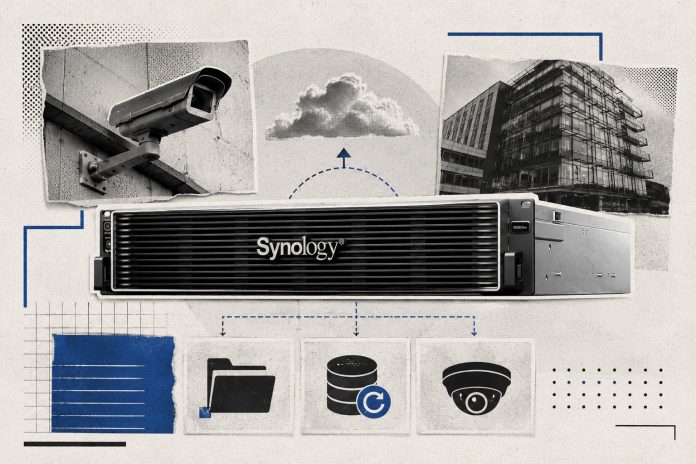
Synology has expanded its rackable storage portfolio with the introduction of two 2U twelve-bay servers, the RS4826xs+ and RS3626xs, both of which will be available starting May 13 through its network of partners. These units boast impressive performance metrics, achieving 135,000 and 115,000 IOPS in write operations, respectively. Equipped with dual 10GbE ports, they also support 10/25GbE or Fibre Channel cards, targeting organizations looking to consolidate file storage, backup, and video surveillance onto a single infrastructure.
The Taiwanese manufacturer has positioned these models within the converged storage segment aimed at mid-sized organizations where high-performance file sharing needs intertwine with site synchronization and backup functions across heterogeneous environments. The 2U twelve-bay chassis can accommodate both SSDs for performance-oriented volumes and mechanical drives for standard or archiving workloads, allowing a flexible architecture that balances IOPS with capacity within a single unit.
High availability is supported through dual power supplies, hot-swappable drives, online volume expansion, and the integration of Synology High Availability, ensuring failover within a minute. Out-of-band (OOB) management enables administrators to troubleshoot systems remotely, even when the equipment is powered down.
Write Performance and Mixed SSD-HDD Architecture
The RS4826xs+ achieves 135,000 IOPS in write operations, while the RS3626xs reaches 115,000 IOPS — metrics obtained through internal testing by the manufacturer. These performance levels place both units above the typical thresholds required for file workloads in dense office environments or for consolidating multiple virtual machines. However, users should note that these figures are derived from the manufacturer’s own testing and should be viewed as benchmarks rather than direct comparisons with competing products.
The mixed SSD-HDD architecture serves as a key selling point. SSDs facilitate performance-oriented volumes and caching, while mechanical drives handle standard and archival volumes, providing a cost-per-terabyte versus access latency trade-off within the same chassis. The native presence of two 10GbE ports, along with slots for additional 10/25GbE or Fibre Channel cards, broadens connectivity options for block storage use cases and integrates with existing data center interconnections.
Backup, Collaboration, and Video Surveillance on One System
Three application suites powered by DSM (DiskStation Manager) guide the usage of these two machines. The Active Backup Suite manages backups for Windows, Linux, and macOS workstations, virtual machines, and cloud accounts, with options for offsite copies. Synology Office Suite adds a layer of productivity for private cloud environments, including file management, email, instant messaging, and calendar functionalities. Surveillance Station offers comprehensive video management capabilities with real-time analytics for physical security monitoring.
In recent months, the company has shifted its messaging to emphasize backup resilience, highlighted by a series of posts on its official blog addressing the rise of AI-assisted ransomware attacks and the critical importance of the 3-2-1-1-0 backup strategy. These new servers align with that trajectory as the manufacturer aims to capture both production workloads and protection tasks.
Robust Controls to Support Compliance
The RS4826xs+ and RS3626xs are available through Synology’s global network of partners and resellers. Pricing has not been disclosed and will vary based on configurations selected, including drives, additional network cards, and associated support services.
For IT departments consolidating their data protection strategies under European regulatory obligations, particularly NIS2 for essential and important entities, the key challenge remains the ability to swiftly restore verifiable and immutable backups. Compliance with this requirement depends less on hardware and more on retention policies, the segregation of copies, and regular testing of restorations — functions for which Synology’s software suites provide the necessary controls to support compliance.
Synology’s trajectory involves transforming a portfolio historically focused on backup and file sharing into a unified production infrastructure for mid-sized organizations. It will be interesting to observe how these two models fit into the cyber resilience strategies of organizations subject to European obligations, particularly regarding the isolation of backup copies against ransomware attacks.



