

Galaxy Z TriFold 2: Samsung may relaunch its three-fold device with a key improvement
When Samsung canceled its first Galaxy Z TriFold after its initial announcement, many interpreted this as the end of the company’s tri-fold ambitions. However, a newly spotted patent suggests that the Galaxy Z TriFold 2 could eventually return in a more refined form.
This time, it seems Samsung aims to address one of the biggest criticisms of the original model: the lack of S Pen support.
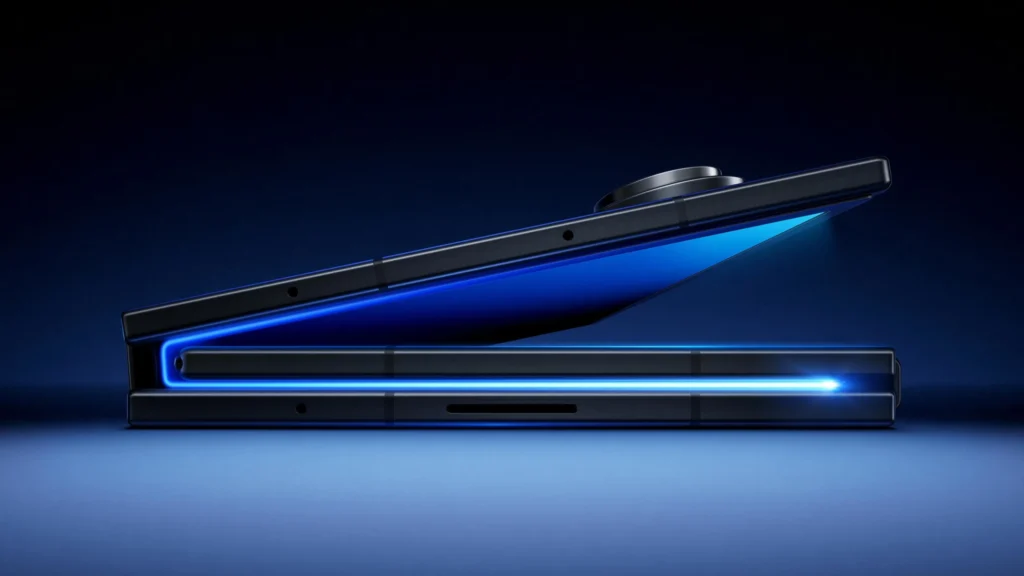
Illustrations from the patent show a device that maintains the philosophy of the first Galaxy Z TriFold. It features a smartphone that can fold into three sections, with a large internal screen that resembles a tablet when opened, along with a standard external display for quick tasks.
Visually, Samsung appears to stick with its original formula. The significant change seems to lie in the integration of the S Pen.
Galaxy Z TriFold 2: An S Pen Slot Directly in the Hinge
The patent indicates that Samsung is working on a dedicated S Pen slot integrated into one of the smartphone’s hinges. This concept makes perfect sense for a device of this size. Once opened, a tri-fold turns into almost a mini-tablet—an ideal form factor for note-taking, drawing, or advanced multitasking.

According to the patent diagrams, the stylus would be secured using an electromagnetic system that can automatically lock and release the S Pen depending on the device’s folding state.
Samsung might even include sensors that monitor the stylus’s position to prevent any interference with the folding mechanism.

Samsung Would Finally Respond to a Real User Demand
The first Galaxy Z TriFold, despite its nearly $2,900 price tag, quickly sparked frustration due to its giant screen lacking stylus compatibility, which seemed illogical to many users.
Samsung appears to have learned its lesson.
This development also reflects an interesting shift in the manufacturer’s strategy. Foldable devices are no longer just about making a visual statement; they now must justify their form factor with practical applications.
The Real Issue Remains the Cost
One major question remains: the price. Several reports have previously indicated that Samsung sold its first TriFold at a loss due to the extremely high costs of components and the industrial complexity of the product.
Moreover, adding an integrated S Pen system, along with electromagnets and additional sensors, would only increase expenses.
In a landscape where memory prices and premium components keep rising, a Galaxy Z TriFold 2 could easily exceed $3,000.
Samsung Continues to Prepare for the Post-Classical Smartphone Era
Even if this patent does not guarantee a commercial launch, it underscores an important point: Samsung is actively exploring the future of foldable devices.
The company likely understands that the traditional smartphone market is approaching stagnation. Hybrid formats, flexible screens, and multitasking capabilities are becoming strategic experimental grounds.
The Galaxy Z TriFold 2 could thus transform from merely a luxury smartphone into a technological showcase aimed at defining what mobile computing might look like in the coming years.
At this level, the price is almost no longer the primary concern.



