

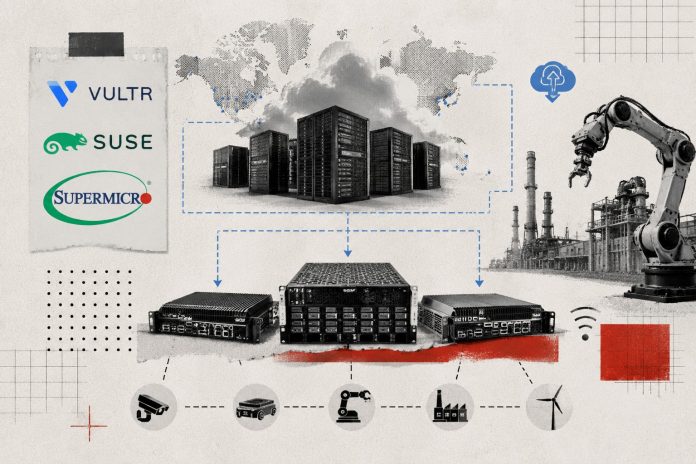
Vultr Expands Its Cloud Alliance into Industrial Edge with SUSE and Supermicro to Scale Distributed AI. The Cloud-to-Edge architecture combines Vultr’s 33 global data center regions, Supermicro’s edge CPU and GPU servers, and the SUSE Kubernetes stack (RKE2, K3s, Rancher Prime, Fleet, SUSE AI) driven by GitOps. This partnership addresses the limitations of centralized cloud architectures for real-time AI.
The center of gravity in AI computing is shifting towards the data itself. While centralized cloud inference remains dominant in 2024, it quickly reaches its limits when applications demand latency lower than a hundred milliseconds or when data cannot leave the site of generation. Use cases such as sensor-equipped factories, connected points of sale, distributed industrial sites, and vehicle networks are driving the need for local processing as operational AI becomes increasingly crucial.
Announced on May 12, 2026, the collaboration between Vultr, SUSE, and Supermicro introduces a cohesive architecture that brings computing closer to the data without sacrificing unified management. This partnership extends the Cloud Alliance initiative that Vultr launched in June 2023, designed as a composable framework for infrastructure and services to compete against hyperscalers. The promise to CIOs is to deploy and operate distributed AI workloads from regional clouds to edge devices without the manual assembly of the orchestration chain.
Three Tiers of Infrastructure from Regional Cloud to Industrial Site
The architecture is structured in three layers. The first layer, Cloud and Near-Edge, leverages Vultr’s 33 globally accessible data center regions equipped with high-performance NVIDIA GPUs. Teams deploy regional AI Kubernetes clusters using the Cluster API (CAPI), which facilitates programmatic replication and scaling. This layer takes over when local inference capacity at the edge is exceeded.
The second layer, Metro Edge, is powered by Supermicro’s range of CPU and GPU-compatible servers and devices. These systems are validated with SUSE Linux Enterprise Server and SUSE’s Kubernetes engines, RKE2 for full environments and K3s for lightweight deployments. They support real-time workloads at the source, enabling computer vision, sensor data processing, and distributed inference agents. The goal is to deliver ultra-low latency and energy consumption, making it viable for sites where traditional data center infrastructure isn’t feasible.
The third layer is the control layer. SUSE Edge, which integrates SUSE Rancher Prime and Fleet, provides a unified GitOps workflow to manage thousands of sites without manual intervention. Coupled with SUSE AI, this setup ensures consistency across the software stack, security policies, model updates, and configurations, from the main data center down to edge devices. SUSE Industrial Edge extends this model to on-premises private deployments with deeper integration into operational environments.
GitOps for Managing Thousands of Distributed Sites
The operational core of the architecture hinges on GitOps management. This model treats edge site configurations as versioned code in a central repository. Any changes—whether deploying a new model, applying a security patch, or adjusting configurations—are automatically implemented at the affected sites from the source repository. This eliminates manual interventions and ensures every site remains aligned with the reference configuration.
“The primary challenge of the Edge ecosystem is large-scale deployment,” explains Rhys Oxenham, Vice President and General Manager of AI at SUSE. “We overlay SUSE AI with SUSE Edge to automate the deployment of models, updates, and security policies across the entire architecture.” Keith Basil, Vice President and General Manager of Edge at SUSE, adds, “The edge is becoming much more than just infrastructure; it is evolving into an operational system.”
The promise of operational consistency is crucial for CIOs managing—or anticipating—distributed fleets across dozens or even thousands of sites. Without unified GitOps governance, each site risks becoming an exception that requires manual management, making operations unmanageable past a critical threshold.
Extending the Cloud Alliance Against Hyperscalers
This announcement extends a strategy that Vultr has pursued since June 2023. The Cloud Alliance, launched by Vultr as a composable infrastructure and service framework, explicitly aims to provide businesses with an alternative to the Big Tech clouds. The original argument, reiterated in the May 2026 partnership, emphasizes the absence of long-term contracts, vendor lock-in, and the ability to build a custom cloud platform from specialized providers. The move into industrial edge and distributed AI applies this philosophy to a segment where hyperscalers have struggled to gain a foothold.
This positioning comes amidst a market where NVIDIA has offered its EGX stack and Fleet Command for edge AI management since 2021, and where Red Hat combines OpenShift AI with Advanced Cluster Management for equivalent distributed multi-site orchestration. The Vultr-SUSE-Supermicro alliance distinguishes itself through the openness of its Kubernetes stack (RKE2 and K3s upstream) and independence from the NVIDIA EGX ecosystem, even as NVIDIA continues to supply GPUs in Vultr regions. For CIOs already leveraging SUSE Rancher or an open Kubernetes distribution, the validated end-to-end integration reduces the cost of assembling a distributed AI platform.
The arrival of a pre-integrated Cloud-to-Edge stack overcomes hardware and software locks, yet operational locks remain. Managing thousands of sites via GitOps demands a platform discipline and skills that the centralized cloud decade has diminished in European IT departments. Organizations that seize the advantage of distributed AI are those investing now in mastering Kubernetes and GitOps pipelines.



